Industrial Refrigeration Systems

Industrial refrigeration is the discipline of moving heat out of cold storage facilities at industrial scale. The system you specify drives ~25–35% of total project cost, ~60–70% of operating cost over the life of the building, and 100% of whether the facility hits its target temperature. This page covers the system types available in 2026, when to specify each, and the engineering decisions that determine performance.

By US Cold Storage Builders Engineering Team
📅 Now booking 60–90 days out | Call (346) 676 - COLD
Performance IndexUpdated quarterly
5
Refrigerant Options
N+1
Standard Redundancy
30–50 wk
Switchgear Lead Time
Refrigeration

Refrigerant choice, system architecture, and sizing — the three core decisions.

The Cycle

Vapor-compression cycle — four basic components.

A cold storage refrigeration system moves heat from the cold space (where you don't want it) to the outdoor environment (where it can be rejected). Every industrial refrigeration system uses the same basic cycle. What varies between systems is the refrigerant, the configuration of components, and the scale of operation.

  • Evaporator — absorbs heat from cold space as refrigerant boils
  • Compressor — compresses refrigerant vapor to high pressure/temperature
  • Condenser — rejects heat to outdoor air as refrigerant condenses
  • Expansion valve — throttles liquid back to low pressure
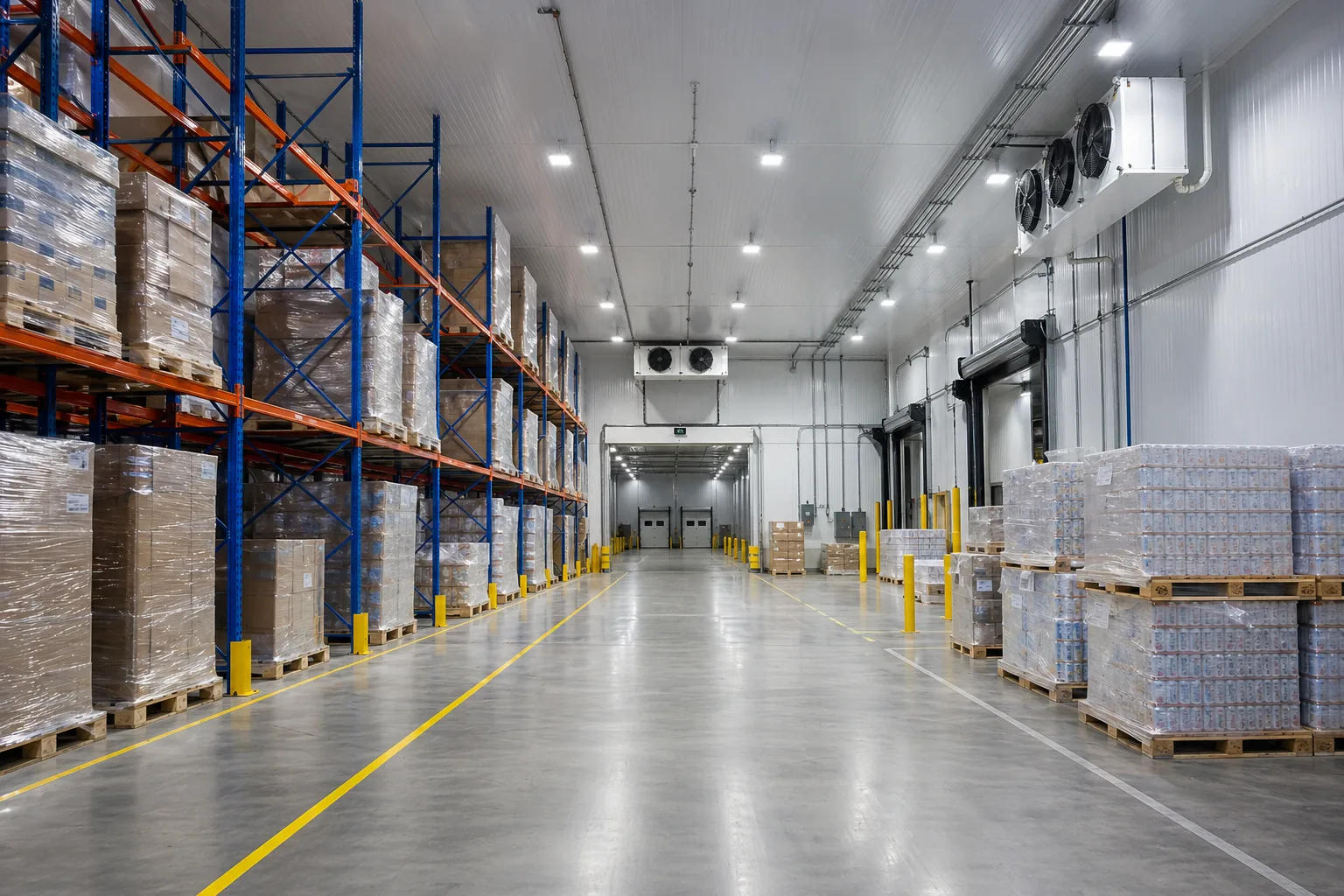
Refrigerated warehouse interior served by industrial vapor-compression refrigeration
Core Decision

Refrigerant selection drives every downstream decision.

The refrigerant choice cascades into every other system decision: equipment sizing, regulatory compliance, capital cost, operating cost, safety infrastructure, and operational complexity. Five main options — ammonia, CO2, HFC blends, glycol secondary loop, and cascade — each with distinct strengths.

  • Ammonia (NH3, R-717) — industrial workhorse, highest efficiency at scale
  • CO2 (R-744) — low GWP, growing share under HFC phase-down
  • HFC blends — DX condensing units, walk-ins, smaller systems
  • Glycol secondary loop — primary refrigerant stays in mech room
  • Cascade — CO2 low-temp circuit + ammonia high-temp circuit
Mechanical room serving industrial refrigeration plant for cold storage facility
Sizing

Right-size capacity to peak load with redundancy.

Refrigeration tonnage is sized to peak design-day load plus safety factor (typically 10–25%) and redundancy strategy. Undersizing leaves the room chronically warm; oversizing short-cycles equipment and wastes capital. Door infiltration is the largest variable component in operating cold storage — underestimating it is the most common refrigeration design error.

  • Envelope load — heat conduction through walls, ceiling, floor
  • Door infiltration — air exchange during operations (largest variable)
  • Product pull-down — cooling incoming product to room temperature
  • Lighting, equipment, personnel — internal loads
  • Defrost cycles — adds load during electric or hot gas defrost
Cold storage construction with refrigeration system sized for peak operating load
DX

Direct Expansion (DX) — the simplest architecture

The simplest refrigeration system architecture. Hermetic or semi-hermetic compressor, condensing unit, copper line set to evaporator, factory-charged refrigerant. Standard for walk-ins, smaller warehouses, and refrigerated facilities under 30,000 SF.

Refrigerants: Modern HFC blends (R-448A, R-449A, R-507A). Phase-out timelines vary by jurisdiction.

Advantages: Lowest capital cost. Simple installation. Standard commercial refrigeration trade can maintain. Readily available equipment.

Disadvantages: Lower efficiency than ammonia at scale. HFC refrigerants subject to phase-down regulations. Less flexibility in zone control.

Ammonia DX

Centralized Ammonia Direct-Expansion

Centralized ammonia plant with direct-expansion ammonia delivery to evaporators in the cold space. Standard for refrigerated warehouses 50,000+ SF, frozen storage, food processing, and multi-zone single-tenant facilities.

Advantages: Highest efficiency at industrial scale. No GWP/ODP. Long equipment service life (30+ years for compressors).

Disadvantages: Higher capital cost than DX. Ammonia in occupied space requires safety infrastructure. PSM compliance above threshold quantity (10,000 lb). Specialized refrigeration trade required.

Secondary Loop

Glycol Secondary Loop

Primary refrigerant (typically ammonia) stays in the mechanical room. Glycol-water mixture circulates through evaporators in the cold space. Used in retrofits, multi-tenant operations, jurisdictions restricting refrigerant in occupied space, and facilities with strict insurance requirements.

Advantages: Eliminates primary refrigerant exposure in occupied space. Reduces ammonia charge (smaller PSM compliance footprint). Simpler operational interface for staff.

Disadvantages: 5–15% efficiency penalty vs direct-expansion. Higher capital cost. Slower pull-down at commissioning.

CO2

CO2 Transcritical

CO2 refrigerant in transcritical cycle (operating pressures above CO2 critical point). Standalone CO2 system without ammonia coupling. Increasing market share in mid-size facilities (50,000–150,000 SF), especially in California and HFC-restricted jurisdictions.

Advantages: Low GWP refrigerant. Non-toxic at occupied space concentrations. Single refrigerant system (less complex than cascade).

Disadvantages: High operating pressure requires properly rated components throughout. Higher capital cost than HFC currently due to component availability. Efficiency drops at warmer ambient.

Cascade

Ammonia/CO2 Cascade

Two-stage refrigeration system. CO2 in low-temperature circuit (where deep cold is needed). Ammonia in high-temperature circuit. Mechanical coupling at cascade heat exchanger. Standard for sub-zero frozen storage (-20°F and colder), blast freezing, IQF, and frozen food manufacturing with deep-freeze requirements.

Advantages: Most efficient available for sub-zero applications. Combines benefits of both refrigerants. Standard design for new sub-zero construction.

Disadvantages: Higher capital cost (~10–20% premium over single-refrigerant ammonia). More complex system architecture. Requires trained operations and service.

Redundancy

Redundancy strategy — N+1 standard

Refrigeration system redundancy determines what happens when a compressor fails. N+1 (one extra compressor beyond design load) is standard for frozen storage. N+2 for critical applications (pharma, Fortune 500 distribution). Distributed plant architecture for very critical applications where any plant failure must affect only one zone.

All compressors rotate in operation, distributing wear evenly. Failure of any single compressor leaves the remaining compressors to carry the load without interruption.

Backup power redundancy: Standby generator sized for critical refrigeration load. UPS for monitoring and controls during generator transfer. Dual utility feeds in very critical applications.

Controls

BMS-integrated controls and monitoring

Modern industrial refrigeration uses BMS-integrated controls with capabilities including variable-speed compressor control (matches capacity to load, reducing cycling), condensing pressure optimization (lowers head pressure when ambient allows), heat recovery (uses condenser heat for underslab heat loop, building heat, hot water), variable-speed condenser fans, remote monitoring with alarm dispatch, continuous temperature data logging, HACCP-ready reporting, and sub-metered energy monitoring.

Build With Us

Tell us about your project

Tell us about your cold storage project — operating temperature, square footage, regulatory environment, target schedule. We engineer refrigeration systems matched to your application. Houston-headquartered · Design-build · Nationwide.

Budgeting

Cost and timeline planning ranges.

12–18 wk

DX Condensing Units

Lead time Q1 2026

18–26 wk

Ammonia Compressor Packages

Lead time Q1 2026

20–28 wk

Cascade Packages

Ammonia/CO2 coupled

22–32 wk

CO2 Transcritical Packages

Lead time Q1 2026

16–22 wk

Glycol Secondary Loop Equipment

Lead time Q1 2026

30–50 wk

Switchgear

Critical path; release early

30–50 wk

Standby Generators

Critical path; release early

Services

Cold Storage Solutions, End to End

❄️ Cold Storage🧊 Blast Freeze🏗️ New Build🔧 Retrofit🌡️ Multi-Temp💊 Pharma-Grade📦 3PL Warehouses
FAQ

Common Questions

What refrigeration system is best for my cold storage facility?

Depends on facility size, operating temperature, regulatory environment, and operator preference. Under 30,000 SF refrigerated: typically DX with HFC blends. 30,000–80,000 SF: DX or ammonia direct-expansion. 80,000–150,000 SF: ammonia with glycol secondary loop, or CO2 transcritical. 150,000+ SF: ammonia at scale. Sub-zero and blast freezer applications: ammonia/CO2 cascade. USCB performs load calculation and system selection in pre-construction.

Why is ammonia the standard for large industrial refrigeration?

Three reasons. First: thermodynamic efficiency. Ammonia is the most efficient industrial refrigerant available, with COP (coefficient of performance) typically 10–20% higher than HFC alternatives at sub-zero temperatures. Second: zero ozone depletion and zero global warming potential, making it favored under HFC phase-down regulations. Third: long equipment service life (30+ years for properly maintained compressors). The trade-off is toxicity and regulatory complexity (PSM compliance above 10,000 lb).

What's PSM and when does it apply?

PSM (Process Safety Management, OSHA 29 CFR 1910.119) applies to ammonia refrigeration systems with ammonia charge above 10,000 lb. Required programs: written PSM program, process hazard analysis, mechanical integrity program, emergency action plan, employee training, contractor management, hot work permits, incident investigation. PSM compliance adds documentation and operational rigor; doesn't directly affect facility construction but influences operational planning.

Should I use CO2 or ammonia for my new cold storage facility?

Depends on application. For refrigerated facilities (34°F–55°F), CO2 transcritical is increasingly competitive with ammonia and has the advantage of lower regulatory burden and no PSM. For frozen storage (0°F to -10°F), ammonia remains more efficient than CO2 alone. For sub-zero (-20°F and colder), ammonia/CO2 cascade is the most efficient option available. Specific market conditions, regulatory environment, and operator preference inform the decision.

What's the difference between primary refrigerant and secondary loop?

Primary refrigerant directly absorbs heat in the evaporator — moves through the refrigeration cycle. Secondary loop refrigerant (typically glycol-water) is heated by primary refrigerant in a heat exchanger, then circulates through evaporators in the cold space. Secondary loop separates primary refrigerant from occupied space. Used when primary refrigerant in cold space is restricted (multi-tenant operations, jurisdiction restrictions, insurance requirements).

How long does refrigeration system installation take?

Typical installation timeline: 3–5 months for refrigeration system itself, overlapping with other trades. Equipment lead times (especially switchgear at 30–50 weeks) often determine procurement critical path. Commissioning at end of installation: 3–4 weeks for standard refrigeration, 4–8 weeks for validated pharma applications.

What's the operating cost of industrial refrigeration?

Highly variable by application. Typical operating cost per SF per year: refrigerated warehouse $0.50–$1.50/SF/yr, frozen storage $1.50–$4/SF/yr, blast freezer $5–$12/SF/yr, pharma facilities $1–$3/SF/yr (refrigerated) to $5–$10+ (ULT). Operating cost depends on operating temperature, refrigeration efficiency, electrical rates, and facility utilization.

Can existing refrigeration systems be upgraded or replaced?

Yes. Common upgrade scenarios: HFC system replacement under phase-down regulations, capacity expansion for facility growth, efficiency upgrades for older systems. Replacement strategy depends on operational continuity requirements — phased replacement during off-hours, temporary capacity, or scheduled facility downtime. USCB has experience in operational facility upgrades.

Field Log· Houston · 29.66°N · 95.47°WOperating Range−40°F → 70°F · ±0.5°FR-Value30–60 IMP
Call UsRequest a Quote