CO2 (R-744) Refrigeration Systems for Cold Storage

CO2 refrigeration (R-744) has gone from niche to mainstream over the past decade. Driven by HFC phase-down regulations (federal AIM Act, California CARB, EU F-gas) and improved equipment availability, CO2 is now a credible standalone refrigerant choice for refrigerated facilities and the standard low-temperature partner in cascade systems for frozen and sub-zero applications.

By US Cold Storage Builders Engineering Team
📅 Now booking 60–90 days out | Call (346) 676 - COLD
Performance IndexUpdated quarterly
GWP = 1
Lowest of Any Common Refrigerant
5,000 ppm
Occupied Exposure Limit (8-hr)
No PSM
Not Listed as HHC
Refrigeration

Three architectures, one regulation tailwind, growing market share.

Why CO2

Six structural advantages.

CO2 has structural advantages that drive its growing market share: low GWP, non-toxic at occupied space concentrations, no ODP, naturally occurring, low refrigerant cost, and improving equipment availability. Major equipment manufacturers now offer comprehensive CO2 product lines; service infrastructure is expanding.

  • Low GWP (GWP = 1) — future-proof under tightening climate regulations
  • Non-toxic at occupied space concentrations — safer than ammonia in cold space
  • No ODP — not subject to ozone-depletion regulations
  • Naturally occurring — high public acceptance
  • Low refrigerant cost — $0.50–$1/lb, similar to ammonia
  • Improving equipment availability — comprehensive product lines available
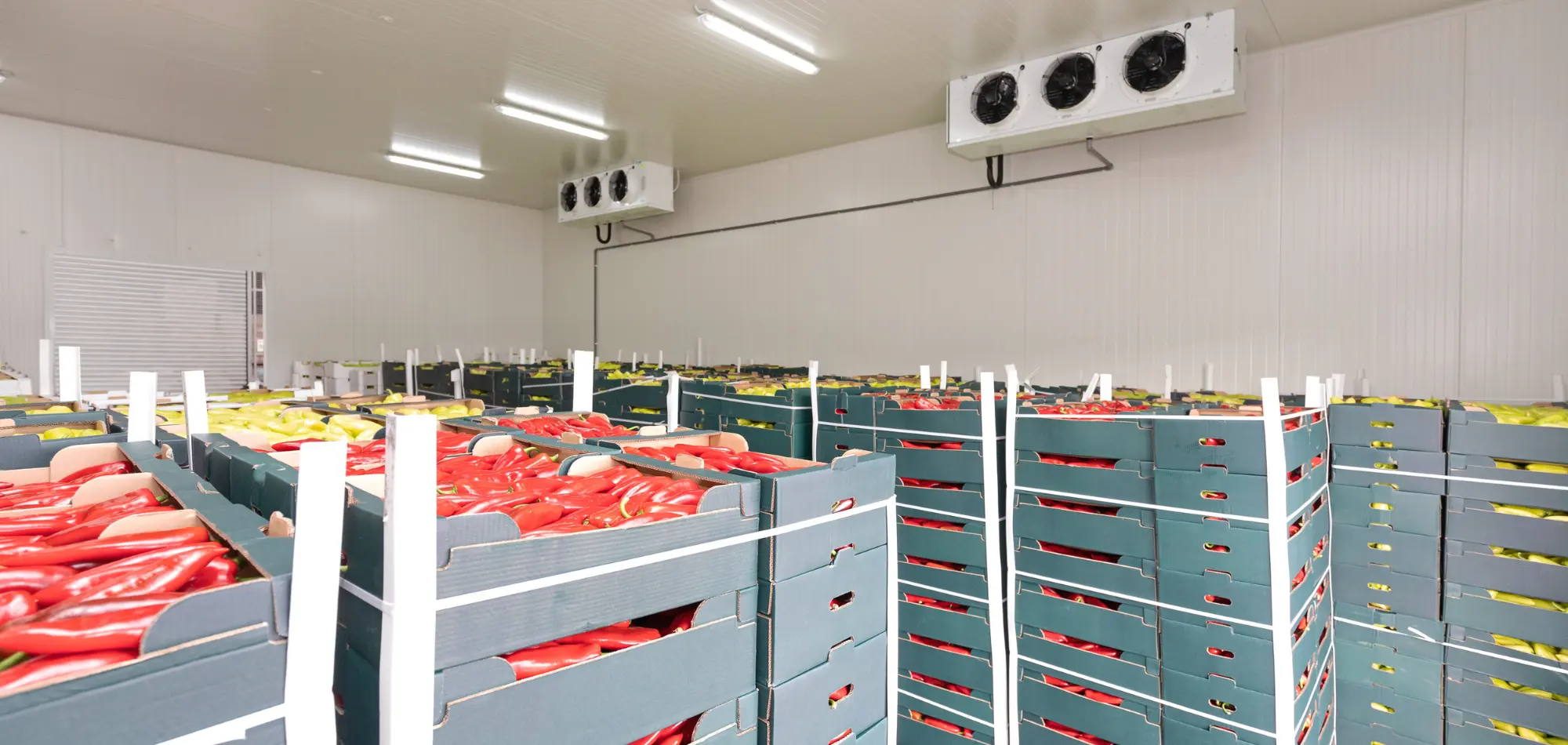
Refrigerated warehouse served by CO2 transcritical refrigeration system
Architecture

Three configurations by pressure regime.

CO2 systems operate in three configurations depending on operating temperature and pressure regime: subcritical (below 88°F / 1,070 psi critical point), transcritical (above critical), and booster cycle (two-stage compression for deep cold). Selection depends on application and ambient design conditions.

  • Subcritical CO2 — standard vapor-compression, used in cascade low-temp circuits
  • Transcritical CO2 — high-side above critical point, gas cooler replaces condenser
  • Booster cycle — two-stage compression for single-refrigerant deep cold operation
  • High-side pressure typically 1,200–1,500+ psi in transcritical operation
  • Components throughout must be properly rated for high pressure
CO2 refrigeration mechanical room with transcritical compressor package
Regulation

No GWP restrictions, no PSM threshold.

CO2 GWP = 1; no phase-down regulations apply. OSHA PSM (29 CFR 1910.119) doesn't list CO2 as a highly hazardous chemical — no threshold-based regulatory program. ANSI/ASHRAE 15 classifies CO2 as A1 (lower toxicity, no flame propagation). ASME pressure vessel code applies to high-side equipment.

  • No GWP-related restrictions (GWP = 1)
  • No OSHA PSM — not listed as highly hazardous chemical
  • ANSI/ASHRAE 15 — A1 classification
  • Pressure design — high-side rated for transcritical (1,500+ psi)
  • Building code — standard; CO2 typically not restricted by jurisdiction
CO2 refrigeration plant under construction in cold storage facility
Subcritical

Subcritical CO2

Operates entirely below CO2's critical point (~88°F / 31°C, 1,070 psi). Standard vapor-compression cycle similar to ammonia or HFC systems.

Typical applications:

  • Cascade systems (CO2 low-temperature circuit)
  • Indirect refrigeration with secondary loop
  • Operations where CO2 head pressure can be managed below transcritical

Operating characteristics: Standard vapor-compression behavior, predictable component selection.

Transcritical

Transcritical CO2

Operates with high-side pressure above CO2's critical point. Standard for warmer ambient conditions where suppressing head pressure below critical isn't feasible.

Typical applications:

  • Standalone CO2 refrigerated facilities
  • Greenfield construction in HFC-regulated jurisdictions
  • Warm-climate operations where subcritical operation isn't practical

Operating characteristics:

  • High-side pressure typically 1,200–1,500+ psi
  • Gas cooler replaces conventional condenser
  • Optimum high-side pressure controller manages efficiency
  • Efficiency drops at higher ambient temperatures
Booster

Booster cycle CO2

Two-stage compression: lower-temperature compressors feed higher-temperature compressors. Allows single-refrigerant operation at deep cold applications.

Typical applications:

  • Multi-temperature refrigerated and frozen facilities
  • Operations seeking single-refrigerant operation rather than cascade
  • Mid-size frozen applications
When to Specify

Strong fit vs marginal vs poor fit

Strong fit: Refrigerated facilities in HFC-regulated jurisdictions (California, parts of Northeast), operations preferring low-GWP refrigerant, multi-tenant operations where ammonia in occupied space is restricted, smaller facilities under 50,000 SF, cold-climate operations.

Marginal fit: Hot-climate refrigerated facilities (efficiency penalty at high ambient), frozen storage at 0°F to -10°F (ammonia or cascade more efficient), operations requiring heat recovery (ammonia more flexible).

Poor fit: Sub-zero standalone (cascade with ammonia is more efficient), very large facilities (200,000+ SF) where ammonia economics dominate, operations with established ammonia trade relationships.

Cost

Capital and operating cost

CO2 system capital cost runs 5–25% higher than HFC alternatives and similar to or slightly above ammonia for equivalent capacity.

Drivers of higher capital cost:

  • High-pressure components throughout (transcritical operation)
  • Specialized equipment availability premium (improving as market matures)
  • Larger initial refrigerant charge for some configurations
  • Specialized installation labor

Operating cost comparison:

  • vs HFC alternatives: typically 5–15% lower operating cost
  • vs ammonia: similar to slightly higher operating cost at typical conditions
  • vs cascade: subcritical CO2 cascade can match or beat ammonia/cascade for some applications
Equipment

CO2 system equipment selection

  • Compressors: Specialized CO2 reciprocating, semi-hermetic screw, or scroll compressors rated for transcritical operation. Manufacturers: Bitzer, Bock, Copeland, Frascold, Refcomp.
  • Gas coolers / Condensers: Sized for ambient design conditions. Larger than equivalent HFC condensers.
  • Heat exchangers: Microchannel and plate-and-frame designs sized for CO2 high pressure.
  • Piping: Carbon steel or stainless steel rated for CO2 high pressure (often 1,500+ psi rated).
  • Controls: CO2-specific controls for high-side pressure optimization.
  • Refrigerant charge: Higher initial charge than HFC equivalent due to denser refrigerant.
Operations

Operating considerations

CO2 systems require specific operating attention:

  • High-side pressure management. Transcritical systems require active high-side pressure control.
  • Ambient sensitivity. CO2 efficiency drops at high ambient. Worth oversizing gas cooler in hot climates.
  • Refrigerant leak handling. CO2 is heavier than air; leaks pool in low spaces. Gas detection and ventilation infrastructure addresses this.
  • Service availability. CO2 service trade is less developed than ammonia in some markets. Operator should verify service relationships before committing.
Build With Us

Tell us about your project

Tell us about your cold storage project — facility size, operating temperature, jurisdiction, sustainability priorities. We design CO2 refrigeration systems matched to your application. Houston-headquartered · Design-build · Nationwide.

Budgeting

Cost and timeline planning ranges.

1

CO2 GWP

Lowest of common refrigerants

88°F / 1,070 psi

Critical Point

Transcritical above; subcritical below

1,200–1,500+ psi

Transcritical High Side

Components rated accordingly

+5–25%

Capital vs HFC

Premium decreasing as market matures

−5–15%

Operating vs HFC

Typical efficiency advantage

22–32 wk

CO2 Compressor Lead Time

Q1 2026

Services

Cold Storage Solutions, End to End

❄️ Cold Storage🧊 Blast Freeze🏗️ New Build🔧 Retrofit🌡️ Multi-Temp💊 Pharma-Grade📦 3PL Warehouses
FAQ

Common Questions

Why is CO2 refrigeration growing?

Three reasons: HFC phase-down regulations (federal AIM Act, California CARB) push toward low-GWP refrigerants; CO2 is non-toxic at occupied space concentrations; equipment availability has improved significantly over the past decade. CO2 is now a credible alternative to ammonia for many applications.

What's the difference between transcritical and subcritical CO2?

Subcritical CO2 operates entirely below CO2's critical point (88°F / 31°C, 1,070 psi). Standard vapor-compression cycle. Transcritical CO2 operates with high-side pressure above critical point. Gas cooler replaces conventional condenser. Transcritical is standard for warm-climate operations and refrigerated applications; subcritical is standard for cascade low-temperature circuits.

Is CO2 refrigeration as efficient as ammonia?

Depends on conditions. For refrigerated facilities (34°F–55°F) at moderate ambient, CO2 transcritical can match or beat ammonia. At sub-zero temperatures and high ambient, ammonia retains efficiency advantage. CO2 efficiency drops at higher ambient (worth oversizing gas cooler). Ammonia/CO2 cascade is most efficient for sub-zero applications.

Does CO2 trigger PSM compliance?

No. OSHA PSM (29 CFR 1910.119) doesn't list CO2 as a highly hazardous chemical. No threshold-based regulatory program applies. This is a significant operational advantage over ammonia, where PSM above 10,000 lb adds substantial documentation and compliance overhead.

What's the capital cost of CO2 vs ammonia?

Similar to slightly higher than ammonia for equivalent capacity. CO2 capital costs run 5–25% above HFC alternatives. Premium reflects high-pressure components, specialized equipment, and current market conditions. Capital cost premium expected to decrease as market matures.

Can CO2 be used in occupied space?

Yes. CO2 is non-toxic at occupied space concentrations (occupational exposure limit 5,000 ppm 8-hour). No special machinery room requirements like ammonia. Standard safety practices apply (gas detection, ventilation, restricted access for service).

What's the leak detection requirement for CO2?

CO2 is heavier than air and accumulates in low spaces. Gas detection sized for occupied space exposure limits. Ventilation infrastructure removes accumulated CO2 from leak events. Pressure monitoring detects system charge loss.

Is CO2 appropriate for blast freezing?

Subcritical CO2 in cascade with ammonia is the standard for blast freezing (-20°F to -40°F applications). Standalone CO2 transcritical is generally not used for blast freezing due to efficiency penalty at deep cold temperatures.

Field Log· Houston · 29.66°N · 95.47°WOperating Range−40°F → 70°F · ±0.5°FR-Value30–60 IMP
Call UsRequest a Quote