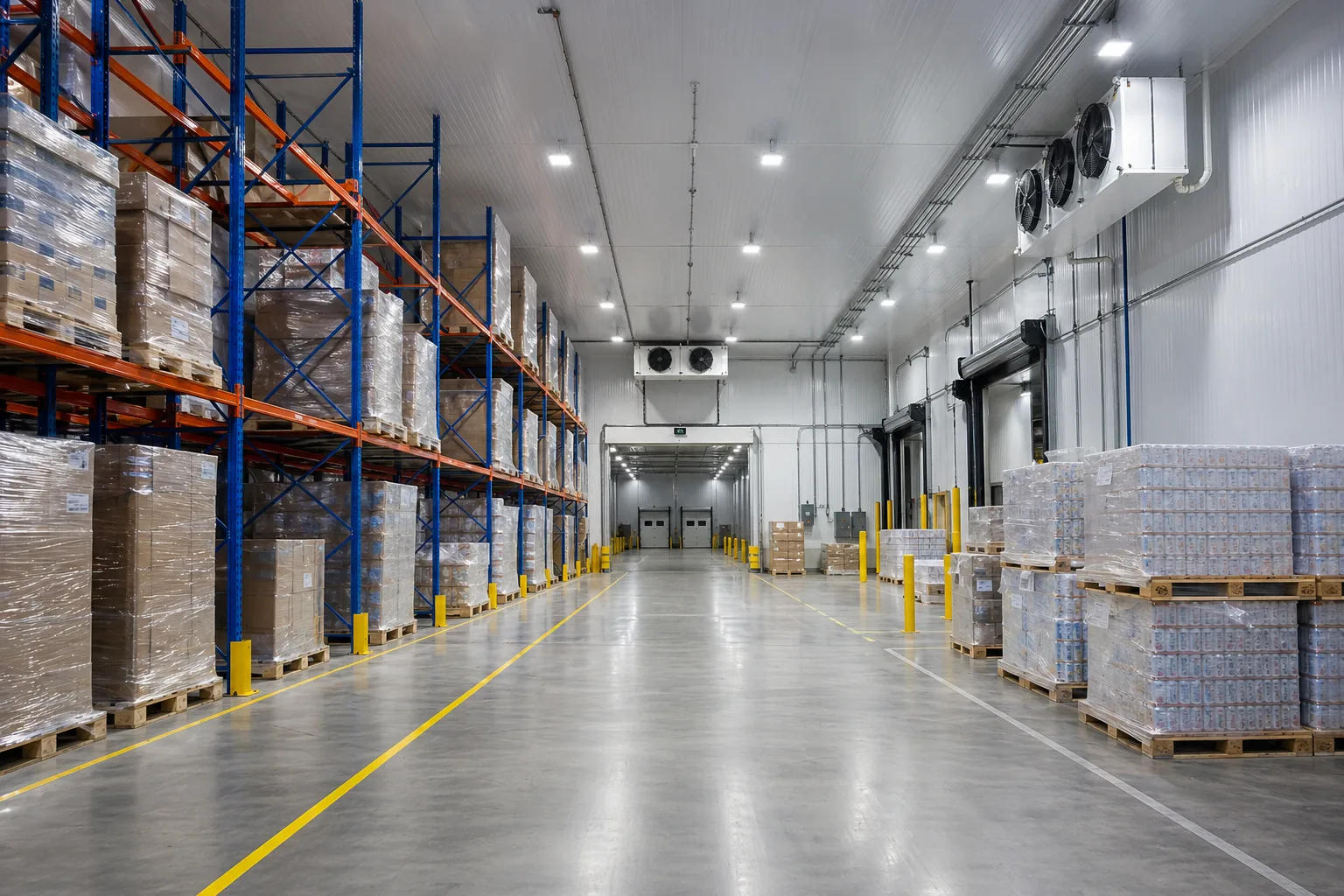
Glycol Secondary Loop Refrigeration Systems

Glycol secondary loop refrigeration keeps primary refrigerant (typically ammonia) in the mechanical room while a glycol-water mixture circulates through evaporators in the cold space. This architecture solves specific operational constraints — multi-tenant operations, ammonia in occupied space restrictions, retrofit conditions — at the cost of moderate efficiency penalty (5–15%) and additional capital cost. This page covers when secondary loop is the right answer and when it's not.

By US Cold Storage Builders Engineering Team
📅 Now booking 60–90 days out | Call (346) 676 - COLD
Performance IndexUpdated quarterly
5–15%
Efficiency Penalty vs DX
8–15%
Capital Premium vs DX
7–15 yr
Glycol Service Life
Refrigeration

Two fluid circuits — primary refrigerant in mech room, glycol in cold space.

What It Does

Primary refrigerant stays in mech room; glycol does the cold-space work.

In a direct-expansion system, primary refrigerant flows directly to evaporators in the cold space. In a secondary loop system, two separate fluid circuits couple through a heat exchanger: primary refrigerant in the mechanical room, glycol-water mixture circulating through evaporators in the cold space. Primary refrigerant never enters the cold space.

  • Primary circuit (mech room) — refrigerant, compressor, condenser, heat exchanger
  • Secondary circuit (cold space) — glycol-water, pumps, evaporators, return path
  • Plate-and-frame heat exchanger couples the two circuits thermally (not mass)
  • Glycol concentration sized to operating temperature (30–50% PG typical)
  • Pumps circulate glycol; controls match flow to load
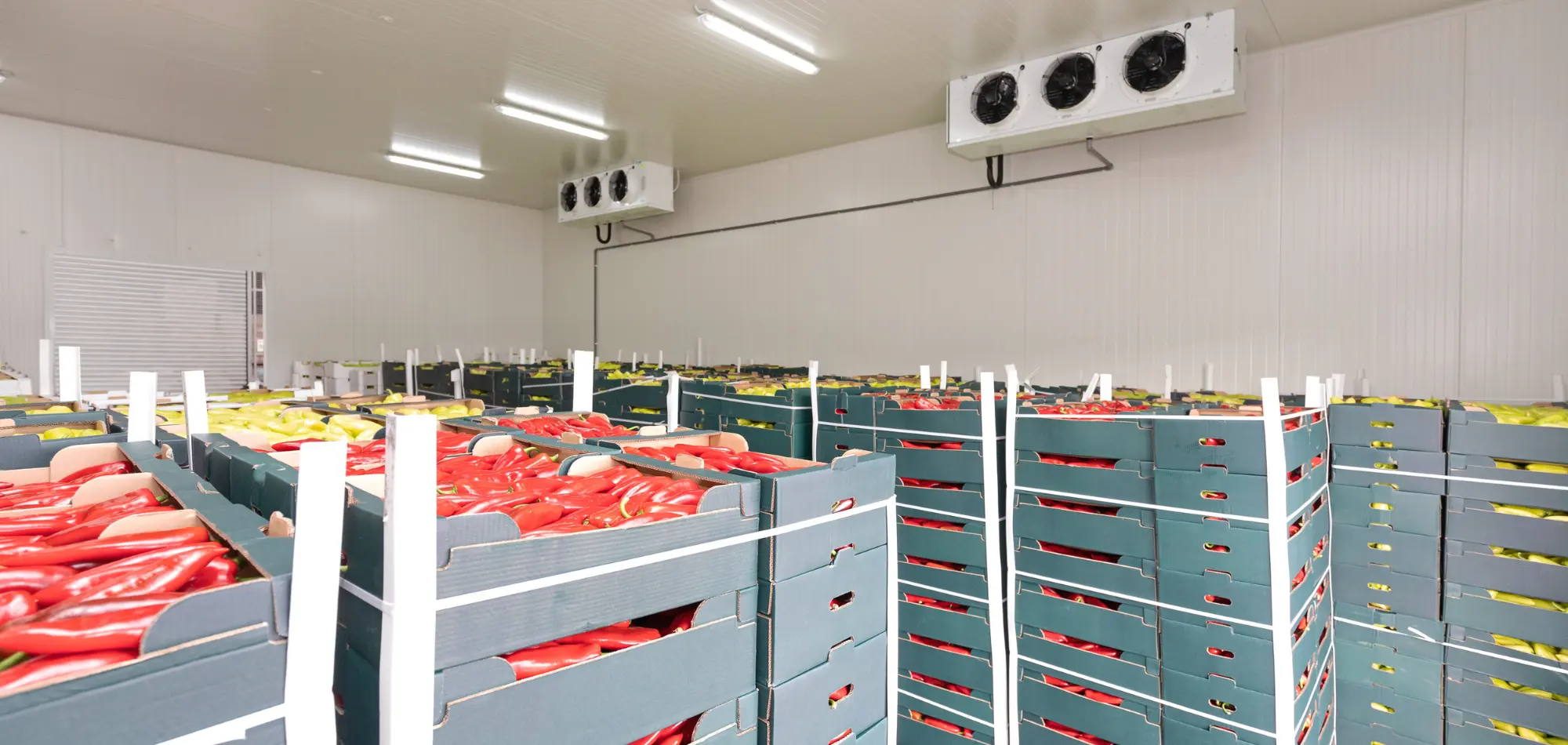
Cold storage facility with glycol secondary loop refrigeration architecture
When It Wins

Six use cases where secondary loop is the right answer.

Multi-tenant cold storage, jurisdictions restricting ammonia in occupied space, retrofit conditions, insurance constraints, phased construction, and pharmaceutical applications. Glycol piping is much easier to retrofit than ammonia piping. Secondary loop sometimes reduces insurance cost enough to offset capital cost premium.

  • Multi-tenant operations — eliminates ammonia training for all tenants
  • Restrictive jurisdictions — satisfies local ammonia ordinances
  • Retrofit conditions — glycol piping easier to install in occupied spaces
  • Insurance constraints — sometimes lower premium loadings
  • Phased construction — centralized plant serves incremental phases
  • Pharmaceutical applications — eliminates primary refrigerant product contact risk
Multi-tenant refrigerated warehouse interior served by glycol secondary loop
Trade-Offs

Five operating costs vs direct-expansion.

Secondary loop carries operational costs that need to be weighed against benefits. Heat is transferred twice (refrigerant to glycol, glycol to air) rather than once, introducing efficiency penalty. Additional capital cost reflects added equipment. More components mean more potential failure points.

  • Efficiency penalty — 5–15% vs direct-expansion
  • Capital premium — 8–15% over direct-expansion equivalent
  • Slower pull-down at commissioning
  • More complex system — more pumps, heat exchangers, controls
  • Glycol management — periodic testing, 7–15 year replacement cycle
Glycol pump array and plate-and-frame heat exchanger in cold storage mechanical room
Glycol

Glycol selection — PG vs EG

Propylene glycol is standard for cold storage applications:

Propylene glycol (PG). Food-grade applications, FDA-approved. Slightly lower thermal performance than ethylene glycol but acceptable safety profile for incidental food contact. Standard for food cold storage and pharma applications.

Ethylene glycol (EG). Better thermal performance than PG. Toxic — not used in food cold storage. Used in industrial applications where food contact concern doesn't apply.

Typical concentration: 30–40% glycol for moderate-climate frozen applications, 40–50% for very cold climates or low operating temperatures.

Pumps

Pump sizing

Glycol loop pumps sized to deliver design flow rate at design head pressure:

  • Flow rate: Sized to evaporator capacity at design loop differential temperature (typically 8–12°F)
  • Head pressure: Sized to system pressure drop (piping, evaporators, heat exchanger)
  • Pump type: Centrifugal pumps standard; variable-speed for efficiency optimization
  • Redundancy: N+1 pump configuration standard
Piping

Piping design

  • Material: Steel or copper standard; some applications use stainless steel
  • Sizing: Per ASHRAE handbook methodology; balance pressure drop against capital cost
  • Insulation: Required on cold-side piping to prevent condensation
  • Expansion: Glycol expansion tank required for thermal expansion management
  • Air management: Air separators and venting prevent air locks in long piping runs
  • Filtration: Strainers and filters protect pumps and evaporators
Heat Exchanger

The critical efficiency component

The heat exchanger between primary refrigerant and glycol is the critical efficiency component:

  • Type: Plate-and-frame heat exchangers standard for industrial scale
  • Material: Stainless steel plates for corrosion resistance with glycol
  • Sizing: Sized for design temperature approach (typically 3–5°F between glycol and refrigerant)
  • Tighter approach = higher capital cost, better efficiency
  • Wider approach = lower capital cost, slightly lower efficiency
Capability

Operating temperature capability

Secondary loop can serve refrigerated through deep-frozen applications:

  • Refrigerated (34°F–55°F): Glycol supply 20°F–30°F. Standard concentration.
  • Frozen (0°F to -10°F): Glycol supply -20°F to -10°F. Higher glycol concentration.
  • Sub-zero (-20°F to -10°F): Glycol supply -35°F to -25°F. Specialty concentration; system design more constrained.
  • Below -20°F: Generally not appropriate; cascade or direct-expansion more practical.

For sub-zero applications, primary refrigerant must achieve glycol supply temperatures lower than -25°F. Ammonia low-pressure refrigeration handles this; CO2 in cascade with ammonia handles this even more efficiently.

Build With Us

Tell us about your project

Tell us about your cold storage project — facility size, operating temperature, operational constraints. We design glycol secondary loop systems for the specific applications where direct-expansion isn't the right answer. Houston-headquartered · Design-build · Nationwide.

Budgeting

Cost and timeline planning ranges.

5–15%

Efficiency Penalty vs DX

Two heat transfers vs one

8–15%

Capital Premium vs DX

Heat exchanger, pumps, glycol piping

30–50% PG

Glycol Concentration

Sized to operating temperature

3–5°F

Heat Exchanger Approach

Tighter = better efficiency

N+1

Pump Redundancy

Standard configuration

7–15 yr

Glycol Service Life

Replacement cycle

Services

Cold Storage Solutions, End to End

❄️ Cold Storage🧊 Blast Freeze🏗️ New Build🔧 Retrofit🌡️ Multi-Temp💊 Pharma-Grade📦 3PL Warehouses
FAQ

Common Questions

When should I use glycol secondary loop instead of direct-expansion?

When ammonia direct-expansion isn't acceptable in occupied space — multi-tenant operations, jurisdictions restricting ammonia exposure, retrofit conditions, pharmaceutical applications, or insurance-driven cost constraints. Secondary loop solves the operational constraint at the cost of 5–15% efficiency penalty and 8–15% capital cost premium vs direct-expansion equivalent.

Why is there an efficiency penalty?

Heat is transferred twice in a secondary loop system — first from refrigerant to glycol, then from glycol to air in the cold space. Each transfer introduces a temperature differential (typically 3–5°F), and the refrigeration system must compensate by operating at lower compressor saturation temperature. Lower saturation temperature = lower compressor capacity per unit power = higher operating cost.

What glycol concentration is used?

30–50% propylene glycol in water. Concentration sized to operating temperature — colder operations require higher glycol concentration for freeze protection. Food-grade propylene glycol for food cold storage; ethylene glycol acceptable for non-food applications where toxicity isn't a concern.

How often does glycol need replacement?

7–15 years typical service life. Glycol degrades from oxidation, contamination, and corrosion inhibitor depletion. Periodic glycol testing (concentration, pH, corrosion inhibitor level) extends service life. Replacement involves draining the loop, disposing of used glycol, refilling with fresh glycol mixture.

Can secondary loop handle frozen storage temperatures?

Yes, for standard frozen storage (0°F to -10°F) with glycol supply temperature of -20°F to -10°F. For sub-zero applications (-20°F or colder), secondary loop becomes constrained — glycol supply temperature must be much colder than space temperature, which pushes primary refrigeration deeper. Cascade systems are more practical at sub-zero temperatures.

What's the maintenance for a secondary loop system?

Additional maintenance vs direct-expansion: periodic glycol testing, pump service intervals, heat exchanger inspection, air management system service. Total maintenance overhead modestly higher than direct-expansion but well within standard cold storage operations.

Can secondary loop be retrofitted to an existing direct-expansion facility?

Yes, but it's a major retrofit. Existing primary refrigerant must be safely recovered from the cold space, replaced with heat exchanger and glycol loop, glycol piping run throughout the cold space, and evaporators replaced. Retrofit is typically justified by regulatory changes, insurance requirements, or operational mandates rather than economics alone.

Are there alternatives to glycol for secondary loop?

Glycol-water mixtures are the standard. Some specialty applications use brine (sodium chloride or calcium chloride solutions) for very cold operations. Pure water is occasionally used in refrigerated applications above 40°F. Glycol-water is the practical choice for most cold storage secondary loops.

Field Log· Houston · 29.66°N · 95.47°WOperating Range−40°F → 70°F · ±0.5°FR-Value30–60 IMP
Call UsRequest a Quote