Evaporator & Condenser Sizing for Cold Storage Refrigeration

Evaporators absorb heat from the cold space. Condensers reject heat to the outdoors. Sizing both correctly determines whether the refrigeration system hits design temperature on the design day at design efficiency. Undersizing leaves the room warm on hot days; oversizing wastes capital and creates operational problems. This page covers the methodology USCB uses to size evaporators and condensers for cold storage facilities.

By US Cold Storage Builders Engineering Team
📅 Now booking 60–90 days out | Call (346) 676 - COLD
Performance IndexUpdated quarterly
ASHRAE
Load Calculation Basis
8–15°F
Standard Evaporator TD Range
15–25°F
Standard Condenser Approach
Refrigeration

Load calculation, TD selection, approach, airflow — the four core decisions.

Load Calculation

Start with the actual heat load.

Per ASHRAE Refrigeration Handbook, calculate envelope load (conduction through walls, ceiling, floor), door infiltration (the largest variable component), product pull-down (cooling incoming product), internal loads (lighting, equipment, personnel), and defrost. Sum, then add 10–25% safety factor. Verify against operational patterns — peak-hour throughput, door cycle frequency.

  • Envelope — conduction; depends on R-value and surface area
  • Door infiltration — the largest variable component in operating cold storage
  • Product pull-down — incoming product mass × ΔT ÷ pull-down time
  • Internal — LED reduces lighting load 50–80% vs HID; equipment + personnel
  • Defrost — electric adds 100%; hot-gas recycles refrigerant heat
  • Safety factor — 10–25% above calculated
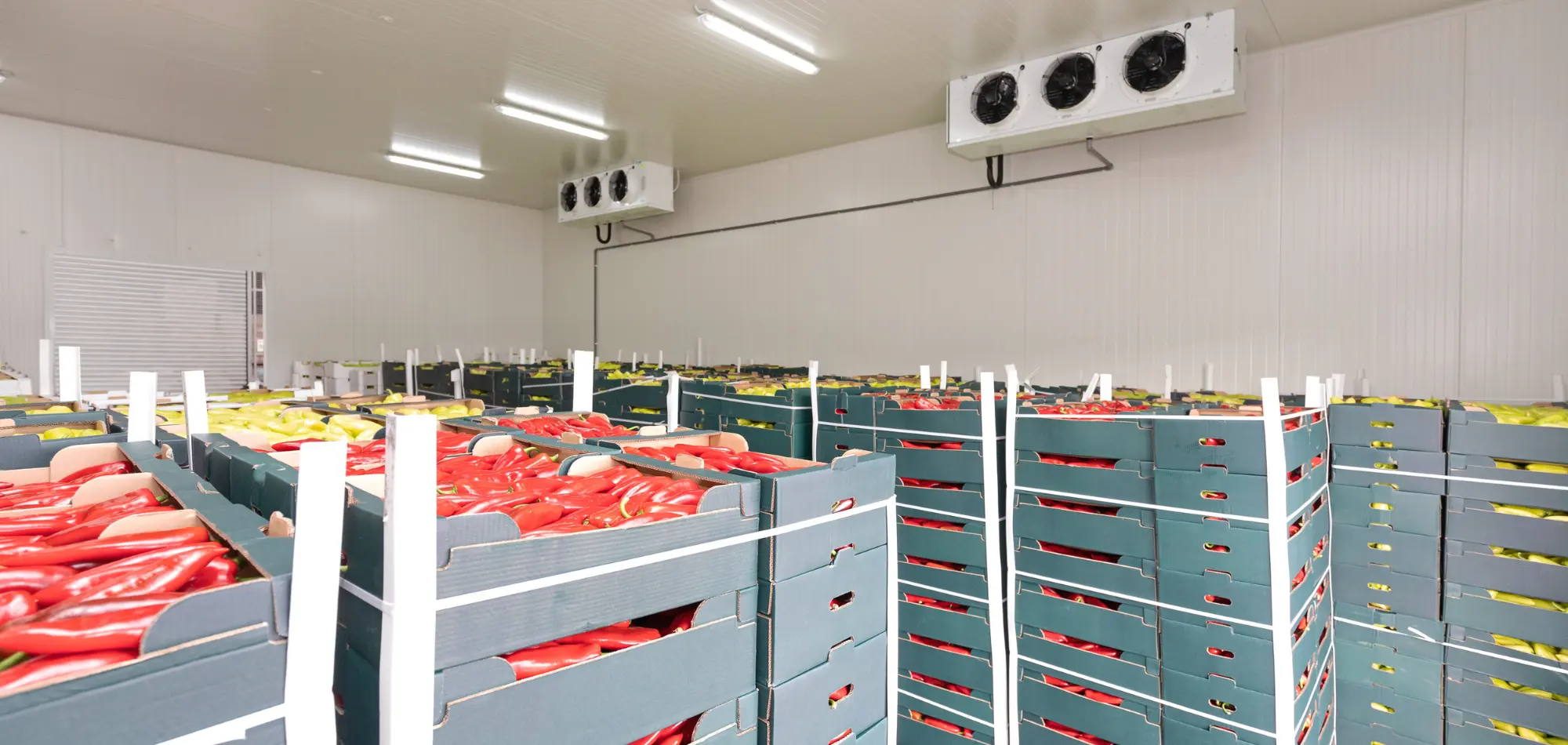
Refrigerated warehouse interior with ceiling-mount evaporators sized for design load
Evaporator

TD selection drives evaporator size and humidity.

Evaporator TD (temperature difference) is the gap between room temperature and refrigerant evaporating temperature. Low TD (8–10°F) means larger coil, higher capital cost, lower humidity loss, better efficiency. High TD (12–15°F) means smaller coil, lower capital cost, more humidity loss. Product humidity sensitivity and capital budget drive selection.

  • Low TD (8–10°F) — produce, premium frozen, pharma; humidity-critical
  • Standard TD (10–12°F) — typical refrigerated and frozen storage
  • High TD (12–15°F) — blast and high-throughput where humidity isn't critical
  • Airflow 50–80 CFM/ton standard; 200–500+ CFM/ton for blast
  • Variable-speed fan control matches airflow to load
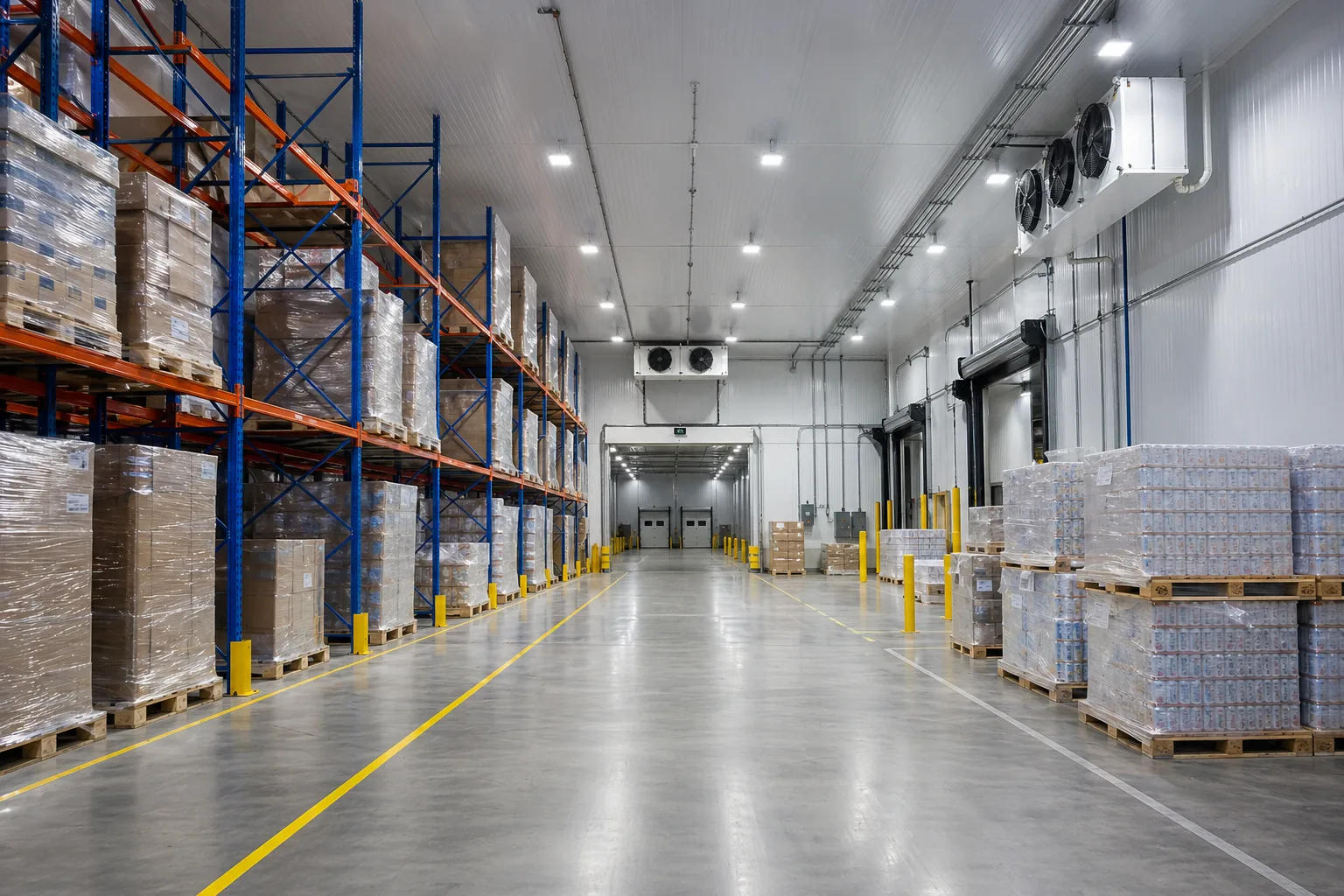
Ceiling-mount evaporator unit cooler in cold storage refrigerated space
Condenser

Approach oversizing has high ROI.

Condenser approach is the gap between condensing temperature and ambient. Air-cooled condenser approach typically 15–25°F over design ambient. Lower approach = larger condenser, lower head pressure, better efficiency. Modest oversizing (10–25%) lowers head pressure across all operating conditions, reducing compressor energy proportionally. Payback 2–4 years.

  • Evaporative condenser — standard for industrial ammonia, requires water treatment
  • Air-cooled condenser — simpler, common for smaller systems, less efficient at warm ambient
  • Approach 15–25°F over design ambient (99% percentile hot day)
  • Modest oversizing (10–25%) → 2–4 year payback via compressor energy
  • Variable-speed condenser fans match condenser airflow to load
  • Head pressure controls allow lower condensing in cool weather
Rooftop evaporative condenser bank for industrial cold storage refrigeration plant
Methodology

USCB sizing methodology

  1. Define operating conditions — temperature, design ambient (99% percentile), humidity, internal loads
  2. Calculate steady-state load per ASHRAE Refrigeration Handbook
  3. Add redundancy capacity — N+1 means total = design + one extra compressor
  4. Verify against operational patterns — peak-hour throughput, door cycles, product pull-down
  5. Specify equipment — compressor count, evaporator placement, condenser sizing
  6. Verify at commissioning — real-world load measured against design
Evaporator Detail

Evaporator selection considerations

  • Mounting: Ceiling-mount unit coolers standard for most cold storage. Penthouse air handlers for very large zones. Plate coils for specialty applications.
  • Tube material: Stainless steel for ammonia; copper or copper-fin-aluminum for HFC.
  • Fin spacing: Wider spacing for frost-prone applications (frozen, high humidity entry). Tighter spacing for higher capacity in stable refrigerated conditions.
  • Defrost: Electric defrost for smaller evaporators; hot-gas defrost integrated for industrial systems. Defrost timing/duration tuned to actual frost accumulation.
  • Air pattern: Throw distance, vertical projection, and pattern designed to cover the zone evenly.
  • Drain: Heated drain pan and drain line for defrost water; drain line slope and trap to prevent backflow.
Condenser Detail

Condenser type selection

Evaporative condenser

  • Water sprayed over condensing coil; evaporation rejects heat
  • Most efficient at warm ambient (best summer performance)
  • Lower head pressure → lower compressor energy
  • Requires water treatment, biological control, freeze protection
  • Standard for industrial ammonia and CO2 cascade

Air-cooled condenser

  • Air alone rejects heat through fin coil
  • No water — simpler operations, no biological/chemical management
  • Less efficient at warm ambient — higher head pressure on hot days
  • Common for smaller systems, DX condensing units, CO2 transcritical

Adiabatic condenser

  • Hybrid — air-cooled with pre-cooling pad in hot weather
  • Compromise — better summer performance than pure air-cooled, less water than full evaporative
  • Increasingly common for mid-size CO2 transcritical and ammonia
Common Errors

Three common sizing errors

  • Underestimating door infiltration. The largest variable component in operating cold storage. Often modeled at "design" rates that real operations exceed. Door cycle frequency and open duration drive actual infiltration; verify against operational patterns.
  • Undersizing the condenser to "save" capital. Condenser is one of the highest-ROI capital decisions in cold storage. Modest oversizing (10–25%) pays back in compressor energy within 2–4 years. Aggressive undersizing creates lifetime efficiency penalty.
  • Ignoring pull-down load. Steady-state holding load is much smaller than peak pull-down. High-throughput operations need either capacity headroom or dedicated pull-down rooms.
Build With Us

Tell us about your project

Tell us about your cold storage project — operating temperature, square footage, product throughput patterns, design ambient. We perform load calculation and equipment sizing in pre-construction. Houston-headquartered · Design-build · Nationwide.

Budgeting

Cost and timeline planning ranges.

ASHRAE

Load Calc Basis

Refrigeration Handbook methodology

8–15°F

Evaporator TD (low/std/high)

Lower = larger coil, less humidity loss

50–80 CFM/ton

Evaporator Airflow (standard)

Cold storage

200–500+ CFM/ton

Evaporator Airflow (blast)

Blast freezing

15–25°F

Condenser Approach

Over design ambient

2–4 yr

Condenser Oversize ROI

10–25% oversize, payback via compressor energy

+10–25%

Refrigeration Safety Factor

Above calculated steady-state

+10–20%

Defrost Sizing Add

For frequent-defrost frozen applications

Services

Cold Storage Solutions, End to End

❄️ Cold Storage🧊 Blast Freeze🏗️ New Build🔧 Retrofit🌡️ Multi-Temp💊 Pharma-Grade📦 3PL Warehouses
FAQ

Common Questions

Why is evaporator and condenser sizing so important?

Evaporators and condensers are the heat-exchange interfaces of the refrigeration cycle. Undersized evaporator = the room never reaches temperature on hot days. Undersized condenser = high head pressure, lower compressor capacity, higher operating energy. Oversized = wasted capital, short cycling, poor humidity control. Right-sized = the system hits design temperature on the design day at design efficiency.

What's evaporator TD?

TD (temperature difference) is the gap between room temperature and refrigerant evaporating temperature inside the evaporator coil. Standard range: 8–15°F. Low TD (8–10°F) = larger coil, higher capital cost, lower humidity loss, better efficiency. High TD (12–15°F) = smaller coil, lower capital cost, more humidity loss. Selection depends on product humidity sensitivity and capital budget.

What's condenser approach?

Approach is the gap between condensing temperature and ambient (or condensing water temperature). For air-cooled condensers, approach is typically 15–25°F over design ambient. Lower approach = larger condenser, lower head pressure, better efficiency. Higher approach = smaller condenser, higher head pressure, worse efficiency. Oversizing condenser is one of the highest-ROI capital decisions in cold storage.

How much airflow does an evaporator need?

Standard cold storage: 50–80 CFM per refrigeration ton. Blast freezing: 200–500+ CFM per ton (much higher velocity across product). Fan power scales with airflow, so blast freezers consume substantial fan energy. Variable-speed fan control optimizes airflow to actual load.

How do you size for defrost?

Defrost adds load during defrost cycles — electric defrost adds load equal to the defrost heater rating; hot-gas defrost recycles refrigerant heat (lower net load impact). Sizing must account for defrost downtime — capacity must recover during the next operating period. For frozen storage with frequent defrost, sizing adds 10–20% beyond steady-state requirements.

Should I oversize the condenser?

Yes, slightly — within reason. Modest condenser oversizing (10–25%) lowers head pressure across all operating conditions, reducing compressor energy consumption proportionally. Payback period typically 2–4 years. Aggressive oversizing (>50%) loses returns and risks problems at low ambient (head pressure too low for proper expansion valve operation).

What's the difference between evaporative and air-cooled condensers?

Evaporative condensers use water evaporation to reject heat — more efficient at warm ambient, lower head pressure, but require water treatment and freeze protection in cold climates. Air-cooled condensers reject heat to air alone — simpler, no water, but less efficient at warm ambient. Evaporative is the industrial standard for ammonia; air-cooled is common for smaller systems.

How does evaporator sizing differ for product pull-down vs holding?

Holding loads are steady-state — envelope, lighting, door infiltration. Pull-down loads (incoming product cooling from ambient to room temperature) are intermittent but large. Sizing must handle peak pull-down without compromising holding temperature. Most cold storage handles this through refrigeration capacity safety factor (10–25%); high-throughput operations may require dedicated pull-down rooms.

Field Log· Houston · 29.66°N · 95.47°WOperating Range−40°F → 70°F · ±0.5°FR-Value30–60 IMP
Call UsRequest a Quote