Ammonia/CO2 Cascade Refrigeration Systems

For sub-zero applications below -20°F — frozen storage, blast freezing, IQF — ammonia/CO2 cascade is the most efficient refrigeration option available. It combines the strengths of both refrigerants: ammonia's thermodynamic efficiency at higher temperatures, and CO2's better performance at deeper cold. The architecture is more complex than single-refrigerant systems, and capital cost runs 10–20% above single-stage ammonia, but operating efficiency advantage compounds rapidly at sub-zero temperatures.

By US Cold Storage Builders Engineering Team
📅 Now booking 60–90 days out | Call (346) 676 - COLD
Performance IndexUpdated quarterly
25–40%
Lower Operating Energy at -40°F
+10–20%
Capital Premium vs Single-Stage NH3
3–6 yr
Payback for Sub-Zero Facilities
Refrigeration

Two refrigerants, each operating in its favorable range.

How It Works

Two circuits coupled at the cascade heat exchanger.

Cascade systems combine two separate refrigeration circuits coupled at a cascade heat exchanger. CO2 in the cold space (safer for occupied space exposure), ammonia in the mechanical room (most efficient at higher temperatures), and deep cold capability without single-refrigerant efficiency penalty. The two refrigerants couple thermally; no mass transfer between circuits.

  • High-temp circuit (ammonia) — compressor, condenser, ammonia evaporator at cascade HX
  • Low-temp circuit (CO2) — compressor, CO2 condenser at cascade HX, evaporators in cold space
  • Cascade heat exchanger — ammonia evaporator (high side), CO2 condenser (low side)
  • Plate-and-frame heat exchanger standard at industrial scale
  • Stainless steel plates rated for CO2 high pressure
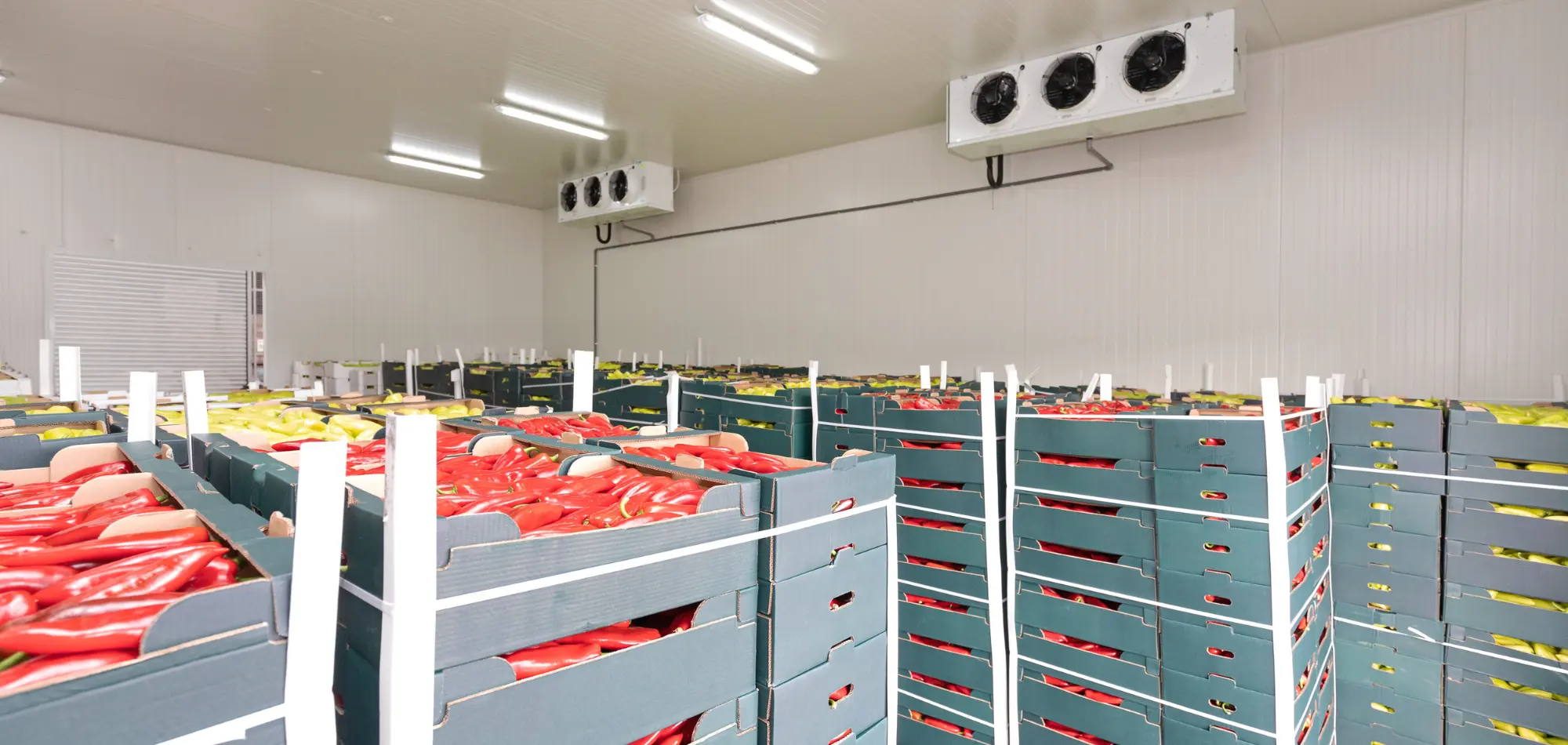
Cascade refrigeration mechanical room with ammonia and CO2 compressors visible
Why It Wins

Each refrigerant operates in its favorable range.

Single-stage ammonia at -40°F operates at very low suction pressure with reduced volumetric efficiency. CO2 transcritical at deep cold has unfavorable pressure ratios. Cascade splits the work: low-temp CO2 circuit operates at favorable conditions for CO2 (relatively warm condensing through cascade HX), high-temp ammonia circuit operates at favorable conditions for ammonia (high evaporating temperature into cascade HX).

  • Combined system efficiency at deep cold significantly exceeds single-stage alternatives
  • Typical 25–40% lower operating energy at -40°F vs single-stage ammonia
  • 10–20% lower at -20°F vs single-stage ammonia
  • Advantage compounds with operating temperature differential
  • Standard design for new sub-zero and blast freezer construction since ~2015
Sub-zero frozen storage interior served by ammonia/CO2 cascade refrigeration
Applications

Strong fit for sub-zero, blast, IQF.

Frozen storage at -20°F or colder, blast freezing applications (-20°F to -40°F), IQF tunnel and spiral freezing, frozen food manufacturing with integrated blast freezing, sub-zero specialty applications (-30°F to -40°F), and large frozen DCs operating at -10°F where future blast freezer addition is planned.

  • Strong fit — sub-zero frozen storage, blast freezing, IQF
  • Strong fit — frozen food manufacturing with integrated blast
  • Marginal — frozen storage at -10°F to 0°F (single-stage NH3 competitive)
  • Marginal — mid-size applications under 30,000 SF
  • Poor fit — refrigerated facilities (no advantage at higher temps)
Blast freezer operations served by cascade refrigeration
High-Temp Side

Ammonia high-temperature circuit

Standard industrial ammonia refrigeration architecture:

  • Ammonia compressors (typically screw)
  • Ammonia condenser (evaporative or air-cooled)
  • Ammonia receiver
  • Ammonia evaporator at cascade heat exchanger

Ammonia operates at favorable suction pressure thanks to the cascade HX raising evaporating temperature relative to a single-stage design serving deep cold.

Low-Temp Side

CO2 low-temperature circuit

CO2-specific equipment:

  • CO2 compressors (rated for low-pressure / cold operation)
  • CO2 condenser at cascade heat exchanger
  • CO2 receiver
  • CO2 evaporators in cold space

CO2 operates subcritically because the cascade HX provides favorable condensing conditions (cooled by ammonia evaporator on the other side). Subcritical CO2 has efficient, predictable behavior.

Cascade HX

The critical efficiency component

  • Plate-and-frame heat exchanger standard at industrial scale
  • Stainless steel plates rated for CO2 high pressure
  • Sized for design temperature approach (typically 5–8°F)
  • Tighter approach = better efficiency; wider approach = lower capital cost
Controls

Coordinated dual-circuit control

Cascade requires coordinated control of both circuits:

  • High-temperature circuit set point matched to low-temperature load
  • Low-temperature circuit set point matched to cold space requirements
  • Cascade heat exchanger approach maintained in design range
  • BMS-integrated for facility-wide coordination
Cost

Capital, operating, and payback

Capital cost premium vs single-stage ammonia: 10–20% additional. Drivers: additional compressor package (CO2), cascade heat exchanger, CO2-rated piping and components, more complex controls.

Operating cost advantage at sub-zero: Typically 25–40% lower operating energy consumption at -40°F vs single-stage ammonia. Lower at -20°F (10–20% advantage). Advantage compounds with operating temperature differential.

Payback period: For typical 100,000+ SF sub-zero facility, capital cost premium recovers in 3–6 years through operating cost reduction. Lower payback for very cold operations; longer for marginal-temperature applications.

Lead Times

Q1 2026 equipment lead times

Cascade systems have longer lead times than single-refrigerant systems:

  • Ammonia compressor package: 18–26 weeks
  • CO2 compressor package: 20–28 weeks
  • Cascade heat exchanger: 12–18 weeks
  • CO2-rated piping and components: 12–18 weeks
  • Switchgear: 30–50 weeks (still critical path)

Procurement requires early release in pre-construction to align all long-lead items.

Build With Us

Tell us about your sub-zero project

Tell us about your sub-zero project — operating temperature, square footage, application type. Cascade is our recommended specification for serious sub-zero work. Houston-headquartered · Design-build · Nationwide.

Budgeting

Cost and timeline planning ranges.

25–40%

Operating Energy Savings at -40°F

vs single-stage ammonia

10–20%

Operating Energy Savings at -20°F

vs single-stage ammonia

+10–20%

Capital Premium

vs single-stage ammonia

3–6 yr

Payback (100k+ SF sub-zero)

Through operating savings

5–8°F

Cascade HX Approach

Tighter = better efficiency

20–28 wk

Cascade Package Lead Time

Q1 2026

Services

Cold Storage Solutions, End to End

❄️ Cold Storage🧊 Blast Freeze🏗️ New Build🔧 Retrofit🌡️ Multi-Temp💊 Pharma-Grade📦 3PL Warehouses
FAQ

Common Questions

What is ammonia/CO2 cascade refrigeration?

A two-stage refrigeration system with CO2 in the low-temperature circuit (cold space) and ammonia in the high-temperature circuit (mechanical room), coupled through a cascade heat exchanger. CO2 in cold space (safer for occupied exposure); ammonia in mechanical room (most efficient at higher temperatures). Most efficient option for sub-zero applications.

Why is cascade more efficient at sub-zero?

Single-refrigerant systems face inherent efficiency limits at deep cold. Single-stage ammonia loses volumetric efficiency at very low suction pressures. CO2 transcritical efficiency drops at deep cold operating conditions. Cascade operates each refrigerant in its favorable temperature range — both circuits operate near optimum conditions, and combined system efficiency at sub-zero exceeds single-stage alternatives by 25–40%.

When does cascade make economic sense?

For sub-zero applications below -20°F, especially blast freezing and IQF operations. Capital cost premium (10–20% over single-stage ammonia) recovers in 3–6 years through operating cost reduction at deep cold. For frozen storage at -10°F to 0°F, single-stage ammonia is typically more economical.

What's the safety advantage of cascade for sub-zero?

CO2 in the cold space is non-toxic at occupied concentrations and has natural properties that aid leak detection. Ammonia remains in the controlled-access mechanical room. This combination provides ammonia's efficiency advantages with CO2's occupied-space safety profile.

Is cascade more complex to operate?

Modestly. Cascade systems require coordinated operation of two refrigerant circuits and the heat exchanger between them. BMS-integrated controls manage the coordination automatically. Operators trained on standard industrial refrigeration can operate cascade systems with appropriate equipment familiarization.

Is cascade common in 2026?

Yes, increasingly. Cascade has been the design standard for new blast freezer and sub-zero construction since approximately 2015. Major equipment manufacturers offer comprehensive cascade product lines. Service trade availability has improved significantly.

What's the service life of a cascade system?

Similar to single-refrigerant systems. Properly maintained ammonia compressors run 30+ years; CO2 compressors run 20–30 years (newer technology, slightly shorter service life expectations). Cascade heat exchanger life: 20–30 years.

Can cascade be used for refrigerated applications?

Yes, but typically not economical. Single-stage ammonia or CO2 transcritical is more economical for refrigerated facilities (34°F–55°F). Cascade's efficiency advantage compounds at sub-zero — at refrigerated temperatures, the advantage is small relative to capital cost premium.

Field Log· Houston · 29.66°N · 95.47°WOperating Range−40°F → 70°F · ±0.5°FR-Value30–60 IMP
Call UsRequest a Quote