What panel cores do you install?
PIR (polyisocyanurate), PUR (polyurethane), and mineral wool. We specify based on temperature target, fire rating requirements, code, and operating cost analysis.
What thicknesses for which temperatures?
Typical: 2"–4" for cooler / produce ranges, 4"–6" for frozen storage, 6"–8" for blast freeze and ultra-low. Final thickness sized through refrigeration load calculation.
Do you handle USDA / FDA-compliant finishes?
Yes. Washdown-rated, antimicrobial, sanitary panel finishes for food and pharma cold envelopes — USDA, FDA, SQF, and BRC-aligned coatings standard scope.
Can you retrofit existing facilities with IMP?
Yes. We retrofit ambient warehouses, conventional cold storage, and brownfield buildings with new IMP envelopes — including selective demolition, structural reinforcement, and refrigeration upgrade coordination.
How long does an IMP envelope last?
Properly installed IMP envelopes hold R-value and structural integrity for 25+ years. Coating maintenance every 10–15 years extends service life significantly.
How much does insulated metal panel installation cost?
Insulated metal panel installation cost depends on panel thickness, total square footage, building geometry, and complexity of integration with existing structural systems. Within a complete cold storage construction project, IMP envelope work typically represents 15 to 25 percent of total construction cost. As a standalone scope, IMP installation typically runs $25 to $50 per square foot of installed panel.
What IMP thicknesses do you install?
We install all standard IMP thicknesses matched to operating temperature: 3-inch (ambient to chilled, R-21 typical), 4-inch (refrigerated 35°F–55°F, R-25 typical), 5-inch (frozen 0°F to -10°F, R-32 typical), 6-inch (sub-zero -20°F to -40°F, R-40 typical), and 8-inch (specialty pharmaceutical and ULT applications, R-50+ typical). Panel facer specifications also vary — galvanized steel with PVDF (Kynar) paint coatings for standard applications, stainless steel for premium sanitation applications, FRP for specific food processing zones.
What IMP manufacturers do you work with?
We work with all major IMP manufacturers serving the US market: Metl-Span, Kingspan, Centria, Nucor (formerly NCI), and others. Manufacturer selection depends on regional availability, project specifications, lead time, and cost. We don't have exclusive arrangements that limit options. Project specifications should not lock to a single manufacturer; competitive specifications allow value engineering during procurement.
What's involved in IMP installation beyond hanging panels?
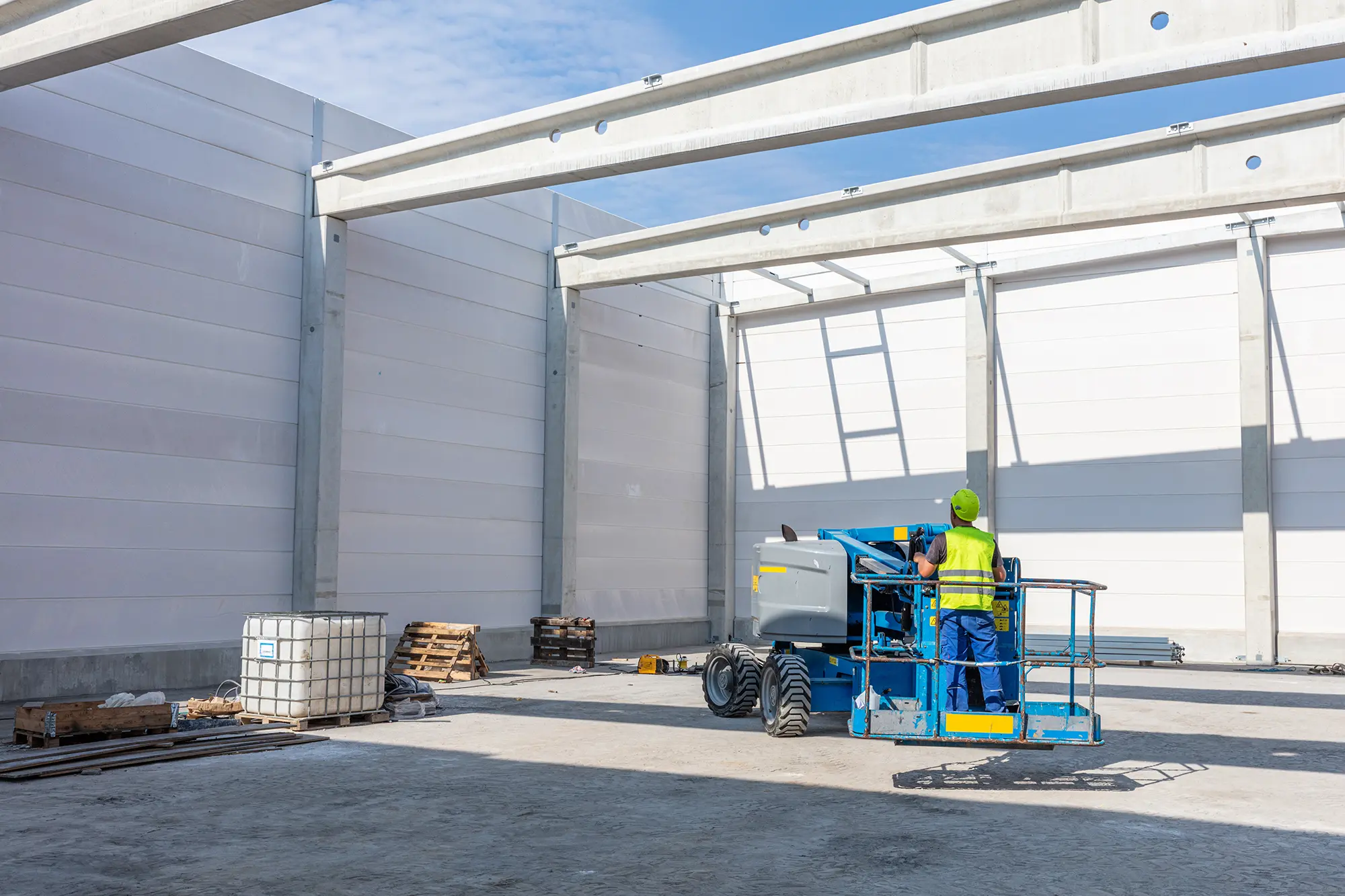
Comprehensive IMP installation includes: panel layout and shop drawing coordination, structural integration design, vapor barrier engineering, thermal break detailing at every penetration and structural connection, panel-to-panel sealing with appropriate sealants for operating temperature, ceiling-to-wall transition detailing, slab-to-wall transition detailing, dock door frame integration, mechanical penetration sealing, fire-rated transitions where required, and post-installation thermal mapping. Hanging panels is the easiest part. The detailing and integration work determines whether the envelope holds for 30 years or fails in 3.
Do you remove and dispose of old IMP for retrofit projects?
Yes — for retrofit projects, IMP removal and disposal is part of the scope. Old IMP typically contains polyurethane or polyisocyanurate insulation cores that may have specific disposal requirements depending on age and refrigerant content (some older panels were manufactured with refrigerants now restricted). We coordinate proper disposal through licensed waste handlers, with documentation of disposal for environmental compliance.
What's the typical IMP installation timeline?
IMP installation timeline depends on facility size and complexity. For typical cold storage projects: 30,000 SF facility runs 4–6 weeks of IMP installation; 60,000 SF runs 6–9 weeks; 100,000 SF runs 9–14 weeks; 150,000+ SF runs 14–20 weeks. These timelines include layout, fabrication coordination, installation, sealing, and quality verification. Multi-zone facilities with complex zone-to-zone wall systems run longer than single-zone facilities of equivalent square footage.
What can go wrong with IMP installation?
The most common IMP installation failures: vapor barrier discontinuities at panel joints (allowing moisture migration into insulation cores), inadequate thermal break detailing at structural connections (creating localized condensation and frost), poor sealing at ceiling-to-wall transitions (the most common condensation location in cold storage), incorrect sealant selection for operating temperature (sealants rated for ambient applications fail at frozen temperatures), and panel damage during installation that's not properly repaired. Most failures show up within 6–24 months as condensation, frost development, or visible insulation degradation.