Ammonia (NH3) Refrigeration Systems for Cold Storage

Ammonia (NH3, R-717) is the industrial workhorse refrigerant for cold storage. It's the most thermodynamically efficient industrial refrigerant available, has zero ozone depletion potential and zero global warming potential, and has been used in industrial refrigeration for over 130 years. The trade-offs are toxicity at elevated concentration and regulatory complexity under IIAR-2, IIAR-9, ANSI/ASHRAE 15, and OSHA PSM at threshold quantities.

By US Cold Storage Builders Engineering Team
📅 Now booking 60–90 days out | Call (346) 676 - COLD
Performance IndexUpdated quarterly
30+ yr
Compressor Service Life
10,000 lb
OSHA PSM Threshold
25 ppm
ANSI/ASHRAE 15 Exposure Limit
Refrigeration

Why ammonia, how it's engineered, and what regulation requires.

Why Ammonia

Six reasons ammonia is the industrial standard.

Ammonia refrigeration dominates large-scale cold storage for specific reasons: thermodynamic efficiency, no GWP/ODP, equipment service life, heat recovery integration, mature supply chain, and low refrigerant cost. Over the 25-year operational life of an industrial plant, ammonia's efficiency advantage compounds rapidly.

  • Thermodynamic efficiency — 10–20% higher COP than HFC alternatives
  • No GWP/ODP — favored under HFC phase-down regulations (AIM Act, CARB, EU F-gas)
  • Service life — 30+ years for properly maintained compressors
  • Heat recovery — 60–80% of building heat offset possible
  • Mature supply chain — trade, parts, technicians widely available
  • Low refrigerant cost — $0.50–$1/lb vs $25–$50/lb HFC
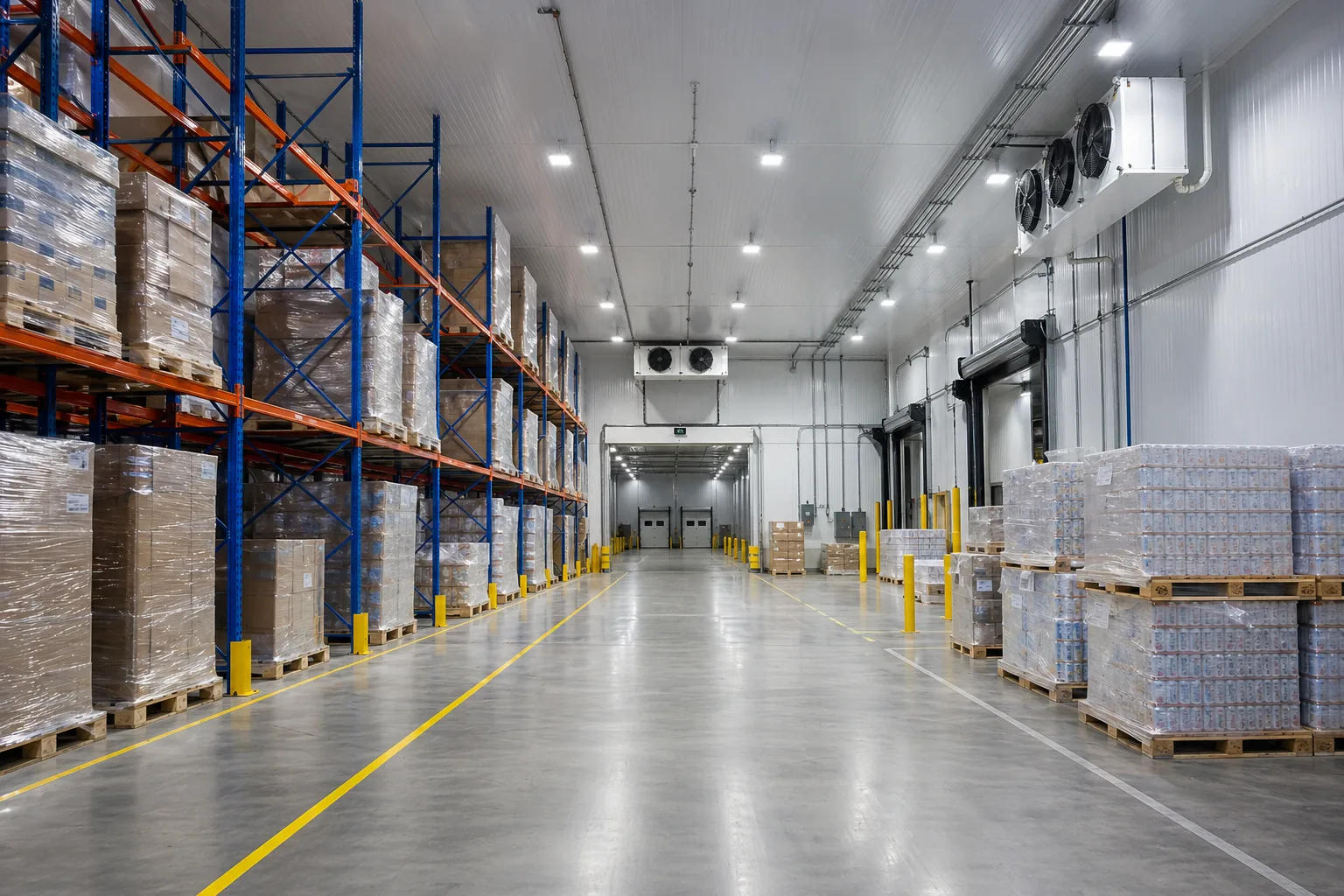
Refrigerated warehouse interior served by industrial ammonia refrigeration plant
Architecture

Centralized plant + distributed evaporators.

Standard for industrial cold storage. Compressor plant in a dedicated mechanical room. Refrigerant piping distributes to evaporators throughout the facility. Condensers either rooftop or in dedicated condenser yard. For very large facilities (300,000+ SF) or multi-tenant operations, distributed plant architecture serves zones independently — failure of one plant affects only its zone.

  • Compressor packages — screw (industrial scale) or reciprocating (smaller)
  • High-side equipment — oil separator, oil cooler, oil recovery
  • Condensers — evaporative most common at industrial scale
  • Receiver — high-pressure refrigerant storage
  • Evaporators — ceiling-mount unit coolers, penthouse air handlers, plate coils
  • Refrigerant piping — welded steel pipe, properly sized for capacity
Ammonia compressor package in cold storage mechanical room
Compliance

IIAR-2, ANSI/ASHRAE 15, and OSHA PSM.

USCB designs and installs all ammonia systems to IIAR-2 standards. ANSI/ASHRAE 15 governs refrigerant safety classification (B2L), occupied space concentration limits (25 ppm 8-hour), and machinery room requirements. OSHA PSM (29 CFR 1910.119) applies above 10,000 lb refrigerant charge with 14 required programs.

  • IIAR-2 — design and installation standard for ammonia refrigeration
  • ANSI/ASHRAE 15 — refrigerant safety classification (B2L)
  • ANSI/ASHRAE 15 — 25 ppm occupied space concentration limit (8-hour)
  • OSHA PSM — applies above 10,000 lb refrigerant charge
  • OSHA PSM — 14 required programs (PHA, MI, EAP, training, etc.)
  • Machinery room — gas detection, emergency ventilation, restricted access
Operations team in ammonia refrigeration machinery room with PSM-compliant infrastructure
DX vs Pumped

Direct-expansion vs pumped recirculation

Direct-expansion (DX): Refrigerant expands directly in the evaporator. Simple. Lower refrigerant charge. Standard for smaller systems and DX condensing units.

Pumped recirculation: Liquid refrigerant pumped from receiver through evaporators at higher mass flow than required for cooling. Excess refrigerant returns to receiver as wet vapor. Better evaporator utilization. Larger refrigerant charge. Standard for large industrial systems.

Pumped recirculation is more efficient at industrial scale. DX systems are sometimes specified for retrofits or applications where reduced refrigerant charge is preferred.

Compressors

Screw vs reciprocating

Screw compressors

Standard for industrial ammonia refrigeration at scale.

  • High capacity per unit (100–1,500+ tons per compressor)
  • Smooth operation, low vibration
  • Efficient at partial load
  • Long service life (30+ years with maintenance)

Manufacturers: Vilter, FES Systems (Sabroe parent), GEA, Mycom, York/Frick (Johnson Controls), Howden.

Reciprocating compressors

Standard for smaller ammonia systems or specific applications.

  • Lower capital cost than screw at smaller sizes
  • Higher efficiency at certain operating conditions
  • Simpler service requirements

Manufacturers: Vilter, Carlyle, York/Frick.

Sizing

Compressor sizing methodology

  1. Calculate design load per ASHRAE Refrigeration Handbook
  2. Determine redundancy level — N+1 standard for frozen; N+2 for critical
  3. Total capacity = design load × (1 + redundancy factor)
  4. Match capacity ranges — compressors operate efficiently in 25–100% range
  5. Smaller multiple compressors stage more efficiently than single large

Example: 150,000 SF frozen DC, 600-ton design load, N+1 redundancy. Total capacity 720 tons. Possible configurations: 3 × 240 ton screws + 1 × 240 ton standby, OR 4 × 180 ton screws (3 active + 1 standby), OR 2 × 360 ton screws + 1 × 240 ton variable.

IIAR-2

IIAR-2 compliance scope

IIAR-2 (Standard for Ammonia Refrigeration Systems) is the design and installation standard for ammonia refrigeration systems. Published by the International Institute of Ammonia Refrigeration (IIAR), adopted by reference in most US jurisdictions.

IIAR-2 covers:

  • Mechanical integrity requirements for piping, vessels, and equipment
  • Pressure relief device specifications
  • Refrigerant containment
  • Emergency ventilation
  • Safety devices and alarms
  • Operating and maintenance documentation requirements
  • Inspection and testing protocols

USCB designs and installs all ammonia systems to IIAR-2 standards.

OSHA PSM

Process Safety Management — 14 program elements

OSHA 29 CFR 1910.119 (Process Safety Management of Highly Hazardous Chemicals) applies to ammonia refrigeration systems with refrigerant charge above 10,000 lb.

  1. Process Safety Information
  2. Process Hazard Analysis (PHA) — repeated every 5 years
  3. Operating Procedures
  4. Training (initial and refresher)
  5. Contractor Management
  6. Mechanical Integrity Program
  7. Hot Work Permits
  8. Management of Change
  9. Incident Investigation
  10. Emergency Action Plan
  11. Compliance Audits
  12. Trade Secrets
  13. Employee Participation
  14. Documentation Maintenance

PSM compliance adds significant operational overhead — but it's manageable. USCB provides PSM documentation and procedures as part of project handoff for systems above threshold.

When to Specify

Strong fit vs marginal vs poor fit

Strong fit: Frozen storage at 0°F to -10°F, sub-zero applications, large refrigerated facilities (100,000+ SF), heat recovery integration, HFC phase-down jurisdictions, single-tenant operations.

Marginal fit: 30,000–80,000 SF facilities (DX or CO2 sometimes more economical), mid-size 3PL multi-tenant operations, facilities in restrictive ammonia jurisdictions.

Poor fit: Walk-in coolers and freezers, refrigerated facilities in heavy multi-tenant urban environments, facilities in jurisdictions with strict ammonia exclusions.

Build With Us

Tell us about your project

Tell us about your cold storage project — facility size, operating temperature, jurisdiction, regulatory considerations. We design and install ammonia refrigeration systems to IIAR-2 and OSHA PSM standards. Houston-headquartered · Design-build · Nationwide.

Budgeting

Cost and timeline planning ranges.

$0.50–$1/lb

Ammonia Refrigerant

vs $25–$50/lb HFC blends

30+ years

Compressor Service Life

Properly maintained screw/recip

10,000 lb

PSM Threshold

OSHA 29 CFR 1910.119 trigger

18–26 wk

Compressor Lead Time

Q1 2026

2,000–4,000 hr

Routine Service Interval

Manufacturer-specific

8,000–12,000 hr

Major Service Interval

Manufacturer-specific

Services

Cold Storage Solutions, End to End

❄️ Cold Storage🧊 Blast Freeze🏗️ New Build🔧 Retrofit🌡️ Multi-Temp💊 Pharma-Grade📦 3PL Warehouses
FAQ

Common Questions

Why is ammonia the standard for industrial cold storage?

Three reasons: thermodynamic efficiency (10–20% higher COP than HFC alternatives), zero GWP/ODP (favored under HFC phase-down regulations), and long equipment service life (30+ years). Trade-offs: toxicity at elevated concentration, regulatory complexity (IIAR-2, OSHA PSM above threshold).

What's the threshold for OSHA PSM with ammonia?

10,000 lb ammonia refrigerant charge. Below threshold, PSM doesn't apply. Above threshold, full PSM program required including process hazard analysis, mechanical integrity program, emergency action plan, and 11 additional regulatory elements. USCB provides PSM documentation as part of project handoff.

What's IIAR-2?

IIAR-2 is the Standard for Ammonia Refrigeration Systems published by the International Institute of Ammonia Refrigeration. It covers design, installation, and mechanical integrity requirements for ammonia refrigeration systems. Adopted by reference in most US jurisdictions; USCB designs and installs all ammonia systems to IIAR-2.

Is ammonia safe?

Ammonia is toxic at elevated concentration but has a strong characteristic smell at very low concentrations (~5 ppm), well below the occupational exposure limit (25 ppm 8-hour). With proper system design (containment, gas detection, emergency ventilation, restricted access to machinery rooms), industrial ammonia refrigeration has an excellent safety record.

What's the difference between direct-expansion ammonia and pumped recirculation?

Direct-expansion: refrigerant expands directly in the evaporator. Simpler, lower refrigerant charge. Standard for smaller systems. Pumped recirculation: liquid refrigerant pumped through evaporators at higher mass flow than required for cooling. Better evaporator utilization, higher efficiency, larger refrigerant charge. Standard for large industrial systems.

Can ammonia refrigeration be in occupied space?

Yes, with proper engineering. Safety infrastructure: gas detection, emergency ventilation, restricted access during alarm, evacuation procedures, refrigerant containment design. For applications where ammonia in occupied space is restricted (some multi-tenant operations, certain jurisdictions), glycol secondary loop keeps ammonia in machinery room.

What size facility justifies ammonia refrigeration?

Generally 30,000+ SF for new ground-up construction. Below that, DX with HFC blends is typically more economical. Above 50,000 SF, ammonia almost always wins on operating cost. Above 100,000 SF, ammonia is essentially the standard specification.

How long do ammonia compressors last?

30+ years for properly maintained screw and reciprocating compressors. Service intervals typically 2,000–4,000 hours for routine maintenance, 8,000–12,000 hours for major service. Long equipment life is one of the main lifecycle cost advantages of ammonia systems.

Field Log· Houston · 29.66°N · 95.47°WOperating Range−40°F → 70°F · ±0.5°FR-Value30–60 IMP
Call UsRequest a Quote