Refrigeration Controls & BMS for Cold Storage

A refrigeration plant is only as good as its controls. The same hardware can run 15–30% more efficiently with well-tuned controls vs poorly tuned. Modern BMS-integrated controls handle variable-speed compressor and fan control, condensing pressure optimization, heat recovery, remote monitoring with alarm dispatch, continuous temperature logging for HACCP and pharma validation, and sub-metered energy reporting.

By US Cold Storage Builders Engineering Team
📅 Now booking 60–90 days out | Call (346) 676 - COLD
Performance IndexUpdated quarterly
15–30%
Energy Reduction vs Untuned Controls
2–4 yr
VFD Payback (typical)
60–80%
Heat Recovery Offset (cold climates)
Refrigeration

Capacity matching, pressure optimization, heat recovery, monitoring, logging.

Capacity Matching

Variable-speed control matches capacity to actual load.

Default on/off compressor and fan control wastes energy when actual load is below design point — which is most operating hours. VFD control varies motor speed to match actual load. Result: less cycling, smoother operation, lower part-load energy. Applies to compressors, condenser fans, evaporator fans, glycol pumps, and CO2 transcritical gas cooler fans.

  • VFD compressors — capacity continuously variable
  • Variable-speed condenser fans — match condenser airflow to load
  • Variable-speed evaporator fans — match airflow to refrigeration demand
  • Variable-speed glycol pumps — match flow to actual loop demand
  • Payback typically 2–4 years through energy savings
Refrigeration controls panel with VFDs and BMS interface in mechanical room
Pressure Optimization

Floating head pressure cuts compressor work.

Default controls hold condensing pressure constant year-round. Optimized controls lower condensing pressure when ambient allows (cool weather), reducing compressor work proportionally. Modern refrigeration controls handle this automatically with floating head pressure logic that respects minimum pressure constraints for proper expansion valve operation. Energy savings 10–20% in moderate climates.

  • Floating head pressure — lowers condensing in cool weather
  • Respects minimum pressure constraints for expansion valve operation
  • Automatic — no operator intervention required
  • 10–20% compressor energy savings in moderate climates
  • Pairs with variable-speed condenser fans for compounded savings
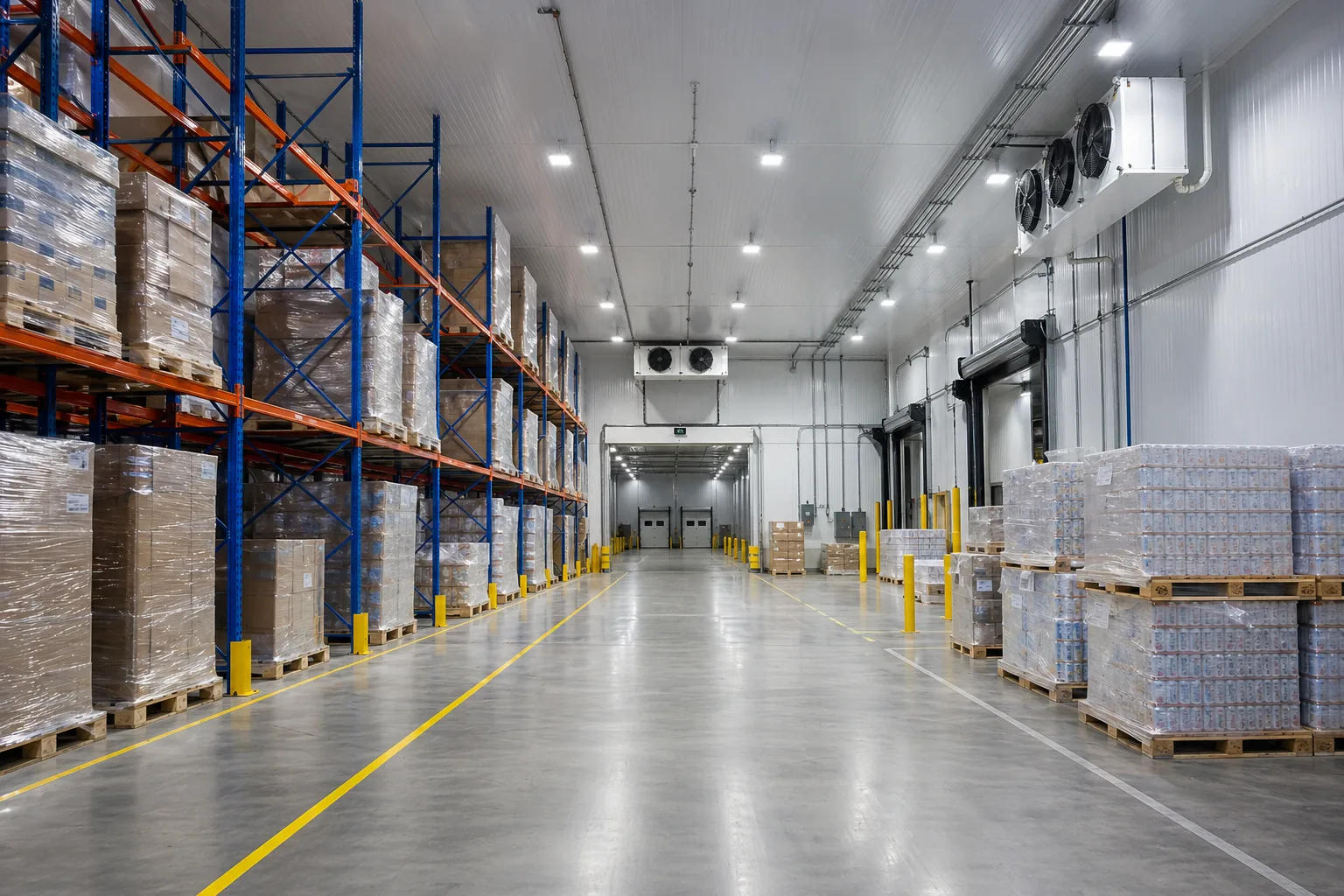
Refrigerated warehouse interior with BMS-controlled refrigeration system
Heat Recovery

Use condenser heat instead of rejecting it.

Condenser heat is normally rejected to the outdoors. Heat recovery captures it for productive use — underslab heat loop for freezer slabs (preventing frost heave), building heat (offsetting natural gas), hot water (process or sanitary), or process heat. In cold climates, recovered heat can offset 60–80% of building heat requirements. Ammonia systems are particularly well-suited to heat recovery.

  • Underslab heat loop — uses recovered heat to prevent frost heave
  • Building heat — offsets natural gas use
  • Hot water — process or sanitary
  • Process heat — for food processing, manufacturing
  • 60–80% building heat offset possible in cold climates
Underslab heat loop integrated with refrigeration heat recovery
Monitoring

Remote monitoring and alarm dispatch

BMS connects to a cloud platform that authorized operators access from anywhere. Alarms dispatch via SMS, email, or phone. Trends and reports available remotely. Service vendors can diagnose issues remotely before dispatching a tech.

Standard alarm conditions:

  • High temperature alarm at each zone
  • Low temperature alarm (where applicable)
  • Door open too long alarm
  • Refrigerant leak detection alarm
  • Power failure alarm
  • Communication failure alarm
  • Compressor failure alarm
  • Pump failure alarm
  • Generator transfer alarm (if backup power)
Logging

HACCP and pharma-validated logging

Continuous temperature logging at defined intervals (typically 5–15 minutes), data retention for the required period (typically 2+ years), tamper-evident records, and ability to generate reports on demand.

For pharma applications, logging extends to:

  • Validated sensor calibration (NIST-traceable)
  • Audit trails (who changed what, when)
  • 21 CFR Part 11 compliance (electronic records and signatures)
  • DQ/IQ/OQ/PQ validated logging system
  • Reports formatted for regulatory submission
BMS Platforms

Common BMS platforms

  • Honeywell. Niagara Framework, WEBs-N4, Tridium ecosystem. Common in larger facilities.
  • Johnson Controls. Metasys, Verasys. Strong in healthcare and pharma.
  • Siemens. Desigo CC. Common in industrial and process applications.
  • Schneider Electric. EcoStruxure Building Advisor.
  • Danfoss. AK-SM 800, refrigeration-specific platform.
  • CPC (Computer Process Controls). E2/E3 platform; common in supermarket and cold storage refrigeration.

USCB integrates refrigeration with owner's existing BMS platform or specifies new BMS in pre-construction.

Sub-Metering

Sub-metered energy monitoring

Sub-metered energy monitoring breaks total facility energy down by system: refrigeration (compressors, condensers, evaporator fans), lighting, dock equipment, office. Granularity at the system level enables operators to identify drift, benchmark against design, and verify the impact of operational changes.

Sub-metering is cheap relative to its value. Standard specification on new USCB builds; common retrofit upgrade.

Upgrade Path

Controls upgrades for existing facilities

Common upgrade scenarios:

  • Legacy pneumatic controls → modern DDC (direct digital control)
  • On/off compressor control → VFD with capacity matching
  • Manual head pressure setpoint → floating head pressure optimization
  • Paper logs → BMS-integrated continuous logging
  • Local-only monitoring → remote monitoring with cloud platform
  • No sub-metering → sub-metered by system

Controls upgrades have some of the fastest payback periods in cold storage retrofits (1–3 years typical). High ROI relative to disruption.

Build With Us

Tell us about your controls scope

Tell us about your cold storage project — new construction or retrofit, existing BMS platform, monitoring requirements, HACCP/pharma validation needs. We design and integrate refrigeration controls and BMS. Houston-headquartered · Design-build · Nationwide.

Budgeting

Cost and timeline planning ranges.

15–30%

Tuned-vs-Untuned Energy

Same hardware, controls difference

2–4 yr

VFD Payback (typical)

Through part-load energy savings

10–20%

Floating Head Pressure Savings

Moderate climates

60–80%

Heat Recovery Offset

Building heat in cold climates

5–15 min

HACCP Logging Interval

Continuous, tamper-evident

21 CFR Part 11

Pharma Logging

Validated, audit-trail, calibrated

1–3 yr

Controls Retrofit Payback

Typical for existing facility upgrade

Services

Cold Storage Solutions, End to End

❄️ Cold Storage🧊 Blast Freeze🏗️ New Build🔧 Retrofit🌡️ Multi-Temp💊 Pharma-Grade📦 3PL Warehouses
FAQ

Common Questions

Why do refrigeration controls matter?

Refrigeration controls determine whether the facility runs efficiently in actual operating conditions — not just at design point. A well-tuned controls system reduces operating energy 15–30% vs poorly tuned controls on the same hardware. Controls also drive alarm response, HACCP/validated documentation, and operator visibility into system health.

What is a BMS?

Building Management System — the central platform that monitors and controls refrigeration, lighting, HVAC, alarms, and other building systems. Refrigeration controls integrate with the BMS so refrigeration data appears alongside other building data, and refrigeration responds to facility-wide events (after-hours, emergency conditions, etc.). Common platforms: Honeywell, Johnson Controls, Siemens, Schneider Electric, and refrigeration-specific platforms like Danfoss and CPC.

What's variable-speed compressor control?

VFD-controlled compressors match capacity to actual load by varying motor speed, instead of staging on/off. Result: less cycling, smoother operation, lower energy at part-load (which is most operating hours). VFD payback typically 2–4 years through energy savings.

What's condensing pressure optimization?

Default refrigeration controls hold condensing pressure constant at design point regardless of ambient. Optimized controls lower condensing pressure when ambient allows (cool weather), reducing compressor work proportionally. Modern controls do this automatically with floating head pressure logic. Energy savings 10–20% in moderate climates.

What's heat recovery?

Condenser heat is normally rejected to the outdoors. Heat recovery captures it for productive use — underslab heat loop for freezer slabs (preventing frost heave), building heat (offsetting natural gas), hot water (process or sanitary), or process heat. Can offset 60–80% of building heat requirements in cold climates.

What's required for HACCP-compliant logging?

Continuous temperature logging at defined intervals (typically 5–15 minutes), data retention for the required period (typically 2+ years), tamper-evident records, and ability to generate reports on demand. Modern BMS systems handle this automatically. For pharma applications, requirements extend to validated logging with calibrated sensors, audit trails, and 21 CFR Part 11 compliance.

How does remote monitoring work?

BMS connects to a cloud platform that authorized operators access from anywhere. Alarms dispatch via SMS, email, or phone. Trends and reports available remotely. Service vendors can diagnose issues remotely before dispatching a tech. Reduces operating overhead and accelerates problem resolution.

Can existing facilities be upgraded with modern controls?

Yes. Common upgrade scenarios: legacy pneumatic controls → modern DDC, on/off compressor control → VFD, manual head pressure → floating optimization, paper logs → BMS-integrated logging. Controls upgrades have some of the fastest payback periods in cold storage retrofits (1–3 years typical).

Field Log· Houston · 29.66°N · 95.47°WOperating Range−40°F → 70°F · ±0.5°FR-Value30–60 IMP
Call UsRequest a Quote