1. Cam-lock under-engagement
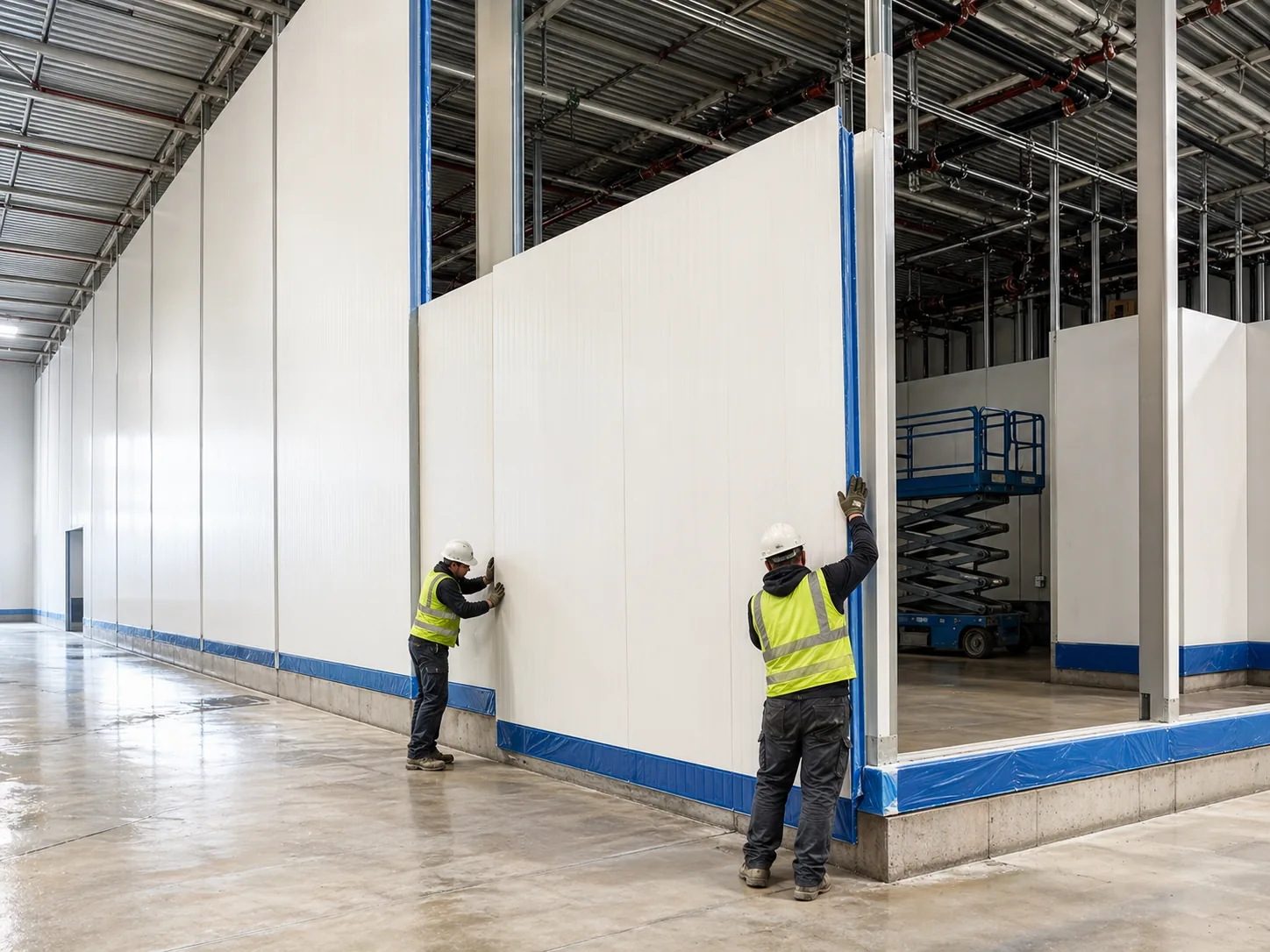
Cam-lock joints pull adjacent panels together with eccentric cam hardware. Failure mode is incomplete engagement — the cam doesn't rotate fully, the panels don't pull tight, and the vapor seal at the joint is compromised. The failure is invisible from inside the panel and only becomes apparent when condensation forms in the joint cavity. Prevention: crew training on cam-lock engagement, joint inspection during install with verification logs, and joint pull-test on a sample basis. USCB's self-perform crews are trained on cam-lock verification per panel system; subcontractor crews variable.
2. Vapor barrier discontinuity
IMP panels include integrated vapor barriers in the steel facing. Continuity at panel joints, at structural transitions (where panel meets steel column or beam), at roof-to-wall joints, and at MEP penetrations is the critical detail. Discontinuity allows moisture to migrate from warm side to cold side, accumulate in insulation, and progressively degrade R-value. Prevention: continuous-vapor-barrier specification on all transitions, vapor barrier tape at panel-to-structural connections, sealed boots at every penetration, and verification with thermography or pressure testing during commissioning.
3. Penetration foam-and-flash failure
Pipes, conduits, ducts, and refrigeration lines penetrate the IMP envelope. Each penetration must be foam-sealed at the panel core, then flashed at the steel facing both sides. Common failures: foam not fully filling the gap, flashing not lapping properly, sealants applied to dirty or wet surfaces. Prevention: written penetration detail per panel system, daily QC inspection of penetrations, photo documentation, and field training of crews on standard details.
4. Thermal bridging at fasteners
Steel fasteners that pass through the panel conduct heat from warm to cold side, causing localized condensation on the cold-side facing. Symptom is condensation streaking visible as a pattern below ceiling fasteners or beside wall fasteners. Prevention: thermal-break fasteners in cold storage applications, fastener pattern designed to minimize count, and avoiding face-fastening where concealed fastening is acceptable.
5. Field-cut edge sealing
Door openings, MEP penetrations, and field-modified panels expose the panel core to moisture. Unsealed cut edges absorb moisture, expand, and progressively delaminate. Prevention: written field-cut detail with edge sealing requirement, sealant specification per panel core, and inspection of every field cut before structural or finish work covers it.
Quality control as a system
Each failure mode is preventable individually. The challenge is consistent execution across thousands of installation points. USCB's self-perform model uses written QC protocols, daily inspection logs, photo documentation, and crew training that is refreshed per panel system. The premium on labor cost partially reflects this QC infrastructure.