Vapor Barrier Systems in Cold Storage Construction

Vapor barrier is the system that determines whether the cold storage envelope performs for 30 years or fails in 3. In any cold storage facility, water vapor moves continuously from warm side toward cold side. If vapor reaches the cold face of the insulation, it condenses inside the panel — saturating foam, reducing R-value, starting corrosion, and progressively destroying the envelope. The vapor barrier prevents this. A 99% effective vapor barrier is not a 1% problem; it's a 100% problem at the 1% location.

By US Cold Storage Builders Engineering Team
📅 Now booking 60–90 days out | Call (346) 676 - COLD
Performance IndexUpdated quarterly
5 locations
Where Vapor Barriers Fail
18 mo–5+ yr
Failure Timeline to Catastrophic
30+ yr
Service Life Properly Installed
Specifications

Vapor barrier integrity determines envelope life.

Function

Block vapor migration into the insulation.

Water vapor diffuses from warm side to cold side continuously through any permeable material. In cold storage, the warm-to-cold vapor pressure differential runs 24/7 for the life of the building. Vapor that reaches the cold face condenses, often freezes, and destroys the envelope from the inside out.

  • Block vapor migration into insulation
  • Prevent condensation inside the envelope assembly
  • Maintain insulation R-value over time
  • Prevent structural corrosion at panel facings
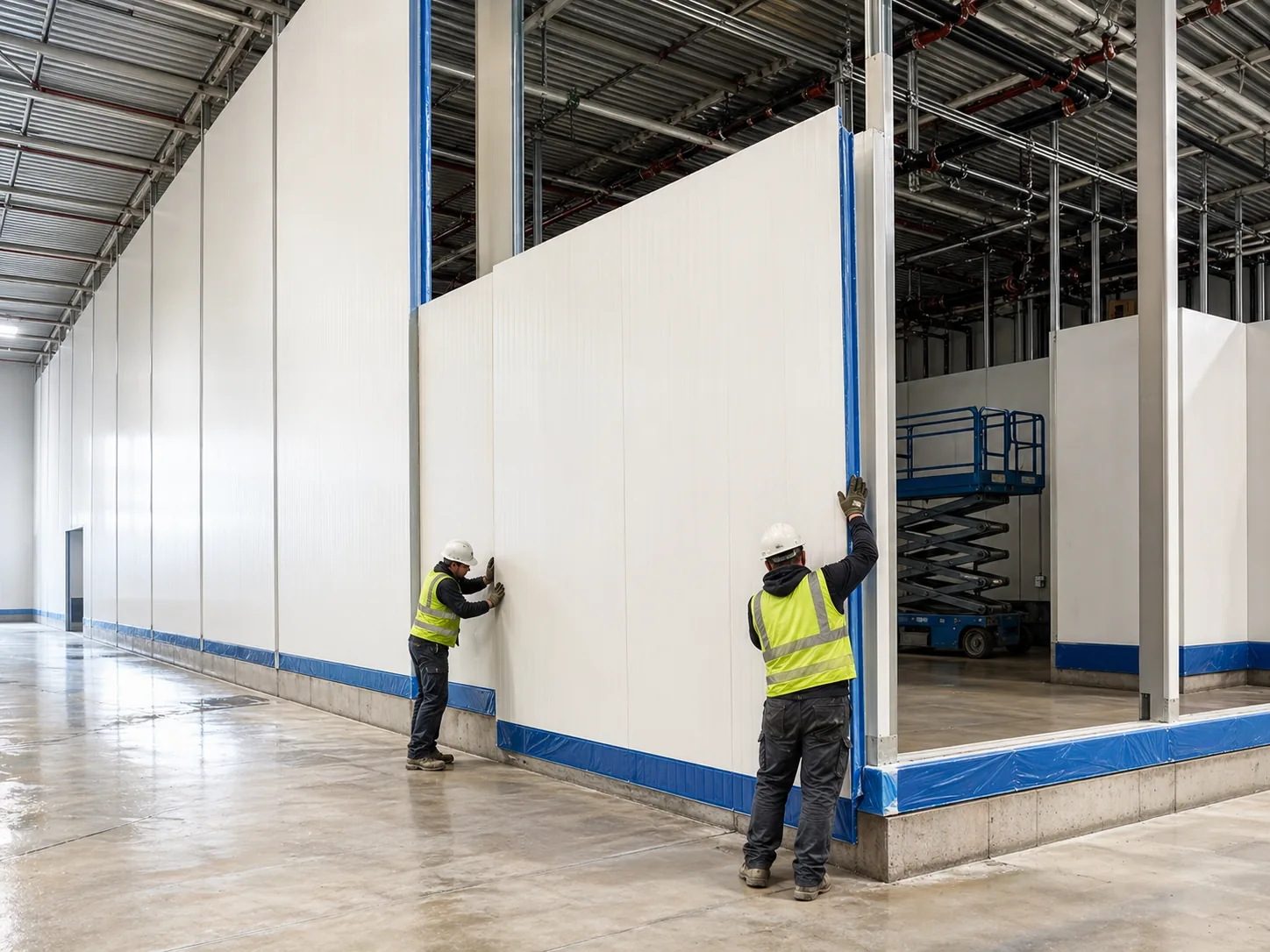
IMP wall section showing vapor barrier integration at panel joint
Drive Mechanism

Vapor diffusion + air leakage — both must be blocked.

Vapor moves through assemblies by two mechanisms: diffusion through material permeability (slow but continuous) and air leakage through discontinuities (faster and more concentrated). A continuous vapor barrier addresses both — low-permeability material plus sealed joints and penetrations.

  • Diffusion: slow, continuous, driven by vapor pressure differential
  • Air leakage: faster, concentrated at any unsealed discontinuity
  • Continuous vapor barrier addresses both mechanisms
  • Higher temperature differential = stronger driving force
Cold storage construction showing IMP wall with vapor barrier path integration
Continuity

Five failure-risk locations need engineered detail.

Vapor barriers fail at specific discontinuities: panel joints, penetrations, wall-to-floor and wall-to-roof transitions, corner conditions, and fastener penetrations. USCB's sealing protocol covers all five with documented QC verification at every location.

  • Panel joints (cam-lock engagement, sealant verification)
  • Penetrations (refrigeration, electrical, fire, HVAC, doors)
  • Wall-to-floor and wall-to-roof transitions
  • Inside and outside corner conditions
  • Fastener penetrations through panel facings
Refrigerated warehouse interior showing completed vapor barrier system in service
Function

What vapor barrier does

Vapor barrier is a continuous moisture barrier installed on the warm side of cold storage insulation. Its function:

Block water vapor migration into the insulation. Water vapor diffuses through most building materials at rates determined by temperature differential, humidity, and material vapor permeability. In cold storage, vapor concentration is high on the warm side and low on the cold side, creating continuous diffusion driving force. Without an effective vapor barrier, vapor reaches the cold face of insulation, condenses to liquid water, and accumulates.

Prevent condensation inside the envelope assembly. Liquid water inside the IMP foam core is the start of every major envelope failure mode — foam saturation, panel delamination, structural corrosion, mold growth, and progressive R-value loss.

Maintain insulation R-value over time. Foam insulation R-value depends on dry foam matrix. Water absorption reduces R-value (water is a relatively good conductor compared to foam). A 2% increase in foam moisture content can reduce R-value by 5–10%.

Prevent structural corrosion. Liquid water in contact with steel facings of IMP causes long-term corrosion that propagates outward from initial contact points. Corrosion eventually compromises panel structural integrity.

Drive Mechanism

Vapor drive mechanism

Water vapor moves through building materials by two mechanisms:

1. Vapor diffusion — vapor molecules move from areas of high vapor pressure to areas of low vapor pressure through material permeability. Slow but continuous. In cold storage, the diffusion driving force is significant because vapor pressure differential between warm and cold sides is large.

2. Air leakage — bulk air carrying vapor moves through any discontinuity in the air barrier (cracks, gaps, unsealed joints, unsealed penetrations). Faster than diffusion and more concentrated. Air leakage is responsible for most vapor barrier failures.

A continuous vapor barrier addresses both mechanisms — it blocks diffusion (low-permeability material) and seals air leakage paths (continuous installation with sealed joints and penetrations).

Vapor pressure differential by operating temperature

Operating TemperatureAmbient (75°F, 50% RH)Vapor Pressure Differential
50°F refrigeratedLow differentialModest driving force
35°F refrigeratedModerate differentialContinuous driving force
0°F frozenHigh differentialStrong continuous driving force
-10°F frozenHigh differentialStrong continuous driving force
-20°F deep frozenVery high differentialSevere continuous driving force
-40°F blast freezerExtreme differentialSevere continuous driving force

Higher temperature differential means more vapor driving force and faster failure if vapor barrier integrity is compromised.

Materials

Vapor barrier materials

Three categories of vapor barrier materials are used in cold storage construction:

Factory-applied (IMP integral)

Modern cold storage IMP includes factory-applied vapor barrier integrated with the panel facings:

  • Painted steel facings themselves serve as vapor barriers (very low permeability)
  • Factory-applied sealants at cam-lock joint geometry (typically butyl tape or polyurethane)
  • Factory-applied membrane wraps at certain joint configurations

The factory-applied system is the first line of defense. Quality varies by panel manufacturer — Kingspan, Metl-Span, and other major suppliers all have well-engineered joint sealants. Cheaper panels may have less robust factory sealing.

Field-applied sealants

At every panel joint, every penetration, and every transition, field-applied sealants supplement or extend the factory-applied vapor barrier.

Sealant TypeApplication
Butyl tapeVapor seal at cam-lock joints; behind interior trim; at panel-to-floor transitions
Polyurethane sealant (non-curing)General-purpose vapor seal; remains flexible over thermal cycling
Silicone sealantHigh-temperature applications; at heat-affected transitions
Polyethylene vapor membraneWraps at penetrations; sheet behind trim; sub-slab vapor barrier
Closed-cell spray foamPenetration fill; provides vapor barrier and thermal break in one application
Foil-faced vapor membraneHigh-permeability resistance applications; specialty trim

Sub-slab vapor barrier

Polyethylene vapor barrier above sub-slab insulation, sealed at all penetrations and edges. Prevents ground moisture migration from below into insulation and slab.

Standard specifications:

  • 10-mil polyethylene minimum
  • 15-mil preferred for sub-zero applications
  • Minimum 6" overlap at seams with seam taping
  • Sealed at all penetrations (column footings, drains, utilities)
  • Continuous coverage across full slab footprint
  • Lapped onto edge insulation at perimeter
Failure-Risk Locations

Where vapor barriers fail

Vapor barriers don't fail uniformly. They fail at specific discontinuities — and those are the places that compromise envelope life.

Panel joints

The cam-lock or tongue-and-groove joint geometry is engineered for vapor seal, but improper engagement compromises the seal:

  • Partial cam engagement (cam not fully rotated)
  • Damaged cam during installation
  • Sealant gap due to misaligned panels
  • Field cuts not properly resealed
  • Sealant aging over decades

USCB QC includes visual verification of every cam engagement and joint sealant.

Penetrations

Every wall and ceiling penetration is a vapor barrier discontinuity unless specifically sealed:

  • Refrigeration piping penetrations
  • Electrical conduit penetrations
  • Fire protection piping penetrations
  • HVAC duct penetrations
  • Personnel door penetrations
  • Overhead door penetrations

Standard USCB penetration sealing protocol: high-density foam fill on warm side, vapor membrane wrap on warm side, flashed exterior collar, in-process inspection.

Wall-to-floor transitions

The transition from wall IMP to floor slab is a major failure-risk location. Standard detail:

  • Continuous vapor seal between wall panel and slab
  • Floor slab vapor barrier lapped upward onto wall panel
  • Sealed at slab edge insulation interface
  • Inspected before close-out

Wall-to-roof transitions

Similar to wall-to-floor. Continuous vapor seal between wall panel and roof/ceiling assembly. Thermal break detail at the transition.

Corner conditions

Inside and outside corners of the IMP envelope are vapor seal complexity points:

  • Inside corners: double-gasket cam-lock detail for sub-zero applications
  • Outside corners: continuous sealant and trim detailing
  • Corner sealants verified before close-out

Fastener penetrations

Every fastener that penetrates the IMP facing is a vapor barrier discontinuity:

  • Through-fasteners with washers and sealants
  • Concealed fasteners where possible
  • Field-applied sealant at any field-installed fasteners
Failure Stages

Vapor barrier failure modes

When vapor barrier fails, the failure progresses through specific stages:

Stage 1: Vapor migration

Vapor enters the assembly through the discontinuity. Initially undetectable — vapor concentrations are low and material is dry.

Stage 2: Condensation

As vapor reaches cold-side surfaces inside the assembly, it condenses to liquid water. Initial condensation is small volume but continuous.

Stage 3: Accumulation

Liquid water accumulates inside the foam core. R-value begins to drop measurably. Refrigeration load begins to climb. Not yet visibly apparent.

Stage 4: Visible symptoms

After months to years (depending on failure rate and operating temperature):

  • Condensation visible on warm-side surfaces near the failure point
  • Paint blistering
  • Localized cold spots on warm-side finishes
  • Frost or ice on cold-side surfaces (in extreme cold applications)
  • Stain marks at panel joints

Stage 5: Structural damage

Sustained moisture exposure causes:

  • Foam delamination from facings
  • Steel facing corrosion
  • Structural fastener degradation
  • Panel deflection or sagging
  • Eventually, panel structural failure

Stage 6: Catastrophic failure

In severe cases, panels fail structurally or thermally, requiring emergency replacement and operational disruption.

Timeline from initial vapor migration to catastrophic failure: 18 months to 5+ years. Earlier in applications with high temperature differential (blast freezers); later in moderate applications (refrigerated warehouses).

Specifications

Vapor barrier specifications by application

ApplicationWall SystemField SealantsPenetration Detail
Refrigerated 34°F–55°FFactory IMP + cam-lockButyl tape, polyurethaneStandard foam fill + vapor wrap
Frozen 0°F to -10°FFactory IMP + double-gasket cam-lockButyl tape, polyurethane, vapor membraneFoam fill + vapor wrap + flashed collar
Sub-zero -10°F to -40°FFactory IMP + double-gasket throughoutButyl tape, polyurethane, vapor membrane, additional sealant verificationFoam fill + vapor wrap + flashed collar + verified
Pharma 2°C–8°CCleanroom-grade IMPCleanroom-grade sealantsValidated sealing protocol
ULT -80°CSpecialty multi-layerSpecialty multi-layer sealantsSpecialty validated protocol
Commissioning

Commissioning vapor barrier performance

USCB commissioning includes vapor barrier verification:

1. Visual inspection at every panel joint, every penetration, every transition. Documented as completed.

2. Smoke pencil testing in critical zones — visible smoke pencil tracing along joints reveals air leakage paths.

3. Thermal imaging during pull-down — temperature anomalies on warm-side surfaces reveal vapor migration paths and thermal bridges.

4. Sustained-operation verification — facility operated for commissioning period (24–48 hours minimum) with temperature mapping. Any moisture migration produces detectable symptoms during this window.

5. As-built documentation — joint sealing, penetration sealing, and transition detailing documented with photographs and signed inspector verification.

Build with us

Tell us about your cold storage project. We engineer vapor barrier systems that don't fail in year 3. Houston-headquartered · Design-build · Nationwide.

Budgeting

Cost and timeline planning ranges.

Cam-lock + butyl/PU

Refrigerated 34°F–55°F

Standard foam fill + vapor wrap at penetrations

Double-gasket cam-lock

Frozen 0°F to -10°F

Vapor membrane + flashed collar

Double-gasket throughout

Sub-Zero -10°F to -40°F

Additional sealant verification

Cleanroom-grade

Pharma 2°C–8°C

Validated sealing protocol

Specialty multi-layer

ULT -80°C

Specialty validated protocol

10-15 mil

Sub-Slab Polyethylene

6" overlap, sealed seams + penetrations

Services

Cold Storage Solutions, End to End

❄️ Cold Storage🧊 Blast Freeze🏗️ New Build🔧 Retrofit🌡️ Multi-Temp💊 Pharma-Grade📦 3PL Warehouses
FAQ

Common Questions

What is a vapor barrier in cold storage construction?

A vapor barrier is a continuous moisture barrier installed on the warm side of cold storage insulation. Its function is to block water vapor migration from warm side (ambient or warmer interior) toward cold side. Without a continuous vapor barrier, vapor reaches the cold face of insulation, condenses inside the panel, and progressively destroys the envelope through foam saturation, corrosion, and R-value loss.

Why is vapor barrier continuity so important?

Vapor migration concentrates at any discontinuity. A vapor barrier that is 99% intact concentrates 100% of the failure at the 1% discontinuity. Localized vapor migration produces localized condensation, which produces localized panel saturation, which produces localized structural failure. The 1% location becomes the failure mode for the entire envelope assembly. Continuity isn't a quality goal — it's an envelope life requirement.

Where do vapor barriers typically fail?

At discontinuities — panel joints (improper cam engagement, damaged cams, sealant gaps), penetrations (refrigeration piping, electrical, fire protection, HVAC, doors), wall-to-floor and wall-to-roof transitions, corner conditions, and fastener penetrations. Standard USCB protocol includes specific sealing details at every one of these failure-risk locations, with QC verification at each.

How long do vapor barrier failures take to show?

18 months to 5+ years from initial vapor migration to catastrophic failure, depending on temperature differential and failure rate. Earlier in blast freezers and sub-zero applications; later in refrigerated warehouses. By the time symptoms are visible, significant damage has accumulated. Prevention at construction is the only economical approach.

What's the difference between vapor barrier and air barrier?

Vapor barrier blocks vapor diffusion through materials. Air barrier blocks bulk air movement through openings. In practice, modern IMP vapor barriers do both — the continuous polyethylene-faced or factory-sealed panel system blocks both mechanisms. Air leakage is the faster and more concentrated vapor transport mode; both barriers must work together.

Can vapor barrier failures be repaired?

Sometimes. Localized failures discovered early (visible condensation but no structural damage) can be re-sealed and the assembly monitored. Failures involving foam saturation or steel corrosion typically require panel replacement on the affected area. Replacement is expensive due to refrigeration disruption and integrated install requirements. Prevention is far less expensive than repair.

Do you guarantee vapor barrier performance?

Vapor barrier installation is covered under construction warranty. USCB commissioning includes thermal imaging and smoke pencil verification before turnover. After turnover, performance depends on owner maintenance (no impacts to panels, sealant integrity over decades, no operational damage). Modern IMP vapor barriers properly installed and maintained have 30+ year service life.

Field Log· Houston · 29.66°N · 95.47°WOperating Range−40°F → 70°F · ±0.5°FR-Value30–60 IMP
Call UsRequest a Quote