Insulated Metal Panel Systems for Cold Storage

Insulated metal panels (IMP) are the standard thermal envelope system for cold storage construction. A typical IMP is a sandwich panel: rigid foam insulation core bonded between two metal facings (typically painted steel), with shaped edges that engage adjacent panels through cam-lock or tongue-and-groove joints. Panel thickness, foam core type, facing material, joint geometry, and installation detailing all determine whether the envelope performs over the life of the building.

By US Cold Storage Builders Engineering Team
📅 Now booking 60–90 days out | Call (346) 676 - COLD
Performance IndexUpdated quarterly
4"–8"
Cold Storage Thickness Range
R-32 to R-64+
Effective R-Value
30–50 yr
Typical Service Life
Specifications

What insulated metal panels are.

Construction

Sandwich panel — facings, core, joint geometry.

Two metal facings (24-22 ga painted steel typical) bonded to a rigid foam insulation core (PUR, PIR, mineral wool, or EPS), with shaped edges that engage adjacent panels. Panel width 36" or 42" standard; length up to 60' for walls. Cold storage IMP is specified at greater thickness and tighter joint detail than generic commercial IMP.

  • Two metal facings, 24-22 ga painted steel typical
  • Rigid foam core: PUR, PIR, mineral wool, or EPS
  • Cam-lock or tongue-and-groove joint geometry
  • Width 36"–42", length up to 60'
  • Factory-applied sealants at certain joint configurations
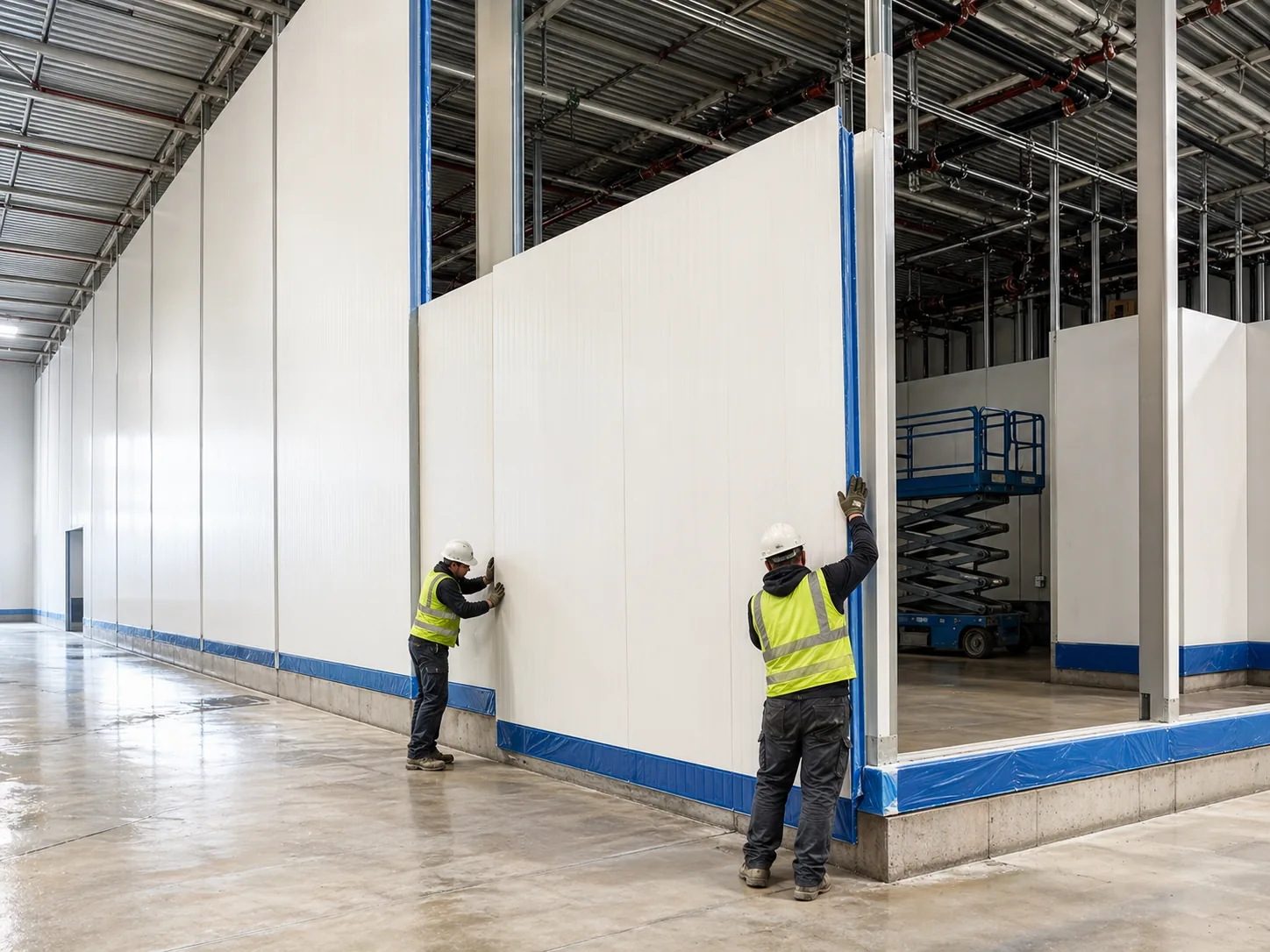
Insulated metal panel cross-section visible at field cut showing facing and foam core
Joints

Cam-lock joints — modern cold storage standard.

Each panel edge has a profile that engages adjacent panels through a rotating cam mechanism. Installer tools the cam to lock position, drawing the panels tightly together and compressing factory-applied sealant. Cam-lock provides tighter, more controlled compression than tongue-and-groove — repeatable, with visual engagement indicator.

  • Rotating cam draws panels into compression seal
  • Visual engagement indicator at every cam
  • Tongue-and-groove legacy joint still in some applications
  • Double-gasket cam-lock at sub-zero corner conditions
Cam-lock joint engagement at panel-to-panel seam during cold storage IMP install
Vapor Barrier

Vapor barrier continuity is the failure axis.

Vapor moves from warm side to cold side continuously below ambient. A 99% effective vapor barrier is not a 1% problem — it's a 100% problem at the 1% location. Vapor migration concentrates at any discontinuity and produces localized condensation, foam saturation, and corrosion that progresses outward over years.

  • Continuous on the warm side of insulation
  • Sealed at every panel joint, penetration, transition, fastener
  • Factory-applied sealants at cam-lock joints
  • Field-applied at penetrations and structural transitions
Cold storage interior showing IMP wall and ceiling continuous vapor seal detail
Panel Types

IMP panel types — PUR, PIR, mineral wool, EPS

Polyurethane (PUR) Core

The most common cold storage IMP core type. Polyurethane foam offers excellent thermal performance (R-7 to R-7.5 per inch), good dimensional stability, and reliable manufacturing consistency. PUR-core panels comprise roughly 75% of cold storage IMP installations.

  • R-value per inch: R-7 to R-7.5
  • Density: 2.0–2.5 lb/ft³
  • Compressive strength: 22–28 psi
  • Service temperature range: -40°F to +180°F

Polyisocyanurate (PIR) Core

A variant of polyurethane chemistry with enhanced fire performance and dimensional stability at elevated temperatures. PIR-core panels run slightly more expensive than PUR but are required or preferred in fire-rated applications.

  • R-value per inch: R-6.5 to R-7
  • Density: 2.0–2.5 lb/ft³
  • Fire rating: improved char layer formation; sometimes FM 4880 / FM 4881 approved
  • Service temperature range: -40°F to +200°F

Mineral Wool Core

Specialty panel type used where higher fire ratings are required than PUR or PIR can achieve. Lower R-value per inch (R-4 to R-4.5) means thicker panels for equivalent thermal performance.

  • R-value per inch: R-4 to R-4.5
  • Fire rating: 1-hour to 4-hour ratings achievable
  • Application: rated fire walls and life-safety partitions in cold storage facilities

Expanded Polystyrene (EPS) Core

Legacy panel core type, occasionally still specified for cost-driven applications. Lower R-value per inch than PUR/PIR (R-4 to R-4.5), lower dimensional stability over time, lower compressive strength. Generally not recommended for modern cold storage applications below 32°F operating temperature. EPS-core panels exhibit dimensional creep at sustained temperature differentials.

Facings

IMP facings — material, gauge, coating

Standard facing options:

Facing TypeApplicationCost Impact
Painted steel, 26 gaLight commercial cold storageBaseline
Painted steel, 24 gaStandard cold storage exterior and interior+5%
Painted steel, 22 gaHigh-traffic / industrial cold storage+10%
Stainless steelUSDA-FSIS food processing, washdown areas+25% to +40%
AluminumSpecialty applications, weight-sensitive+15% to +25%
FRP-overlay (fiberglass-reinforced plastic)Sanitary food applications, washdown+20% to +35%
Smooth-finish steelCleanroom, pharma applications+10% to +20%

Facing thickness matters for impact resistance and dent tolerance. 24 ga is industrial standard; 26 ga shows handling damage more readily; 22 ga is specified in high-traffic areas (forklift contact zones, dock walls).

Coating systems for painted steel facings: factory-applied PVDF (Kynar 500) for exterior weatherability, SMP (silicone-modified polyester) for interior, polyester for cost-sensitive applications.

Joints

Cam-lock vs tongue-and-groove joints

The panel-to-panel joint is the highest-failure-risk location in any IMP envelope. Two primary joint geometries:

Cam-Lock Joints

Industry-standard joint for modern cold storage IMP. Each panel edge has a profile that engages adjacent panels through a rotating cam mechanism. Installer tools the cam to lock position, drawing the panels tightly together and compressing the factory-applied sealant.

Advantages:

  • Tight, controlled compression at joint
  • Repeatable engagement quality
  • Visual indicator of proper engagement (cam position)
  • Standard across major panel suppliers (Kingspan, Metl-Span, others)

Failure modes:

  • Improper cam engagement (partial lock, missed engagement)
  • Damaged cam during installation
  • Sealant aging over time

Installation requires experienced crews and quality control verification at each cam.

Tongue-and-Groove Joints

Older joint geometry. One panel edge has a tongue projection; adjacent panel has a matching groove. Panels engage by sliding together and compress through joint geometry and applied sealant.

Advantages:

  • Simpler installation
  • Lower cost panels

Failure modes:

  • Less controlled compression than cam-lock
  • More dependent on installer skill for vapor seal
  • Sealant aging over time

Still used in some applications but cam-lock is the contemporary standard for cold storage.

Specialty Joint Configurations

  • Double-gasket cam-lock for sub-zero corner conditions and high-criticality applications
  • Mechanically-fastened lap joints at specific transition conditions
  • Welded steel transitions at structural connections
Vapor Barrier

Vapor barrier integration

For cold storage at any temperature below ambient, vapor moves from warm side toward cold side continuously. If vapor reaches the cold face of the insulation, it condenses inside the panel — wetting the foam, reducing R-value, and starting progressive corrosion.

Vapor barrier requirements:

  • Continuous on the warm side of the insulation
  • Sealed at every panel joint with factory-applied or field-applied vapor sealant
  • Sealed at every penetration through the envelope
  • Sealed at every structural transition (wall-to-floor, wall-to-ceiling, corner conditions)
  • Sealed at every fastener that penetrates the panel facing

A 99% effective vapor barrier is not a 1% problem — it's a 100% problem at the 1% location. Vapor migration concentrates at any discontinuity and produces localized condensation, foam saturation, and corrosion that progresses outward over years.

Factory-applied vapor sealants at cam-lock joints typically include butyl tape, polyurethane sealant beads, or factory-applied membrane. Field-applied vapor sealants at penetrations and transitions include butyl tape, polyurethane sealant, vapor membrane wraps, and high-density spray foam.

Read more about vapor barrier systems →

Penetration Sealing

Penetration sealing protocol

Every wall and ceiling penetration is a thermal break and a vapor barrier discontinuity. Standard USCB protocol for IMP penetration sealing:

  1. Frame the penetration with structural collar (steel or aluminum sized for opening)
  2. Vapor membrane wrap on the warm side of the panel, extending onto the collar
  3. Closed-cell spray foam fill between the penetrating element and collar, sized for thermal break
  4. Flashed exterior collar to shed water and protect the foam
  5. In-process inspection before close-out
  6. Final inspection with thermal imaging at substantial completion

Refrigeration piping penetrations receive particular attention — insulated suction and liquid lines passing through warm space cause exterior condensation if the penetration isn't thermally broken. The pipe insulation must be continuous through the penetration; the thermal break must extend the full panel thickness.

Common penetration failure modes:

  • Inadequate foam fill (gaps for vapor migration)
  • Vapor membrane discontinuity at penetration
  • Exterior collar improperly flashed (water entry)
  • Pipe insulation discontinuity at penetration (cold bridge)
Thermal Bridging

Thermal bridging at structural connections

Structural steel members that penetrate the IMP envelope create thermal bridges — short-circuit heat conduction paths from warm to cold side. Bridges manifest as cold spots on warm-side finishes, condensation patches, frost in extreme cold applications, and elevated refrigeration load.

USCB designs envelope penetrations around structural members rather than through them where feasible. At unavoidable structural penetrations, thermal break details include:

  • Thermal break gaskets at structural connections (engineered structural-thermal isolators)
  • Insulation wraps on structural members passing through the envelope
  • Detailed flashing at penetration to maintain vapor barrier continuity
Specifications

IMP specifications by cold storage application

ApplicationOperating TempWall IMPCeiling IMPVapor Barrier
Cooler / refrigerated, light40°F–55°F4" PUR4"–5" PURContinuous warm side
Cooler / refrigerated, standard34°F–40°F4"–5" PUR5" PURContinuous warm side
Post-harvest produce28°F–35°F5" PUR5"–6" PURContinuous warm side
Frozen storage, light0°F to 20°F5"–6" PUR6" PURContinuous warm side, double-gasket corners
Frozen storage, standard-10°F to 0°F6" PUR6" PURContinuous warm side, double-gasket corners
Deep frozen-20°F to -10°F6"–7" PUR or PIR7" PUR or PIRContinuous warm side, double-gasket throughout
Blast freezer-40°F to -20°F6"–8" PIR7"–8" PIRContinuous warm side, double-gasket throughout, additional sealant verification
Pharma 2°C–8°C35°F–46°F4"–5" smooth interior5" smoothContinuous warm side, cleanroom-grade joint detail
ULT -80°C-112°FSpecialty multi-layerSpecialtySpecialty multi-layer barrier
Suppliers

Panel suppliers we specify

SupplierStrengths
KingspanBroad product line; common cold storage standard; reliable lead times in normal market
Metl-SpanStrong cold storage specification depth; established cam-lock systems
PermaThermCold storage specialist; flexibility in custom panels
FalkIndustrial cold storage focus; large-panel capability
UPI (United Panel Inc.)Cold storage-specific; competitive pricing
ThermalSafeFire-rated cold storage panels; specialty applications

Selection criteria: R-value target, panel size availability, fire rating requirements, facing material specification, lead time, and price. USCB switches between suppliers based on project requirements; we don't have a single-supplier lock-in.

Installation

Installation considerations

Self-perform vs subcontract

USCB self-performs IMP installation. The reason: panel-joint cam engagement, vapor seal continuity, penetration detailing, and field cuts all directly determine envelope performance over the life of the building. Subcontracting these details introduces quality variance exactly where the building can least afford it.

Self-perform cost premium over lowest-bid subcontract: typically 15–25%. Payback: failure avoidance and consistent thermal envelope performance. See the IMP installation cost page for the full analysis.

Equipment

  • Forklifts with extending boom or hydraulic clamp for panel handling
  • Articulating boom lifts for wall panel placement
  • Scissor lifts for ceiling and access work
  • Cranes for large panels or high-bay applications
  • Cam-lock engagement tools specific to panel system

Sequencing

  1. Pre-install — structural framing complete, fasteners templates set
  2. Wall panels — bottom-up, sealing joints as installed
  3. Ceiling panels — installed against pre-set hangers or structure
  4. Penetration sealing — coordinated with refrigeration, MEP, fire protection trades
  5. Finish trim and flashing
  6. Final inspection — joint sealing, vapor barrier verification, thermal imaging

Quality control

USCB QC protocol at each phase:

  • Pre-installation: Panel material inspection upon delivery, damage tagging
  • Cam-lock engagement: Visual verification at every cam, tooling spot-check
  • Vapor seal: Visual inspection at every joint; smoke pencil test in critical zones
  • Penetration: Sealing inspection before exterior cladding closes out
  • Final: Thermal imaging walkthrough to identify any thermal bridges or condensation potential

Build with us

Tell us about your cold storage project — operating temperature, square footage, location, target schedule. We'll specify IMP system, install it ourselves, and stand behind it. Houston-headquartered · Design-build · Nationwide.

Budgeting

Cost and timeline planning ranges.

4"–5" PUR

Refrigerated 34°F–55°F

R-32 to R-40, continuous warm-side vapor barrier

5"–6" PUR

Frozen 0°F to -10°F

R-40 to R-48, double-gasket corners

6"–7" PUR/PIR

Deep Frozen to -20°F

Double-gasket throughout

6"–8" PIR

Blast Freezer to -40°F

Continuous + sealant verification

4"–5" smooth

Pharma 2°C–8°C

Cleanroom-grade joint detail

Specialty multi-layer

ULT -80°C

Specialty multi-layer barrier

Services

Cold Storage Solutions, End to End

❄️ Cold Storage🧊 Blast Freeze🏗️ New Build🔧 Retrofit🌡️ Multi-Temp💊 Pharma-Grade📦 3PL Warehouses
FAQ

Common Questions

What thickness IMP do I need for cold storage?

Depends on operating temperature. For refrigerated (34°F–55°F): 4"–5" with R-32 to R-40. For frozen (0°F to -10°F): 5"–6" with R-40 to R-48. For sub-zero (-20°F to -40°F blast freezer): 6"–8" with R-48 to R-64. For pharma 2°C–8°C: 4"–5". For ULT: specialty multi-layer systems.

What's the difference between PUR and PIR IMP core?

Polyurethane (PUR) and polyisocyanurate (PIR) are related foam chemistries. PIR has improved fire performance (better char layer formation, sometimes FM 4880/4881 approved). PIR runs slightly more expensive than PUR. PUR has slightly higher R-value per inch. For cold storage, both are standard; PIR is specified when fire rating requirements drive selection.

What's the longest IMP lead time?

Standard panels (4", 5", common sizes) run 12–16 weeks. Specialty panels (8"+, custom sizes, specialty facings) run 16–24 weeks. ULT specialty wall systems run 20–30 weeks. Procurement starts in pre-construction.

Why does USCB self-perform IMP installation?

Panel-joint cam engagement, vapor seal continuity, and penetration detailing are the highest-failure-cost details in cold storage construction. Subcontracted installation introduces quality variance exactly where the building can least afford it. Self-performed installation by experienced crews costs 15–25% more than lowest-bid subcontracted installation; the premium pays back in failure avoidance.

What panel suppliers do you work with?

Kingspan, Metl-Span, PermaTherm, Falk, UPI, ThermalSafe. Selection depends on R-value target, panel size, fire rating, facing material, lead time, and price. USCB has self-perform experience with each.

How is vapor barrier integrated with IMP?

Vapor barrier must be continuous on the warm side of insulation, sealed at every panel joint, every penetration, every structural transition, and every fastener. Factory-applied sealants at cam-lock joints; field-applied vapor sealants at penetrations and transitions; vapor membrane wraps at openings.

Can IMP be repaired if damaged?

Yes, with caveats. Surface damage (dents, scratches) can be touched up. Mechanical damage that penetrates the facing into the foam typically requires panel replacement — water or vapor migration into the damaged panel produces progressive failure. Panel replacement is more expensive than panel installation because of removal labor and refrigeration disruption.

What's the service life of cold storage IMP?

30–50 years typical for properly installed and maintained IMP. Failure modes that shorten service life: vapor barrier failure (panel saturation), corrosion (especially at penetrations and roof transitions), impact damage that goes unrepaired, foam degradation in EPS-core panels.

Field Log· Houston · 29.66°N · 95.47°WOperating Range−40°F → 70°F · ±0.5°FR-Value30–60 IMP
Call UsRequest a Quote