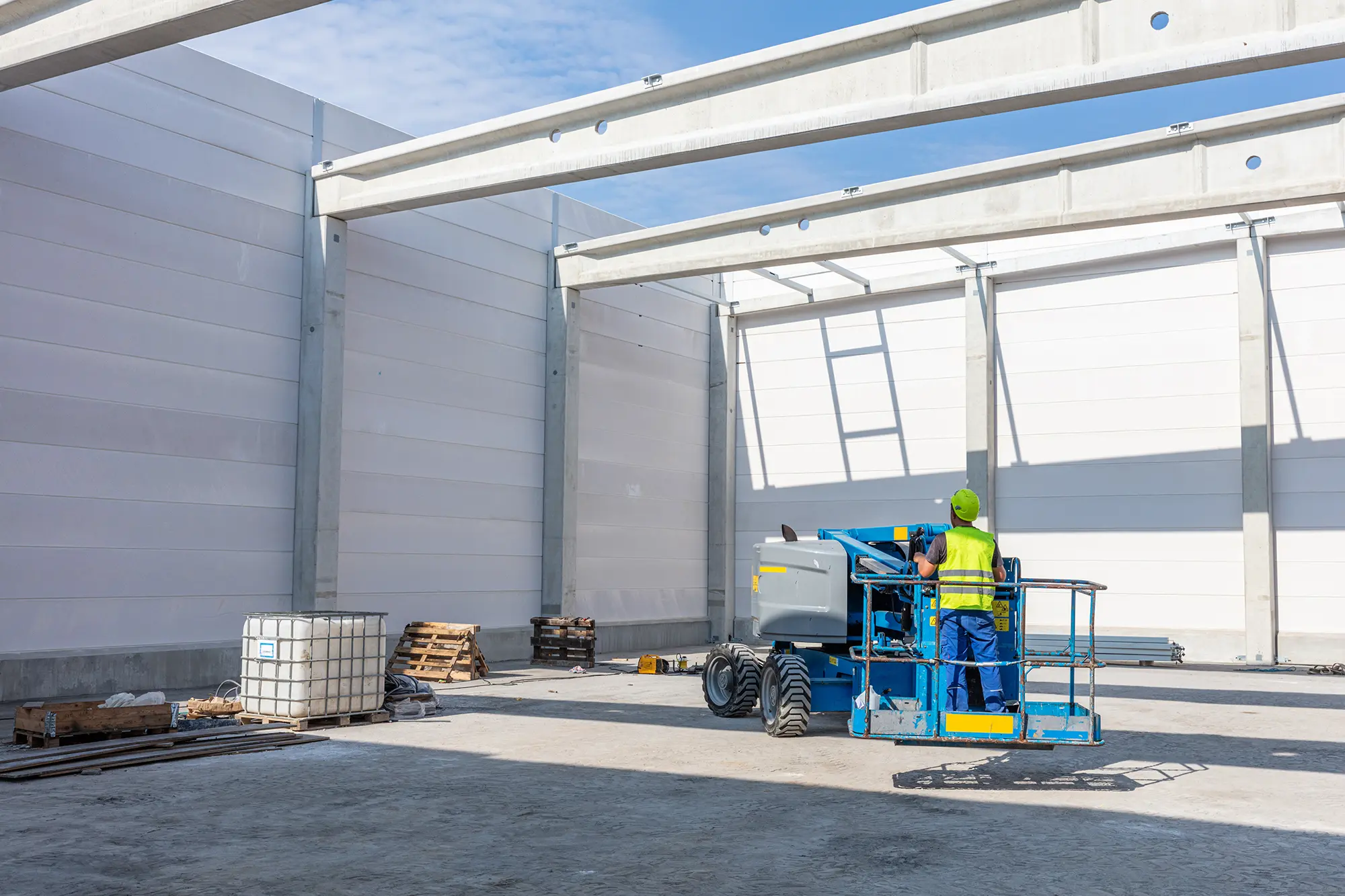
Freezer Slab Insulation & Heated Underslab Systems

For frozen storage and sub-zero applications, the slab is the most consequential single building system. Sub-zero slab construction includes a heated underslab system, sub-slab insulation, vapor barrier, edge insulation, and engineered concrete tolerance. Get any one of these wrong at construction and you're rebuilding the slab later — at facility-replacement-grade cost.

By US Cold Storage Builders Engineering Team
📅 Now booking 60–90 days out | Call (346) 676 - COLD
Performance IndexUpdated quarterly
R-30 to R-60
Sub-Slab Insulation Range
30+ yr
Glycol Loop Service Life
~9%
Soil Frost Expansion
Specifications

Why freezer slabs are different.

Engineering Response

Sustained heat flow, soil freezing, thermal cycling.

A frozen slab at 0°F to -10°F is different from any other slab-on-grade in three ways: sustained downward heat flow, soil freezing risk, and long-term thermal cycling. The engineering response addresses all three at once — heated underslab system, sub-slab insulation, edge insulation, and concrete tolerance.

  • Sustained downward heat flow from soil into cold space
  • Frozen soil moisture expands ~9% by volume — lifts the slab
  • Daily and seasonal thermal cycling at slab-soil interface
  • Engineering response: heat + insulation + edge + tolerance
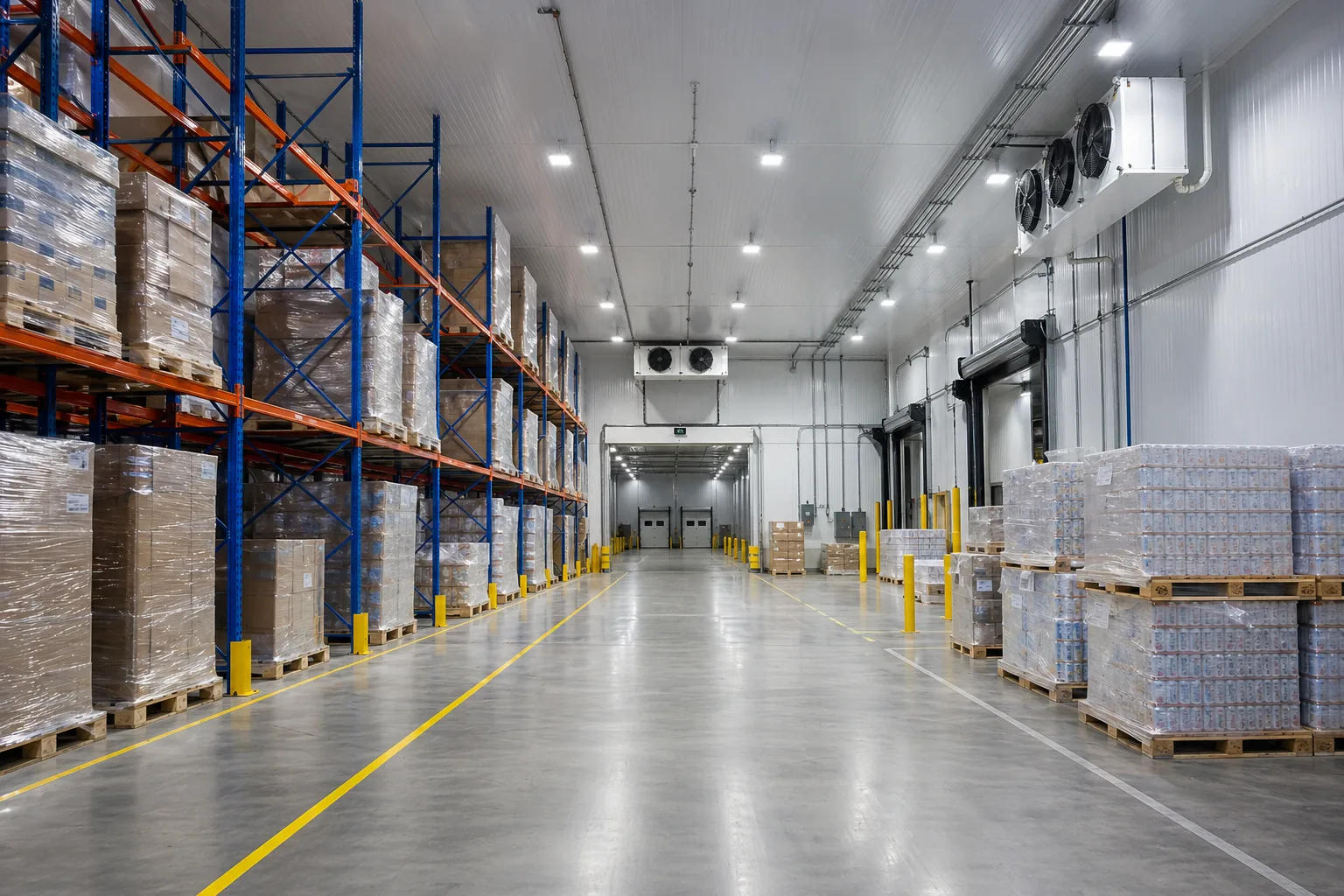
Frozen storage facility interior with engineered freezer slab and racking
Heated Underslab

Heated underslab — glycol loop or electric mat.

Heated underslab is non-negotiable for sub-zero applications. Glycol loop circulates warm fluid through embedded PEX tubing — standard for larger projects, resilient, service-friendly, lower long-term operating cost. Electric mat uses resistance heating below insulation — lower upfront cost, useful for smaller facilities and retrofits.

  • Glycol loop: $4–$8/SF, 30+ year service life, heat recovery integration
  • Electric mat: $2–$5/SF, 15–25 year service life, simpler install
  • Glycol standard for new construction 30,000+ SF
  • Electric mat practical for retrofits and small frozen rooms
Cold storage construction with sub-slab insulation and heated underslab tubing visible
Tolerance

Concrete tolerance is a slab decision, not a finish decision.

Slab flatness and levelness directly determine which racking and material handling systems work. FF/FL targets are specified per ACI 117 against racking choice. Tight tolerance cannot be ground in after the pour without major cost. Specify before bid; document FF/FL targets in pre-construction.

  • Standard fork truck: FF35/FL25
  • Reach truck: FF45/FL35
  • Narrow aisle wire-guided: FF50/FL40 (tight: FF60/FL50)
  • AS/RS / VNA: FF60+/FL50+ per manufacturer spec
Refrigerated warehouse interior showing slab finish and pallet racking integration
Why Different

Why freezer slabs are different

A standard slab-on-grade in dry warehouse or refrigerated warehouse construction transfers heat to ground at modest rates. The thermal load is steady, the soil stays at moderate temperature, and the slab performs for the life of the building without special engineering.

A frozen storage slab at 0°F to -10°F operating temperature is different in three ways:

1. Sustained downward heat flow. Cold slab continuously conducts heat from soil below into the cold space above. Without insulation, refrigeration load from ground heat transfer is enormous and continuous.

2. Soil freezing risk. As the slab cools soil below, soil moisture begins to freeze. Frozen soil moisture expands ~9% by volume. Expansion lifts the slab.

3. Long-term thermal cycling. Daily and seasonal temperature variation in the slab and underlying soil creates thermal stress at the slab-soil interface, edge connections, and structural transitions.

The engineering response to all three: heated underslab system + sub-slab insulation + edge insulation + concrete tolerance.

Heated Underslab

Heated underslab systems — glycol loop and electric mat

Heated underslab is non-negotiable for sub-zero applications. Without it, soil freezing and frost heave will eventually destroy the slab. Two approaches: glycol loop and electric mat.

Glycol Loop

A circulating warm fluid loop runs through embedded PEX or HDPE tubing in a sand bed below the sub-slab insulation. Loop fluid temperature typically 40°F–55°F supply, 5°F–10°F return temperature drop.

Why glycol loop is standard for larger projects:

  • Resilient to localized failure (one circuit fail doesn't take out the whole system)
  • Heat source flexibility (refrigeration heat recovery, boiler, heat pump)
  • Lower operating cost long-term (heat recovery integration)
  • Service-friendly (manifolds accessible in mechanical room, isolation valves per circuit)

Glycol loop specifications:

ComponentStandard Specification
TubingPEX-A or HDPE, 1/2" to 5/8"
Tubing spacing9" to 12" on center; 6"–8" at slab edges and dock face
Maximum loop length per circuit~300 feet (limited by flow rate and pressure drop)
Manifold locationMechanical room, accessible for service
Manifold isolationValve per circuit
Sand bed3"–4" sand around tubing for thermal coupling and protection
Fluid30–50% propylene glycol-water mixture (food-grade glycol for FDA applications)
Supply temperature40°F–55°F typical
System pressureLow pressure (under 30 psi); separate from refrigeration loops
PumpsVariable-speed for energy efficiency; redundant pumping standard
ControlsBMS-integrated, with slab temperature sensors at multiple positions

Heat source options:

  • Refrigeration heat recovery (standard for new construction): waste heat from refrigeration condensers heats the glycol loop. Lowest operating cost.
  • Standalone boiler: gas or electric boiler dedicated to slab heating. Higher operating cost.
  • Heat pump: increasingly used for high-efficiency applications.
  • Hybrid: heat recovery primary with boiler backup.

Capital cost: $4–$8/SF for complete glycol loop installation including tubing, manifolds, pumps, heat source, and controls.

Electric Mat

Resistance heating mats installed below sub-slab insulation. Cable spacing engineered for slab area and operating temperature.

Why electric mat is used:

  • Lower upfront capital cost ($2–$5/SF)
  • Useful in retrofit conditions where glycol piping isn't feasible
  • Simpler installation
  • Smaller mechanical room footprint (no glycol pumps or manifolds)

Trade-offs:

  • Higher operating cost (no heat recovery option)
  • Less resilient — mat failure typically requires slab demolition to repair
  • Energy consumption directly proportional to slab area and operating temperature
  • Lower service life than glycol loop (typically 15–25 years vs 30+)

For small frozen facilities, retrofits where glycol piping isn't viable, or budget-constrained projects, electric mat is acceptable. For new construction of meaningful scale (30,000+ SF frozen), glycol loop is the better engineering choice.

Sub-Slab Insulation

Sub-slab insulation — XPS specifications and thickness

Sub-slab insulation reduces heat loss to ground and limits the rate at which the heat system has to operate.

Material: XPS (Extruded Polystyrene)

Standard sub-slab insulation for frozen and sub-zero applications. Closed-cell foam with high compressive strength, low water absorption, and stable R-value over time.

XPS specifications:

PropertyStandard Specification
Compressive strength25–60 psi (sized for slab and racking loads)
R-valueR-5 per inch nominal (R-5 to R-5.6 per inch at design temperature)
Water absorption<0.1% by volume
Dimensional stability<2% under sustained load and temperature
Service life30–50+ years

Thickness Specifications

Operating TemperatureSub-Slab Insulation R-ValueApproximate Thickness
34°F–55°F refrigeratedGenerally not required (verify against frost depth)N/A
28°F–35°F cooler (cold climate)R-10 to R-202"–4"
0°F to 20°F frozenR-20 to R-304"–6"
-10°F to 0°F frozenR-30 to R-406"–8"
-20°F to -10°F deep frozenR-40 to R-508"–10"
-40°F to -20°F blast freezerR-50 to R-6010"–12"

Installation Detail

  • Two-layer installation with staggered joints reduces thermal bridging at panel seams
  • Continuous coverage across full slab footprint
  • Edge condition continues vertically up the perimeter to grade level or to wall envelope intersection
  • Penetrations through insulation (column footings, drains, utilities) sealed and reinsulated to maintain continuous R-value
  • Damage tolerance during construction — protect insulation surface during tubing/mat install and before slab pour

Sub-Slab Vapor Barrier

A polyethylene vapor barrier (10-mil minimum, 15-mil preferred for cold storage) installed above the sub-slab insulation. Sealed at all penetrations and at slab edges. Prevents ground moisture migration into the insulation layer and into the slab itself.

Common vapor barrier failures:

  • Discontinuity at penetrations (column footings, utility penetrations)
  • Inadequate seal at slab edge
  • Tears during construction not repaired
  • Inadequate overlap at seams (minimum 6" overlap with seam taping)
Edge Insulation

Edge insulation prevents perimeter thermal bridging

Vertical XPS insulation around the slab perimeter prevents perimeter thermal bridging. Critical at:

  • Slab edge to wall envelope interface — continuous insulation around the perimeter, extending from sub-slab to bottom of wall IMP
  • Dock face — vertical insulation between cold slab and warm yard
  • Wall-to-slab transitions — sealed thermal break at every wall-to-floor connection
  • Column footings — wrapped insulation around footing perimeters

Without edge insulation, thermal bridging at the slab perimeter creates a "halo" of elevated heat loss around the building perimeter, drives perimeter cold spots, and concentrates frost heave risk at the slab edge.

Tolerance

Concrete tolerance — FF/FL targets per ACI 117

Slab flatness and levelness directly determine which racking and material handling systems work. Specifications per ACI 117:

ApplicationFF TargetFL Target
Standard manual fork truckFF35 / FL25FF35 / FL25
Reach truck operationFF45 / FL35FF45 / FL35
Narrow aisle wire-guidedFF50 / FL40 typical, FF60 / FL50 tightSame
Very narrow aisle (VNA), defined trafficFF60+ / FL40+FF60+ / FL40+
AS/RS / automated storageFF60+ / FL50+ per manufacturer specSame

Tolerance is a slab decision; you can't grind in tight tolerance after the pour without significant expense and material loss. Specify before bid. Document FF/FL targets in pre-construction.

Tight tolerance slabs require:

  • Laser screed pour with experienced finishing crews
  • Proper concrete mix design (workability, slump, fiber if specified)
  • Controlled placement rate and temperature
  • Curing protocol that prevents differential shrinkage
  • Post-pour verification with calibrated FF/FL survey equipment

Slope and drainage

Storage slabs are flat. Sloped slabs are incompatible with tight FF/FL tolerance.

Process slabs in food processing facilities slope-to-drain(typically 1/8" to 1/4" per foot toward floor drains). Different areas of the building get different slab treatment. Plan the layout around this constraint.

Slope-to-drain integration with heated underslab system requires careful coordination — the heat system follows the slab profile, with tubing spacing adjusted at drain locations to maintain coverage.

Reinforcement

Slab reinforcement and concrete mix

Cold storage slabs typically include:

  • Welded wire fabric (WWF) or fiber reinforcement for crack control
  • Deformed bar reinforcement at high-load locations (racking column footings, dock face, mechanical equipment pads)
  • Control joints sized and placed per slab geometry
  • Expansion joints at long building dimensions and at structural transitions
  • Pour stops at construction joints

In sub-zero applications, sustained cold temperature increases concrete brittleness and shrinkage characteristics. Concrete mix design and reinforcement detail account for this.

Retrofit

Retrofit slab approaches

For cold storage retrofits inside existing buildings, three slab approaches:

Slab Overlay

New 4"–6" slab poured over existing slab, with heated underslab system and insulation embedded in the overlay.

When this works: Existing slab is structurally sound, ceiling clear can accommodate added height (overlay drops effective clear by 4"–6"+), existing slab condition supports overlay (no major heave or settlement).

Cost: Significantly less than full slab demolition. Typically $25–$45/SF for complete overlay including heated underslab.

Selective Slab Replacement

Demolish and replace slab in affected areas only (cold zone footprint), preserve existing slab in non-cold zones.

When this works: Cold zone is a subset of total building footprint, existing slab is sound in non-cold zones, transition between new and existing slab can be detailed cleanly.

Full Slab Demolition and Replacement

Required when existing slab is fundamentally inadequate (major heave, settlement, structural failure, contamination, or other deal-breakers).

Cost impact: Removes most retrofit savings; total cost approaches ground-up. See cold storage retrofit cost.

Build with us

Tell us about your frozen storage project — operating temperature, square footage, location, ground-up or retrofit. We engineer the slab system from the ground up to prevent the failure modes that take cold storage facilities offline. Houston-headquartered · Design-build · Nationwide.

Budgeting

Cost and timeline planning ranges.

$4–$8/SF

Glycol Loop System

30+ year service life, heat recovery integration

$2–$5/SF

Electric Mat System

15–25 year service life, simpler install

R-30 to R-40

XPS Sub-Slab (frozen)

6&quot;–8&quot;, two layers staggered joints

R-40 to R-50

XPS Sub-Slab (deep frozen)

8&quot;–10&quot;, edge condition continuous

R-50 to R-60

XPS Sub-Slab (blast)

10&quot;–12&quot;, full perimeter wrap

$25–$45/SF

Slab Overlay Retrofit

Complete overlay with heated underslab

Services

Cold Storage Solutions, End to End

❄️ Cold Storage🧊 Blast Freeze🏗️ New Build🔧 Retrofit🌡️ Multi-Temp💊 Pharma-Grade📦 3PL Warehouses
FAQ

Common Questions

Why is heated underslab required for frozen storage?

Without heated underslab, soil moisture below the sub-zero slab freezes and expands ~9% by volume. Expansion lifts the floor (frost heave), destroys flatness, damages racking, and renders the facility inoperable. Repair requires removing all racking and product, demolishing the slab, excavating, installing heat, and re-pouring — months of downtime and $50/SF or more. Heated underslab prevents the failure mode.

What's the difference between glycol loop and electric mat?

Glycol loop uses circulating warm glycol fluid through embedded PEX tubing. Higher upfront cost ($4–$8/SF). Lower operating cost. More resilient to localized failure. Service-friendly. Standard for 50,000+ SF frozen facilities. Electric mat uses resistance heating mats below insulation. Lower upfront cost ($2–$5/SF). Higher operating cost. Less resilient. Useful for smaller facilities and retrofits where glycol piping isn't feasible.

What sub-slab insulation thickness do I need?

Depends on operating temperature. For frozen storage 0°F to -10°F: R-30 to R-40 (6&quot;–8&quot; XPS). For deep frozen -20°F to -10°F: R-40 to R-50 (8&quot;–10&quot;). For blast freezer -40°F to -20°F: R-50 to R-60 (10&quot;–12&quot;). Install in two layers with staggered joints.

What's the FF/FL spec for a freezer slab?

Depends on racking system. Standard manual fork truck: FF35/FL25. Reach truck: FF45/FL35. Narrow aisle wire-guided: FF50/FL40 typical or FF60/FL50 tight. AS/RS or VNA: FF60+/FL50+. Specify before bid; you cannot grind tolerance in after the pour without major cost.

Can existing slab be reused in a retrofit?

Sometimes. Three approaches: slab overlay (new slab poured over existing with heat embedded), selective slab replacement (demolish cold zone only), or full slab demolition and replacement. Overlay is most common and most economical when existing slab is structurally sound. Slab evaluation in pre-construction determines feasibility.

What sub-slab vapor barrier do I need?

Polyethylene vapor barrier, 10-mil minimum (15-mil preferred for sub-zero applications). Installed above sub-slab insulation. Sealed at all penetrations and at slab edges. Minimum 6&quot; overlap at seams with seam taping. Vapor barrier prevents ground moisture migration into insulation and slab.

What concrete mix is used for freezer slabs?

Standard cold storage concrete mix design: 4,000–5,000 psi compressive strength at 28 days, low slump, low water-cement ratio, air entrainment for freeze-thaw resistance if relevant to climate. Fiber reinforcement or welded wire fabric for crack control. Concrete mix design accounts for sustained sub-zero exposure in service.

Field Log· Houston · 29.66°N · 95.47°WOperating Range−40°F → 70°F · ±0.5°FR-Value30–60 IMP
Call UsRequest a Quote