Frost Heave Prevention in Cold Storage Construction

Frost heave is the single highest-failure-cost event in cold storage construction. When soil moisture below a sub-zero slab freezes, it expands ~9% by volume, lifts the floor, cracks the slab, and damages racking and operations above. Repair requires taking the facility offline for months and rebuilding the slab system from excavation up. Prevention is engineered into the slab system at construction — heated underslab, sub-slab insulation, edge insulation, drainage, and concrete tolerance, working together.

By US Cold Storage Builders Engineering Team
📅 Now booking 60–90 days out | Call (346) 676 - COLD
Performance IndexUpdated quarterly
~9%
Soil Moisture Expansion on Freezing
12-24 mo
Time to Detectable Heave
$5-$10/SF
Prevention vs $30-$100+/SF Repair
Specifications

The single highest-failure-cost issue in frozen storage.

Three Conditions

Sub-freezing soil, available moisture, time.

Frost heave requires all three. A sub-zero slab conducts cold downward; soil moisture freezes and expands ~9% by volume; expansion pushes upward against the slab over months. Remove any one of the three conditions and heave does not develop. Engineered prevention removes the first — sustained sub-freezing soil temperature — through heated underslab systems.

  • Sustained sub-freezing temperature in the soil column
  • Available moisture (bound water, pore water, capillary water)
  • Time — heave develops over months to years, not days
  • 9% volume expansion creates upward force against the slab
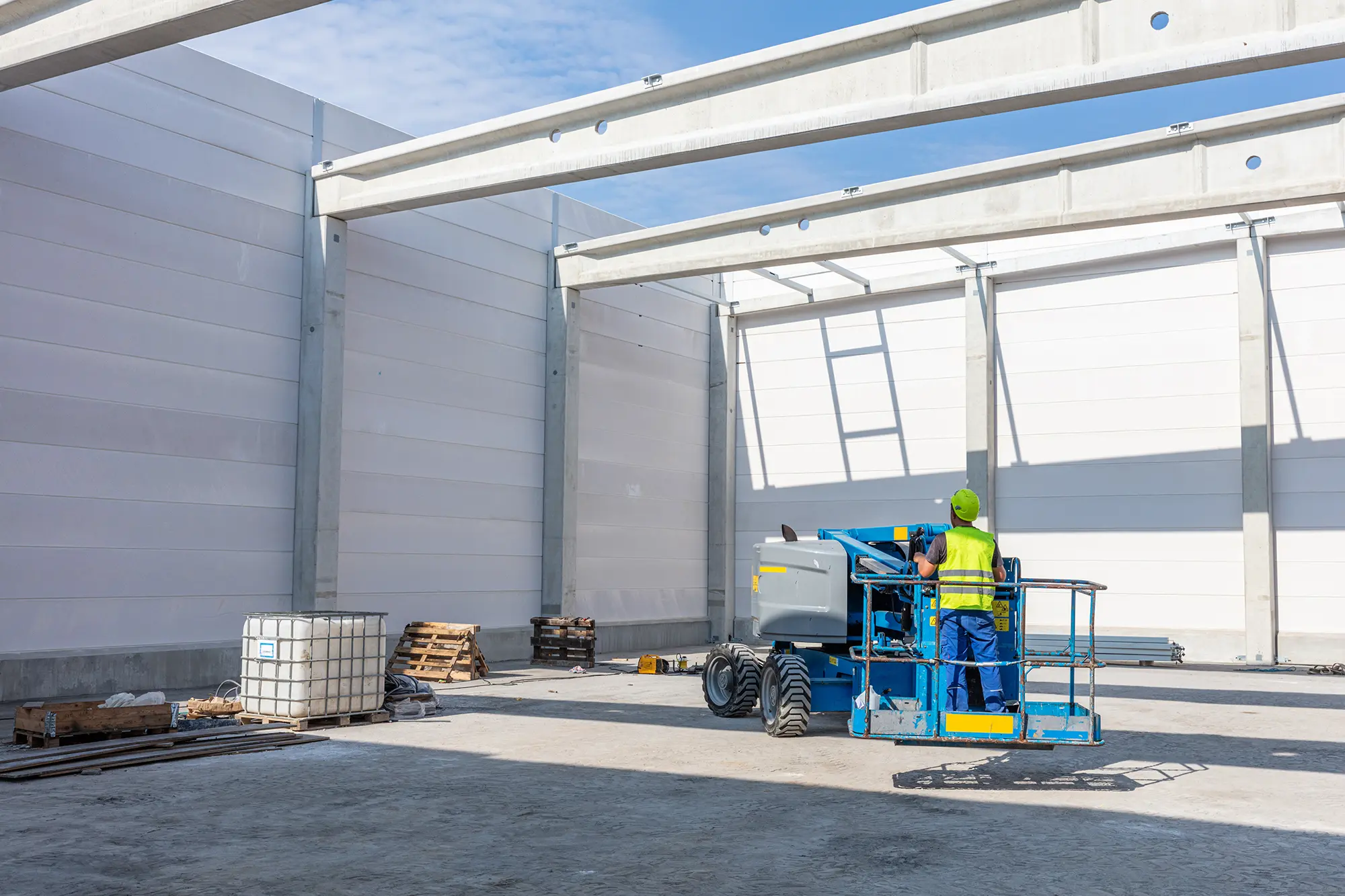
Frozen storage facility where frost heave prevention is engineered in at construction
Prevention System

Five layered systems work together.

Heated underslab (glycol or electric), sub-slab insulation (XPS sized to operating temperature), edge insulation (vertical XPS around the perimeter), soil drainage (perimeter and sub-slab), and concrete quality. No single layer prevents heave alone; the combination keeps soil above freezing at the slab-soil interface.

  • Layer 1: Heated underslab system maintains soil above freezing
  • Layer 2: Sub-slab XPS insulation reduces heat input required
  • Layer 3: Edge insulation prevents perimeter thermal bridging
  • Layer 4: Drainage reduces moisture available to freeze
  • Layer 5: Concrete quality tolerates minor stress
Cold storage construction with sub-slab insulation and heated underslab tubing installation
Failure Trajectory

Heave develops over months to years, then accelerates.

Early stages (months 1-18) show minor floor irregularities and subtle racking alignment shifts. Intermediate (18-36) shows visible heave at slab edges and around columns, drain compromise, door frame distortion. Late stages (36+) show severe distortion, racking collapse, and full operational disruption. Remediation cost scales with how late it's caught.

  • Months 1-18: subtle, often mistaken for shrinkage
  • Months 18-36: visible heave, operational impact
  • Months 36+: severe distortion, racking collapse, shutdown
  • Remediation cost multiplies with stage of detection
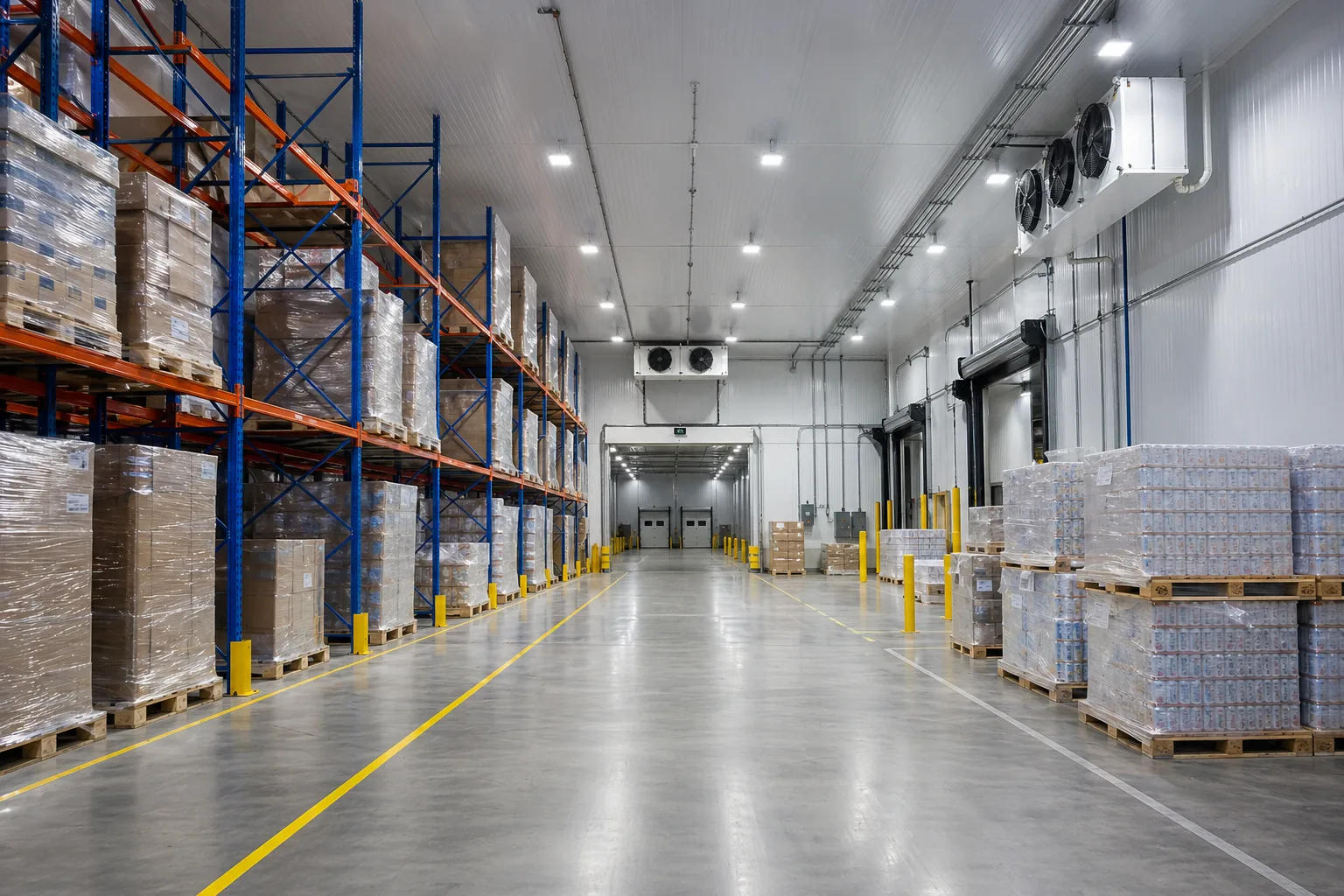
Refrigerated warehouse interior showing slab and racking integration that frost heave would destroy
Mechanism

What frost heave is

Frost heave occurs when soil moisture freezes and expands beneath a slab. Three conditions are required:

1. Sustained sub-freezing temperature in the soil column. A slab held at 0°F to -10°F operating temperature conducts cold downward into the soil. Without insulation between slab and soil, the freezing front migrates downward into wet soil over weeks to months.

2. Available moisture in the soil column. Most soils contain moisture — bound water in fines, free water in pores, capillary water rising from the water table. The amount depends on soil type and groundwater conditions.

3. Time. Frost heave doesn't happen in days. Heave progresses over months and years as the freezing front advances and as moisture migrates toward the freezing zone.

When ice forms in soil, it occupies ~9% more volume than the source water. Confined expansion pushes upward — against the slab — because that's the path of least resistance. The slab lifts.

Symptoms

What frost heave looks like in a cold storage facility

Frost heave doesn't appear suddenly. It develops over months to years and typically presents as:

Early stages (months 1–18)

  • Minor floor irregularities, sometimes mistaken for normal concrete shrinkage
  • Subtle alignment shifts in racking
  • Drainage issues at slab edges
  • Occasional cracking near columns or penetrations

Intermediate stages (months 18–36)

  • Visible floor heave concentrated in specific areas (often at slab edges, around columns, or near refrigeration mechanical rooms)
  • Racking misalignment becomes operationally noticeable
  • Slab cracking widens and propagates
  • Drain function compromised
  • Door frame distortion at high-cycle dock locations

Late stages (months 36+)

  • Severe floor distortion (sometimes 6" of vertical displacement)
  • Racking collapse or removal required
  • Slab structural failure
  • Facility operational disruption
  • Major remediation required

By the time frost heave is severe enough to be undeniable, remediation cost runs many multiples of the original slab construction cost. Prevention at construction is the only economical approach.

Prevention System

The prevention system — five layers

Frost heave prevention is a layered system. No single component prevents heave alone; the combination keeps soil moisture below the freezing point.

Layer 1: Heated underslab system

The primary prevention mechanism. A heated fluid loop (glycol) or electric mat below the slab keeps the soil temperature above freezing at the slab-soil interface. Two approaches:

  • Glycol loop: Circulating warm fluid through embedded PEX tubing in a sand bed. Supply temperature 40°F–55°F, maintained continuously.
  • Electric mat: Resistance heating mats below sub-slab insulation. Continuous low-power heating.

The heated system doesn't have to keep soil warm — it just has to keep it above freezing. Typical target: maintain soil at 35°F minimum at the slab-soil interface.

Read more about heated underslab systems →

Layer 2: Sub-slab insulation

XPS rigid foam insulation between the slab and the heat system. Reduces the heat input required to keep soil above freezing. Without sub-slab insulation, the heat system would have to inject enormous amounts of heat — uneconomic and sometimes impossible.

Standard specifications by operating temperature:

  • Frozen storage (0°F to -10°F): R-30 to R-40 XPS (6"–8")
  • Deep frozen (-20°F to -10°F): R-40 to R-50 XPS (8"–10")
  • Blast freezer (-40°F to -20°F): R-50 to R-60 XPS (10"–12")

Layer 3: Edge insulation

Vertical insulation around the slab perimeter. Critical because:

  • The slab edge is the primary location of thermal bridging
  • Frost heave concentrates at slab edges and corners
  • Without edge insulation, cold migrates outward into soil beyond the slab footprint and freezes ground at the perimeter

Edge insulation continues from sub-slab level upward, typically to grade level or to the bottom of wall IMP. R-20 to R-30 typical.

Layer 4: Soil drainage

Reducing soil moisture below the slab reduces the moisture available to freeze. Standard practices:

  • Sub-slab drainage — perforated drain lines below the sub-slab insulation, sloped to daylight or to a sump pump
  • Site grading — surface water directed away from the building footprint
  • Foundation drainage — perimeter drains around the building perimeter
  • Vapor barrier above sub-slab insulation — prevents moisture migration from below into the insulation and slab

In high-water-table sites, soil drainage may require active dewatering during construction and ongoing groundwater management.

Layer 5: Concrete quality

While not a direct frost heave prevention measure, concrete quality affects how the slab responds to any heave that does occur:

  • Proper concrete mix design (4,000–5,000 psi, low water-cement ratio)
  • Adequate reinforcement for crack distribution
  • Control joints placed to manage shrinkage
  • Curing protocol that minimizes early-age cracking
  • Construction joint detailing that maintains continuity

A well-built slab tolerates minor stress better than a poorly-built slab fails catastrophically. Neither substitutes for the prevention system.

Soil & Site

Soil conditions and frost heave risk

Frost heave risk varies significantly by soil type, climate, and water table conditions.

Soil types

Soil TypeFrost Heave Risk
Sand and gravel (clean, well-drained)Low
Sandy loamLow to moderate
Silt and silty soilsHigh (frost-susceptible)
Clay, especially expansive claysModerate (clay holds moisture but doesn't drain)
Organic soilsHigh
Mixed soils with significant finesModerate to high

Silty soils are the highest-risk. Silt particles are small enough to support capillary action (drawing moisture upward toward freezing front) but large enough not to bind moisture tightly. Frost heave in silty soils can be severe.

Climate

In moderate climates (Texas, Southeast, Gulf Coast), ambient soil temperature is high enough that the heat system maintains soil above freezing with modest heat input.

In cold climates (Midwest, Northeast, Mountain West), ambient soil temperature can already be near or below freezing in winter. The heat system has to inject more heat to keep soil above freezing. Sub-slab insulation specifications increase in cold climates.

In very cold climates (Northern Plains, Alaska), specific engineering may be required for permafrost or near-permafrost conditions.

Water table

A high water table close to the slab elevation increases frost heave risk because moisture is readily available to migrate toward the freezing front. Site evaluation includes water table assessment; in high-water-table sites, additional drainage and sometimes site preparation may be required.

Failure Modes

What happens if frost heave prevention fails

If any layer of the prevention system fails or is improperly installed, frost heave can develop. Common failure scenarios:

Heat system failure (full or partial)

  • Pump failure in glycol loop
  • Glycol leak
  • Heat source failure (boiler, heat exchanger)
  • Electric mat short circuit
  • Controls failure

Without monitoring and alarming on the heat system, failure can go undetected for weeks while soil freezes. Heat system monitoring and alarming is non-negotiable.

Insulation failure or damage

  • Insulation crushed during construction
  • Inadequate insulation thickness for operating temperature
  • Insulation discontinuity at penetrations
  • Edge insulation missing or compromised

Drainage failure

  • Drain lines clogged or damaged
  • Site grading directs water toward building
  • High water table not managed

Vapor barrier failure

  • Vapor barrier discontinuous at penetrations
  • Vapor barrier damaged during construction not repaired
  • Inadequate vapor barrier overlap at seams

Any one of these can initiate frost heave. The remediation cost is typically much greater than the cost of doing it right at construction.

Remediation

Remediation if frost heave develops

If frost heave is identified, remediation depends on severity:

Early-stage remediation

If heave is detected early (slab movement under 1"):

  • Diagnose root cause (heat system check, insulation evaluation via cores, drainage check)
  • Restore heat system to specification
  • Sometimes inject supplemental heat to thaw frozen soil column
  • Monitor over months for slab recovery

Cost: Modest, typically $5–$15/SF on affected area.

Mid-stage remediation

If heave is more developed (slab movement 1"–4"):

  • Demolish affected slab section
  • Excavate frozen soil column
  • Allow soil to thaw and dry
  • Re-install heat system, insulation, vapor barrier
  • Re-pour slab

Cost: $30–$60/SF on affected area. Operational disruption during repair.

Late-stage remediation

If heave is severe (slab movement 4"+, structural damage to racking and operations):

  • Full facility shutdown
  • Demolish all affected slab and structure as required
  • Excavate, dewater, prepare new subgrade
  • Install full new slab system
  • Restore racking and operations

Cost: $50–$100+/SF on affected area. Major operational disruption (months of downtime). May be uneconomic compared to building replacement.

USCB Approach

How USCB engineers frost heave prevention

USCB approach to every frozen storage project:

  1. Site evaluation in pre-construction. Soil type, water table, climate exposure. Slab system specifications matched to site conditions.
  2. Heated underslab system specification. Glycol loop typical for new construction at 30,000+ SF; electric mat acceptable for smaller and retrofit applications.
  3. Sub-slab insulation specification. Thickness sized for operating temperature and climate. Two-layer install with staggered joints.
  4. Edge insulation continuity. Vertical XPS around slab perimeter, extending to bottom of wall IMP. Continuous, sealed.
  5. Drainage design. Sub-slab drainage where soil/water table conditions warrant. Site grading directing water away from building. Perimeter drains as needed.
  6. Vapor barrier integrity. Continuous polyethylene vapor barrier above sub-slab insulation. Sealed at penetrations and edges.
  7. Heat system monitoring. BMS-integrated heat system with alarms on glycol supply temperature, flow rate, pump operation, and slab temperature sensors.
  8. Commissioning verification. Slab temperature mapping during commissioning to verify heat system performance. Documentation as part of project handoff.
  9. Operator training. Owner training on heat system operation, monitoring, alarm response, and maintenance.
  10. Warranty coverage. Slab heat system covered under construction warranty per specifications.

Build with us

Tell us about your frozen storage project — operating temperature, location, soil conditions. We engineer slab systems that don't heave. Houston-headquartered · Design-build · Nationwide.

Budgeting

Cost and timeline planning ranges.

$5–$10/SF

Prevention Cost

On top of standard slab (heat + insulation + edge)

$5–$15/SF

Early-Stage Repair

<1" movement, root cause addressable

$30–$60/SF

Mid-Stage Repair

1"–4" movement, slab demolition required

$50–$100+/SF

Late-Stage Repair

4"+ movement, may exceed replacement cost

35°F minimum

Heat System Target

At slab-soil interface, monitored continuously

R-30 to R-60

XPS Sub-Slab

Thickness sized to operating temperature

Services

Cold Storage Solutions, End to End

❄️ Cold Storage🧊 Blast Freeze🏗️ New Build🔧 Retrofit🌡️ Multi-Temp💊 Pharma-Grade📦 3PL Warehouses
FAQ

Common Questions

Why does frost heave happen?

When soil moisture freezes below a sub-zero slab, it expands ~9% by volume. Confined expansion pushes upward against the slab, lifting the floor. Three conditions are required: sustained sub-freezing slab temperature transmitted to soil, available moisture in soil, and time for the freezing front to develop. All three are present in frozen storage facilities without heated underslab systems.

How long does frost heave take to develop?

It depends on slab operating temperature, soil moisture, sub-slab insulation (if any), and ambient conditions. Detectable heave typically appears within 12–24 months in a frozen facility without proper underslab heat. Severe heave can develop within 36 months.

Can frost heave be fixed without rebuilding the slab?

Only if caught very early (under 1" of movement) and root cause can be addressed (heat system restored, drainage corrected). Once heave exceeds about 1", remediation typically requires demolition and rebuild of the affected slab section. Severe heave (4"+) often requires full slab replacement.

What's the difference between heated underslab and just thicker insulation?

Sub-slab insulation slows the rate of heat transfer to soil but doesn't eliminate it. Over time, sustained cold transmission through insulation still cools soil below the freezing point. Heated underslab actively keeps soil above freezing — it's the only reliable prevention. Insulation works with the heat system, not in place of it.

Do you need heated underslab in a refrigerated warehouse?

Generally no. Refrigerated warehouses operate at 34°F+ — soil moisture below the slab doesn't freeze at this temperature. Heated underslab is required for frozen and sub-zero applications.

Can existing buildings be retrofitted with heated underslab?

Yes, typically with a slab overlay approach — new 4"–6" slab poured over existing with heat embedded in the overlay. Slab overlay drops effective ceiling clear by the overlay thickness; verify that remaining clear height accommodates intended racking and refrigeration.

What soil conditions are highest-risk for frost heave?

Silty soils are highest-risk because silt supports capillary moisture transport to the freezing front. Clay holds moisture but drains slowly. Sand and gravel are lowest-risk because they drain well and don't support capillary action. Soil evaluation in pre-construction determines site-specific risk and influences slab system specifications.

What's the cost of frost heave prevention vs the cost of frost heave damage?

Prevention costs $5–$10/SF on top of standard slab construction (heat system + sub-slab insulation + edge insulation). Damage remediation costs $30–$100+/SF on affected area plus months of operational disruption. Prevention is dramatically more economical than remediation.

Field Log· Houston · 29.66°N · 95.47°WOperating Range−40°F → 70°F · ±0.5°FR-Value30–60 IMP
Call UsRequest a Quote