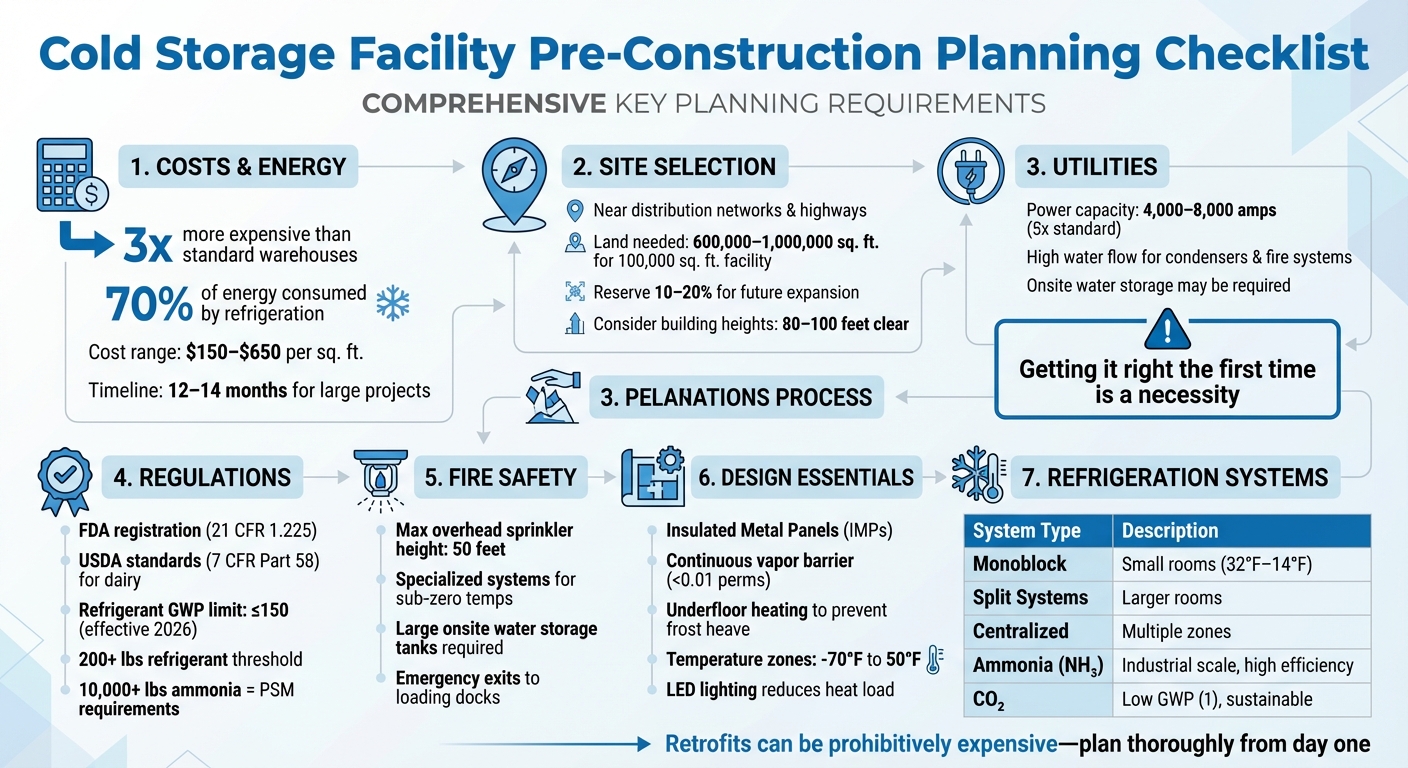
Cold storage facilities cost three times more than standard warehouses — and the decisions made before a single panel goes up determine whether that investment performs for decades or requires expensive corrections within years. Site selection, utility capacity, regulatory compliance, thermal design, and refrigeration system selection are not sequential steps. They are interdependent decisions that must be resolved together, early, before construction begins.
At a glance: Seven planning domains determine the outcome of every cold storage project:
Site Selection: Location relative to the supply chain is permanent — all other problems can be fixed. A bad location cannot.
Utilities: Confirm 4,000–8,000 amp power capacity and water flow rates before purchasing the site.
Regulatory Compliance: FDA/USDA food safety, fire safety codes, and GWP ≤ 150 refrigerant restrictions (effective January 2026) must be built into design, not retrofitted.
Thermal Envelope Design: A continuous six-sided vapor barrier — walls, roof, and slab — is the foundation of every design decision.
Refrigeration System Selection: The system type determines energy costs, staffing requirements, and long-term compliance exposure.
Materials and Structure: Insulation panels, flooring, and structural components must be specified for sub-zero durability and food-grade hygiene.
Budget and Timeline: $150–$650/sq ft depending on temperature and automation. Plan for 12–14 months and a 5–15% contingency fund.
“The first consideration should be the location relative to the supply chain. If it is not in an advantageous position, then it is almost impossible to overcome.”
— Art Rasmussen, SVP, CBRE
Every other problem in cold storage construction can be addressed after the fact. Equipment can be upgraded. Insulation can be improved. Refrigeration systems can be replaced. Location cannot. Once your facility is built, you can't move it closer to customers, ports, or distribution hubs.
Access to Distribution Networks
Proximity to major north–south interstate highways ensures reliable regional distribution. Every added mile increases drayage costs — facilities near ports or rail intermodals reduce transportation expenses and lower risks tied to temperature-sensitive goods in transit. If rail access is part of the plan, review the provider's routes carefully and factor in the cost of constructing and permitting a rail spur. Land near transportation hubs commands a premium, but the long-term savings in fuel, labor, and reduced product loss typically justify the difference.
Space for Operations and Expansion
A 100,000 sq ft cold storage facility typically requires 600,000–1,000,000 sq ft of land to accommodate truck courts, trailer staging, refrigerated trailer storage, and vehicle circulation. Reserve 10–20% of the site for future expansion now — adding storage chambers or mechanical equipment later is far cheaper than relocating. For facilities targeting 80+ foot clear heights, assess neighboring properties early to anticipate opposition to building height before zoning variance processes begin.
Utility and Infrastructure Access
Utility capacity is a site disqualifier. Confirm that high-capacity power lines — 4,000–8,000 amps, approximately five times the standard requirement — can be connected without expensive offsite extensions.
“Increased water flows are required for the condensers, and power demand can range from 4,000 to 8,000 amps.”
— Mike Jeitner, PE and Principal, Bohler
Water infrastructure is equally critical. High flow rates and pressure are required for cooling condensers and supporting fire sprinkler systems. If the municipal water system falls short, onsite water storage tanks add both cost and footprint. Conduct thorough utility assessments during site selection — not after purchase. Discovering that your site requires expensive capacity upgrades after closing can derail both budget and timeline.
2
Regulatory and Compliance Requirements
“Every single thing in a cold storage environment ends up in the human body. That reality elevates the stakes for design decisions, particularly as requirements under the Food Safety Modernization Act continue to shape facility standards.”
— Adam Bortz, Nelson Worldwide
Food Safety Standards (USDA/FDA)
FDA registration is required under 21 CFR 1.225 for cold storage facilities handling food in the U.S. Current Good Manufacturing Practices (CGMPs) under 21 CFR Part 117, Subpart B govern sanitary design, pest control, and cleaning protocols. Facilities storing sealed, temperature-controlled packaged foods face modified requirements under 21 CFR 117.206 — strict temperature monitoring, regular documentation, and corrective action protocols. The Sanitary Transportation Rule (21 CFR Part 1 Subpart O) requires shippers and receivers to verify temperature maintenance throughout transit.
Facilities handling dairy products must comply with USDA regulations under 7 CFR Part 58: light-colored impervious walls, sloped floors with drainage traps, 30 foot-candles on work surfaces, 50 foot-candles in grading areas, and biannual bacteriological water supply testing. Build temperature mapping and automated monitoring systems with alarms and escalation protocols into your design — these are compliance requirements, not optional upgrades.
Fire Safety and Emergency Planning
Overhead sprinkler systems are effective up to 50 feet clear height. Exceeding that threshold triggers significant cost increases and operational risks.
“Current overhead systems generally allow for a maximum of 50-foot clear heights for buildings. Exceeding this limit will cause a large added cost for in-rack sprinklers and put the owner at risk of a forklift operator hitting a sprinkler head in the rack.”
— Andy Lucas, Preconstruction Manager, Brinkmann Constructors
Sub-zero temperatures freeze standard sprinkler systems — specialized systems like the Ultra K34 Quell are required in freezer environments. In automated storage areas, low-oxygen suppression systems can be a better alternative, reducing product damage and eliminating in-rack piping complexities. High-demand sprinkler systems often require large onsite water storage tanks. Engage local Authorities Having Jurisdiction (AHJs) during the design phase — not after. Emergency egress paths must lead workers directly to loading docks, minimizing exposure to freezing temperatures during evacuations.
Environmental and Zoning Regulations
Effective January 1, 2026, federal regulations cap GWP at 150 for refrigerants in systems with 200 lbs or more. This directly eliminates most HFCs from new construction and has accelerated adoption of ammonia and CO₂. Facilities using over 10,000 lbs of ammonia must comply with EPA and OSHA Process Safety Management (PSM) requirements — specialized safety managers, detailed reports, and comprehensive emergency response plans are mandatory.
“Regulatory compliance is more than a legal obligation — it's a fundamental driver of facility design, staffing strategies, operational protocols and long-term financial planning.”
— Andy Lucas and Mike Bildner, Brinkmann Constructors
Zoning laws may impose building height restrictions on facilities targeting 80–100 foot clear heights. Variance approvals can delay construction timelines significantly — initiate this process as early as possible. Install a continuous vapor barrier with permeance below 0.01 perms and underfloor heating to satisfy frost heave prevention requirements in most jurisdictions.
3
Design and Engineering Considerations
Temperature Requirements and Load Calculations
Load calculations account for more than the target storage temperature. Internal heat sources — LED lighting, automated guided vehicles, forklift traffic — all add to the heat load. Infiltration loads at loading docks are a major factor: every door opening introduces warm, humid air, making dock seals and airlocks essential. Thermal bridging at wall-roof junctures allows heat to bypass insulation — these transitions must be engineered explicitly.
Each temperature zone requires its own calculations. Frozen storage at -10°F, chilled areas at 35°F, and ambient staging zones each demand specific insulation and refrigeration configurations. Refrigeration typically consumes up to 70% of total facility energy — accurate load calculations directly size your refrigeration investment. A continuous six-sided vapor barrier covering walls, roof, and slab is not optional; it is the structural response to moisture pressure differentials created by temperature differences.
Insulation and Thermal Envelope Design
Insulated Metal Panels (IMPs) form the continuous thermal barrier. The wall-roof juncture is the most common failure point.
“The juncture where the wall meets the roof is critical… insulation must go all the way to the corner, and vapor barriers have to be wrapped tight around the building.”
— Kate Lyle, Principal Architect, Lamar Johnson Collaborative
Vapor barriers must fully enclose the building to prevent “indoor rain” — condensation that forms when warm air contacts cold surfaces. All sealants must be rated for below-freezing temperatures; standard materials crack under thermal contraction. Underfloor heating systems prevent frost heave — installing them during initial construction avoids the far greater cost of retrofitting. Test the thermal envelope near the end of construction by gradually lowering temperature — ice formation or sealant cracks indicate a compromised seal that must be addressed before operations begin.
Refrigeration System Selection
“The refrigeration system is the heart and soul of a controlled environment building and is often the first decision that owners make.”
— Andy Lucas, Preconstruction Manager, Brinkmann Constructors
System Type
Best For
Key Considerations
Monoblock Units
Small rooms (32°F–14°F)
Easy installation; limited capacity
Split Systems
Larger rooms
Keeps compressor noise and heat outside
Centralized Systems
Large facilities with multiple zones
Fewer units required; more complex installation
Ammonia (NH₃)
Industrial-scale operations (200+ tons)
High efficiency; trained staff required; PSM compliance for 10,000+ lbs
Transcritical CO₂
Sustainable operations of all sizes
GWP of 1; higher upfront cost; adaptable
Install a second compressor to avoid single points of failure — a compressor failure in a fully loaded freezer means total inventory loss. Seal all electrical conduits to prevent cold air migration into walls. If the pressure ratio exceeds 8 for ammonia or 10 for Freon systems, two-stage compression protects equipment and improves efficiency.
4
Material and System Selections
Insulation Panels and Moisture Control
Mechanical systems cannot compensate for a poorly sealed building envelope — a strong thermal seal is non-negotiable. Air barriers and vapor retarders must be installed on the exterior (warm side) of insulation to prevent humid air from entering and condensing inside walls. Failed insulation boards can absorb 10–15 times their weight in water when vapor barriers are incomplete. In the Northeast, where interior temperatures may be held at 20°F, exterior dew points exceed indoor temperatures for over 80% of the year — condensation risk is effectively constant.
Use sealants rated for sub-freezing conditions — standard materials crack under thermal contraction. Specify non-porous, washable materials for walls and ceilings. If constructing a cooler zone, install floor heating and insulation as if it were a freezer — this enables a cost-effective temperature conversion later without tearing up flooring.
Cooling Units and Temperature Zoning
Size and position cooling units in coordination with racking and automation systems from the beginning of design — not after racking is specified. Facilities with 80–100 foot clear heights require precise evaporator placement for even air distribution. Rack-based refrigeration systems save floor space by eliminating dedicated engine rooms but require additional roof support. Multi-zone facilities must have separate cooling circuits for each temperature range — some sections may operate at 50°F while others hold -70°F. Variable-frequency drives (VFDs) and smart controls eliminate energy waste from oversized system operation.
Structural Components and Durability
Pre-engineered metal buildings resist pests, mold, decay, and fire while integrating cleanly with insulation and cooling systems. Floors require shrink-compensating concrete mixes with steel fibers — not rebar — to withstand heavy forklift traffic and extreme cold without cracking.
“Every single thing in a cold storage environment ends up in the human body. That reality elevates the stakes for design decisions.”
— Adam Bortz, Director and Account Leader of Industrial, Nelson Worldwide
All structural surfaces must meet FSMA standards — non-porous, washable finishes throughout. Seal all electrical conduits with specialized fittings to prevent cold air from traveling through structural systems and causing condensation. In high-pile storage areas exceeding 50 feet, in-rack sprinklers are typically required — some automated facilities substitute low-oxygen suppression systems to eliminate forklift damage risk.
5
Budgeting and Project Planning
“I generally try to tell my clients that building a new cold storage facility is going to start in the ballpark of three times the cost of a traditional industrial building.”
— Kate Lyle, Principal Architect, Lamar Johnson Collaborative
Per-square-foot pricing ranges from $150 to $650 depending on temperature requirements and automation levels. There is no shortcut through this cost structure — the physics of sub-zero construction and food-grade compliance drive the numbers regardless of project size.
Cost Estimation for Key Components
For a mid-sized facility (1,000–2,500 sq ft), a rough component breakdown: building shell runs $60,000–$380,000; refrigeration equipment $50,000–$420,000 depending on complexity; insulation and doors $20,000–$150,000. Labor typically accounts for 30–60% of total budget. Set aside a contingency fund of 5–15% of overall budget for unexpected site conditions or permitting changes — these are not optional reserves, they are the difference between a completed project and a stalled one.
Turnkey construction combines design, engineering, procurement, and construction into one package, keeping costs predictable and eliminating coordination gaps. Modular systems manufacture components off-site and complete up to 80% of work before site delivery — cutting delivery times by up to 50% and minimizing weather-related delays. For smaller facilities (1,000–2,500 sq ft), modular installation completes in 3–6 months.
Timeline Development and Milestone Planning
Larger cold storage projects target a 12–14 month completion window. Critical milestones: site selection, permitting and regulatory approvals, procurement of long-lead refrigeration equipment, structural construction, and “Cold Start” testing — the gradual temperature pull-down that reveals leaks, sealant failures, and structural issues before operations begin. Design-Build delivery overlaps these phases, compressing the overall schedule. In February 2025, Brinkmann Constructors completed the first phase of Coastal Cold Storage in Foristell, Missouri — a 125,000 sq ft facility — in just nine months using an experienced Design-Build team.
Plan engine rooms and utility infrastructure with 10–20% extra capacity from the start — future expansions that require utility upgrades while the facility is operational are significantly more expensive than building in that headroom initially.
Conclusion
Pre-construction planning in cold storage is not a phase that precedes real work — it is the work. Every shortcut taken in site selection, utility assessment, vapor barrier design, or refrigeration system specification becomes a correction that costs three to five times more to fix after the fact.
“In an industry where retrofits and corrections can be prohibitively expensive, getting it right the first time isn't just an advantage — it's a necessity.”
— Andy Lucas and Mike Bildner, Brinkmann Constructors
Confirm underfloor heating, fully sealed vapor barriers, and sufficient utility capacity before construction begins. Conduct a thermal pull-down test once the structure is sealed to identify and fix leaks before they become operational failures. Engage experienced design-build contractors from the earliest planning stages — coordinated expertise from day one eliminates the redesigns and permitting delays that inflate timelines and budgets. US Cold Storage Builders manages every phase of cold storage construction — from pre-construction planning through commissioning — ensuring your facility performs efficiently from day one.
frequently asked questions
FAQ — Cold Storage Pre-Construction Planning
What size electrical service does my cold storage facility need?
Large permanent cold storage facilities require three-phase power with capacity in the 4,000–8,000 amp range — approximately five times the demand of a standard industrial building. The exact requirement depends on facility size, refrigeration system type, automation load, and lighting. Smaller portable or modular cold storage units can operate on single-phase 220V. Perform a detailed electrical load assessment during the pre-construction phase — not after site selection. Discovering that your site requires expensive offsite electrical infrastructure upgrades after purchase is a budget and timeline risk that thorough pre-construction utility assessment eliminates.
How do I choose a refrigerant that will still be compliant in 2026?
Starting January 1, 2026, federal regulations cap GWP at 150 for refrigerants in systems with 200 lbs or more of charge. This effectively eliminates R-404A, R-22, and most common HFCs from new cold storage construction at industrial scale. Ammonia (R-717, GWP 0) and transcritical CO₂ (R-744, GWP 1) are the primary compliant options. Ammonia requires trained staff and PSM compliance for systems over 10,000 lbs; CO₂ carries higher upfront cost but adapts to various facility sizes. Work with refrigeration engineers during the design phase — refrigerant selection affects pipe sizing, safety system design, staffing requirements, and long-term operating costs simultaneously.
What design steps best prevent condensation and frost heave?
Condensation prevention requires placing vapor barriers on the warm (exterior) side of insulation, using sealants rated for sub-freezing temperatures, and engineering airtight transitions at the wall-roof juncture — the most common failure point. Frost heave prevention requires active sub-slab heating (glycol loop or electric heat-trace), multi-layer insulation with staggered joints beneath the slab, and redundant heating loops so a single failure doesn't leave the foundation unprotected. Install both systems during initial construction — retrofitting either after concrete is poured is significantly more expensive and disruptive than building them in from the start.