Navigating USDA and FDA Compliance for Food Cold Storage Facilities
Clear guidance on USDA and FDA cold storage rules: temperature limits, FSMA controls, traceability, facility design, monitoring, and audit-ready records.
USDA and FDA compliance in cold storage is not a documentation exercise — it is a daily operational discipline. Food recalls average $10 million in direct costs. FSIS enforcement actions increased 36% in early 2025. The gap between a $10,000 corrective action and a $10 million recall comes down to response time measured in minutes. Here is what your facility needs to have in place.
At a glance: Five compliance domains determine whether your cold storage facility passes inspection — or triggers enforcement action:
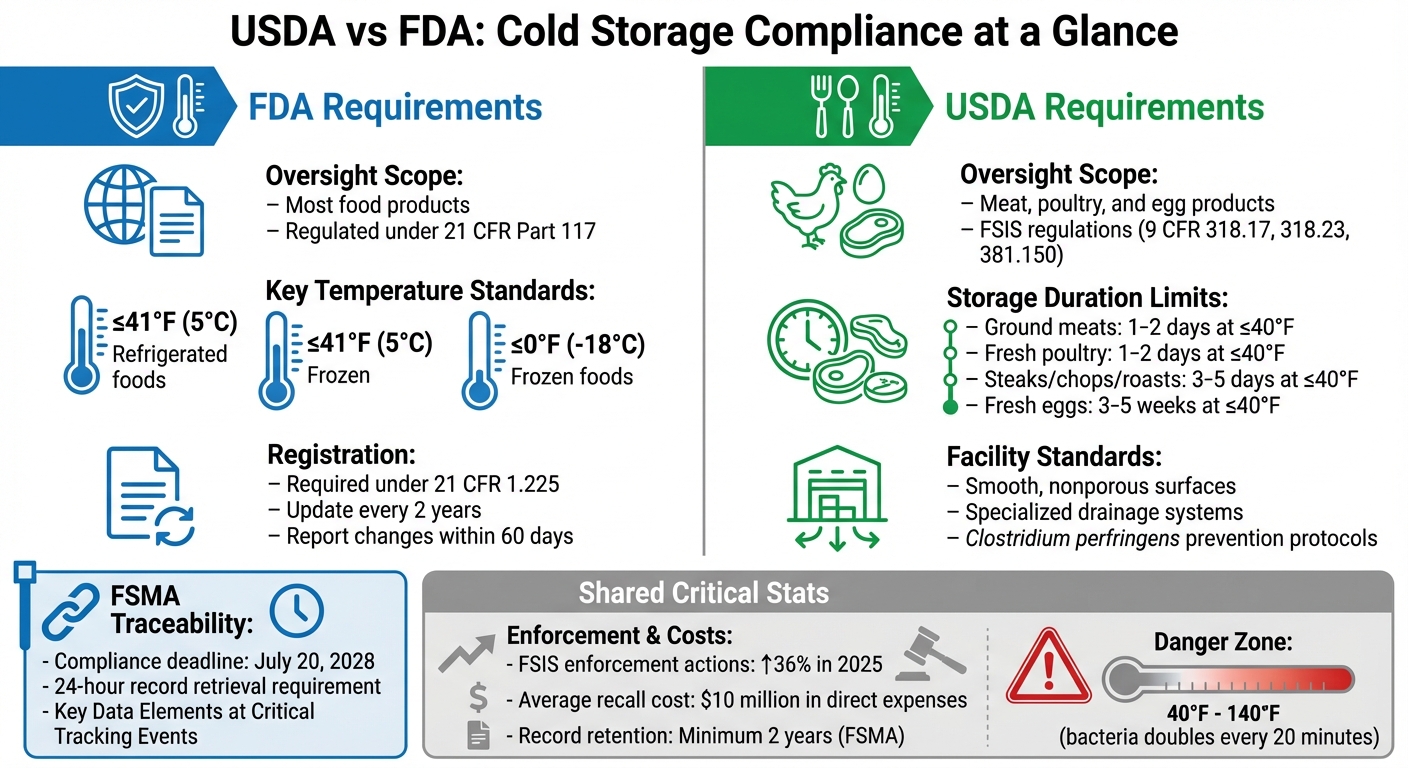
USDA vs. FDA Jurisdiction: The FDA regulates most food products under 21 CFR Part 117. The USDA FSIS governs meat, poultry, and egg products. Knowing your regulator determines your specific construction and operational requirements.
Temperature Control: Refrigerated TCS foods must stay at or below 41°F. Frozen items must remain at 0°F or colder. These are regulatory floors, not targets.
Facility Design: Smooth, nonporous food-safe surfaces, proper drainage slope, and zoned layouts prevent contamination and satisfy both agencies' construction standards.
Monitoring and Documentation: Real-time temperature monitoring with tamper-proof records under 21 CFR Part 11, retained for at least two years. Records must be producible within 24 hours of an FDA request.
FSMA Traceability: Facilities handling Food Traceability List items must document Key Data Elements at every Critical Tracking Event. Compliance deadline: July 20, 2028.
USDA vs FDA Cold Storage Compliance Requirements Comparison
1
USDA and FDA Regulations for Cold Storage Facilities
The FDA oversees most food products under 21 CFR Part 117. The USDA Food Safety and Inspection Service (FSIS) governs meat, poultry, and egg products. These are distinct regulatory frameworks with different inspection regimes, documentation requirements, and facility design standards. Which agency governs your facility determines everything downstream — from construction materials to staffing requirements to record retention schedules.
Before operations begin, both agencies require registration. Under 21 CFR 1.225, any warehouse storing food for U.S. consumption must register with the FDA unless exempt. Registration must be renewed every two years. Changes in ownership, location, or product categories must be reported within 60 days.
FSMA Preventive Controls for Cold Storage
FSMA emphasizes a prevention-first approach under 21 CFR Part 117. Facilities must conduct a hazard analysis and implement risk-based preventive controls tailored to their specific processes. For facilities storing unexposed packaged food, 21 CFR 117.206 outlines modified requirements focused on Time/Temperature Control for Safety (TCS) foods. These facilities must establish written procedures for monitoring temperatures, corrective actions, and verification — but not a full preventive control plan. Refrigerated products must be kept at or below 40°F (4°C); frozen items at 0°F (-18°C). Detailed documentation is required for temperature parameters, monitoring schedules, and corrective action protocols for each product type.
FDA inspections prioritize high-risk foods — ready-to-eat products exposed to the environment, items with allergen cross-contact risks, and foods requiring strict refrigeration. Facilities handling these products receive more frequent inspections and in-depth record reviews.
USDA Requirements for Meat, Poultry, and Egg Storage
FSIS stabilization guidelines (Revised Appendix B) define cooling rates and temperature maintenance requirements that directly influence refrigeration system design — specifically to prevent spore-forming bacteria like Clostridium perfringens. Regulations 9 CFR 318.17, 318.23, and 381.150 define acceptable temperature ranges, storage durations, and facility design standards, including how quickly products must reach safe storage temperatures after processing.
Product Category
Recommended Temp
Raw Storage Limit
Ground Meats (Beef, Turkey, Pork)
40°F or below
1–2 days
Fresh Poultry (Whole or Parts)
40°F or below
1–2 days
Steaks, Chops, and Roasts
40°F or below
3–5 days
Fresh Eggs (in shell)
40°F or below
3–5 weeks
FDA Traceability Standards
The FSMA 204 Food Traceability Rule requires facilities handling items on the Food Traceability List (FTL) to document Key Data Elements (KDEs) during Critical Tracking Events (CTEs) — receiving and shipping. The compliance deadline has been extended to July 20, 2028. Manual systems fall short in high-volume operations: records must be produced as an electronic, sortable spreadsheet within 24 hours of an FDA request during outbreak investigations.
2
Building USDA and FDA-Compliant Cold Storage Facilities
“Surfaces must be smooth, nonporous and easily cleanable to eliminate potential harborage points for bacteria.”
— RealCold
Food-Grade Materials and Hygienic Surfaces
Walls, ceilings, racks, and support structures must be built with materials that handle frequent cleaning without developing cracks or crevices where bacteria can harbor. Polyurethane foam (PUF) and polyisocyanurate (PIR) sandwich panels provide excellent thermal insulation with smooth, sealed surfaces that meet food-grade requirements. Flooring must be impervious and slope toward drainage points — flat floors that pool water are a compliance violation, not just an inconvenience.
Temperature Zoning and Cross-Contamination Prevention
Multi-temperature facilities require physical separation between zones to maintain thermal isolation and prevent contamination transfer. Standard zoning for compliant facilities: ambient zones (50–70°F) for loading and packaging; chilled zones (33–55°F) for produce and dairy; cold zones (28–32°F) for meat and seafood; frozen zones (0 to -10°F) for long-term storage. Each zone needs controlled air circulation to prevent contaminants from moving between areas. For facilities handling allergen-containing products, physical segregation between allergen and non-allergen zones is a regulatory requirement — not a best practice.
Drainage and Sanitation Systems
“Drainage systems must be engineered to avoid pooling water, while insulation and refrigeration equipment require regular inspection and servicing.”
— RealCold
Floors must slope at least 1/4 inch per foot toward drains. Design for deep cleaning from the start: adequate clearance around refrigeration units, accessible ceiling panels, and proper lighting throughout. Seal all potential pest entry points — gaps in foundations, loading docks, and utility penetrations. Facilities that address these in design avoid expensive retrofits during their first compliance inspection.
3
Temperature Monitoring and Control Systems
“The difference between a $10,000 corrective action and a $10 million recall often comes down to response time measured in minutes rather than hours.”
— Envigilance
Cold holding must stay at 41°F or below. Frozen storage at 0°F or below. These are the regulatory thresholds — set warning alerts below them to create a response buffer. Configuring alerts at 38°F gives time to act before a violation occurs.
Real-Time Monitoring and Alarm Systems
Modern wireless sensors record readings every 1–5 minutes. Resistance Temperature Detectors (RTDs) are highly accurate in deep-freeze settings; Type T thermocouples perform reliably in extremely cold conditions. Place sensors strategically: at evaporator returns, near dock doors (15–20 feet away), at ceiling-level coils, and at zone transitions. Rate-of-change alerts — triggered at approximately 2°F per hour of rise — detect equipment issues before temperatures reach critical levels. Alerts should escalate via SMS, email, and voice notification if deviations persist.
Backup Power and Redundancy Systems
Industrial-grade sensors with lithium batteries lasting up to 10 years operate reliably at -40°F. Wireless mesh networks such as WirelessHART create self-healing communication pathways — if one connection fails, sensors reroute automatically through alternative gateways, maintaining monitoring continuity through power outages and equipment failures.
Data Logging and Calibration
21 CFR Part 11 requires temperature records to be tamper-proof, timestamped, and include full audit trails. Monitoring and corrective action records must be reviewed within seven working days and retained for at least two years. FDA Food Code accuracy standards: food probes must be accurate to ±2°F; ambient air devices to ±3°F. Calibrate regularly against NIST standards and maintain written verification procedures — updated calibration certificates traceable to accredited standards are required under GFSI schemes.
4
Daily Operations for Maintaining Compliance
Sanitation and Hygiene Protocols
Daily cleaning is non-negotiable. High-traffic surfaces — door handles, loading docks — require daily cleaning. Racking systems and drains need weekly deep cleaning. Walls, ceilings, and low-traffic areas can be addressed monthly. Clean spills immediately with hot soapy water followed by a thorough rinse. Pathogenic bacteria double every 20 minutes when food enters the Danger Zone of 40°F–140°F — response time matters. Licensed pest control professionals should monitor traps daily and document corrective actions. Staff must follow GMPs: 20-second handwashing, appropriate protective clothing, immediate illness reporting.
Inventory Management and Allergen Segregation
Implement FIFO (First In, First Out) or FEFO (First Expired, First Out) rotation to ensure older products move before newer ones. Use dedicated zones with physical barriers or color-coded markings for allergen control — dedicated equipment per allergen to prevent cross-contact. Verify packaging integrity at receiving. Record Key Data Elements at every Critical Tracking Event. Separate raw materials from finished goods with clearly marked barriers. A mock recall conducted annually using current records identifies gaps in documentation or staff readiness before an actual recall forces the issue.
Employee Training and Accountability
All food-handling staff require training in GMPs, allergen control, and temperature management under 21 CFR 117.4. A Preventive Controls Qualified Individual (PCQI) must oversee the Food Safety Plan. Document all cleaning tasks to create an audit trail. Annual refresher training keeps staff current with FSMA and USDA regulatory changes. Competency assessments verify that protocols are being executed correctly — not just acknowledged in a training session. With FSIS enforcement actions up 36% in early 2025, documentation gaps that would have been overlooked in previous years are now triggering enforcement action.
5
Documentation and Audit Preparation
“If it isn't written, it didn't happen.”
— Rinac
Record-Keeping for USDA and FDA Inspections
Four record categories must be maintained and retrievable: facility operations (cleaning schedules for food-contact and non-contact surfaces, pest control logs, maintenance reports, employee training records); temperature safety (continuous monitoring logs, calibration certificates traceable to accredited standards, temperature mapping studies identifying warm spots, corrective action reports for deviations); traceability (FTL identification procedures, TLC assignment process, documented point of contact); and shipping and receiving (TLCs, location descriptions, quantities, units of measure, arrival and departure times). FSMA Preventive Controls records must be retained for at least two years. FDA records must be kept for one year beyond the product's shelf life.
FSMA Traceability and Key Data Elements
For FTL foods, document at every Critical Tracking Event: Traceability Lot Code (TLC), quantity and location, supplier information at receiving, new TLCs if created, ingredients used, process and transformation dates, output descriptions, and recipient information with ship dates and origin locations at shipping. Your written traceability plan must outline record maintenance procedures, FTL identification methods, and TLC assignment process — and designate a specific point of contact. Records must be producible as an electronic, sortable spreadsheet within 24 hours of an FDA request. Train staff to access and format these records before an outbreak investigation requires it.
Preparing Your Facility for Audits
Review monitoring records monthly to identify potential issues before inspectors do. Conduct at least one annual mock recall to test traceability and recall procedures end-to-end. Automated temperature monitoring systems resolve up to 90% of documentation errors by creating tamper-proof digital audit trails — manual systems create the documentation gaps that trigger enforcement actions. Ensure all sensors and probes have updated calibration certificates. FSIS inspections now target systemic control issues, not isolated incidents — a pattern of documentation failures is more dangerous than a single deviation.
“The difference between a $10,000 corrective action and a $10 million recall often comes down to response time measured in minutes rather than hours.”
— FDA FSMA Compliance Guide
Conclusion
USDA and FDA compliance is not a one-time certification — it is a daily operational discipline built into facility design, monitoring infrastructure, staff training, and documentation systems. Food recalls averaging $10 million in direct costs and FSIS enforcement actions up 36% in 2025 have raised the cost of non-compliance to a level that makes proactive investment in compliant design and operations unambiguously justified. Build compliance into the facility from day one. Retrofit compliance is more expensive, less effective, and increasingly scrutinized by inspectors trained to identify systemic failures. US Cold Storage Builders designs and constructs USDA and FDA-compliant cold storage facilities — from food-grade surface specifications and drainage systems to temperature monitoring infrastructure — ensuring your facility is inspection-ready from commissioning.
frequently asked questions
FAQ — USDA & FDA Cold Storage Compliance
How do I know if my facility is under USDA or FDA jurisdiction?
Check your facility's registration and the product categories you store. USDA FSIS governs facilities handling meat, poultry, and egg products — these facilities typically hold a federal license through the United States Warehouse Act or operate under direct FSIS oversight. FDA-regulated facilities store all other food categories and must register under 21 CFR 1.225. If your facility stores both USDA and FDA-regulated products, you may be subject to both regulatory frameworks simultaneously — with different documentation requirements, inspection schedules, and design standards for each product category. Consult a regulatory specialist if your product mix spans both agencies.
What temperature monitoring records do inspectors expect?
Inspectors expect continuous, real-time temperature logs with clear timestamps, deviation flags, and documented corrective actions for every temperature excursion. Under 21 CFR Part 11, records must be tamper-proof and include full audit trails. Calibration certificates for all sensors and probes must be current and traceable to NIST standards. Records must be retained for at least two years and be producible within 24 hours of an FDA request. Manual logs with gaps, illegible entries, or missing corrective action documentation are the most common triggers for enforcement action during inspections.
Do I need FSMA 204 traceability if I only store packaged food?
It depends on whether the packaged food appears on the FDA's Food Traceability List (FTL). If your facility stores only packaged foods not listed on the FTL, FSMA 204 traceability requirements do not apply — you still need standard temperature monitoring and corrective action documentation under 21 CFR 117.206, but not the full Key Data Element tracking at Critical Tracking Events. If any FTL items are in your inventory — including certain fresh produce, shell eggs, nut butters, and ready-to-eat foods — the full traceability requirements apply to those items regardless of packaging status. The compliance deadline is July 20, 2028.

 The FDA oversees most food products under 21 CFR Part 117. The USDA Food Safety and Inspection Service (FSIS) governs meat, poultry, and egg products. These are distinct regulatory frameworks with different inspection regimes, documentation requirements, and facility design standards. Which agency governs your facility determines everything downstream — from construction materials to staffing requirements to record retention schedules.
Before operations begin, both agencies require registration. Under 21 CFR 1.225, any warehouse storing food for U.S. consumption must register with the FDA unless exempt. Registration must be renewed every two years. Changes in ownership, location, or product categories must be reported within 60 days.
The FDA oversees most food products under 21 CFR Part 117. The USDA Food Safety and Inspection Service (FSIS) governs meat, poultry, and egg products. These are distinct regulatory frameworks with different inspection regimes, documentation requirements, and facility design standards. Which agency governs your facility determines everything downstream — from construction materials to staffing requirements to record retention schedules.
Before operations begin, both agencies require registration. Under 21 CFR 1.225, any warehouse storing food for U.S. consumption must register with the FDA unless exempt. Registration must be renewed every two years. Changes in ownership, location, or product categories must be reported within 60 days.