
Food Safety Compliance Knowledge Hub
Blast freezer zones are critical for maintaining food safety and preventing costly losses. This guide breaks down the challenges of compliance and offers actionable solutions for engineering, monitoring, and training in these environments.
At a glance: Compliance in blast freezer zones requires precise temperature control, airflow engineering, and real-time monitoring.
- Temperature Control: Keep food out of the danger zone to prevent bacterial growth.
- Airflow Issues: Poor airflow leads to uneven cooling and compliance failures.
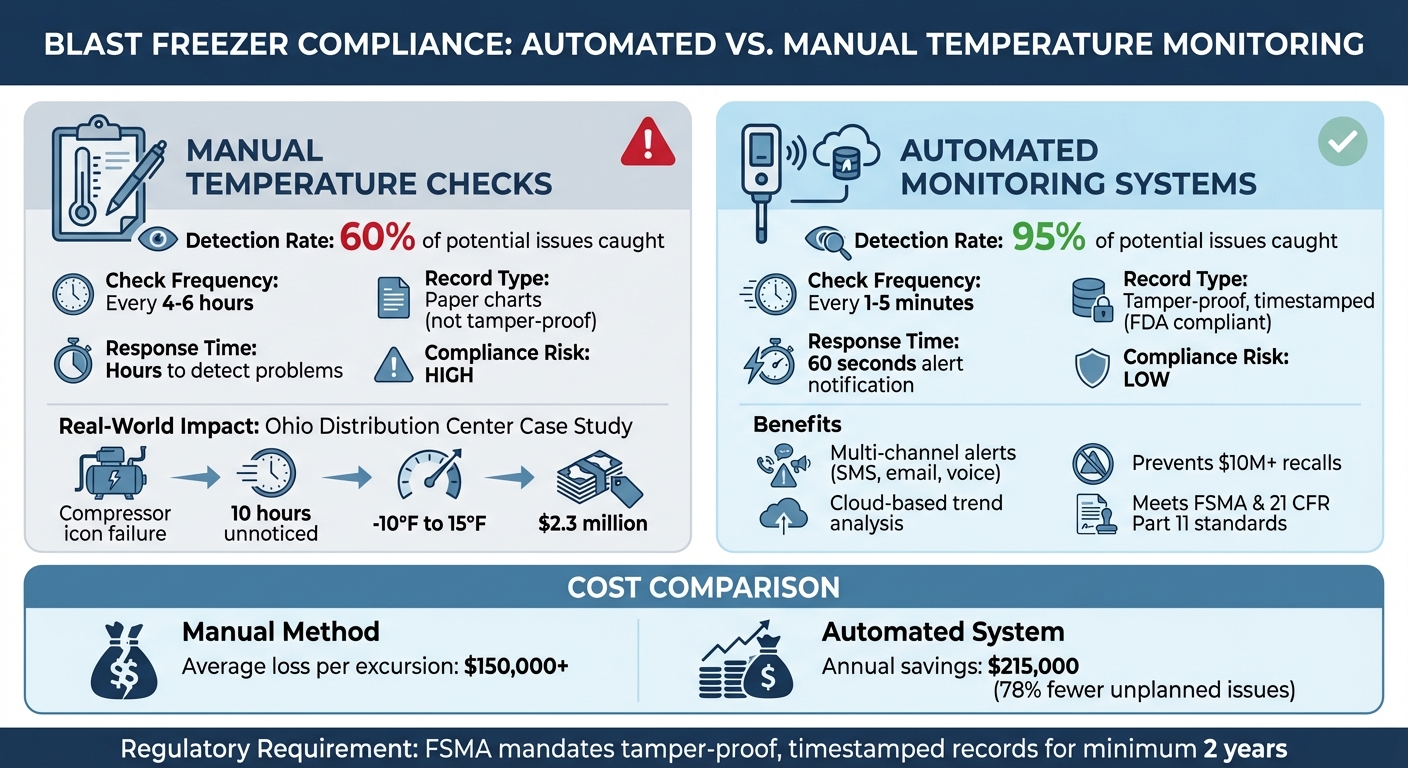
- Monitoring Gaps: Automated systems catch 95% of issues, compared to 60% for manual checks.
Temperature Control and Bacterial Risks
Food in the temperature danger zone (40°F–140°F) can develop harmful bacteria like Listeria and E. coli. Regulations require cooling from 158°F to 41°F within 90 minutes. If cooling takes too long, compliance and public health are at risk.
Airflow and Cooling Challenges
Uneven cooling happens when airflow bypasses products, leaving warm spots. Air short-circuiting is often caused by poorly stacked pallets or blocked vents. Proper airflow at over 700 feet per minute ensures uniform cooling and prevents issues like large ice crystals and drip loss.
Monitoring and Documentation
Manual temperature checks leave dangerous gaps. Automated systems, which log data every 1–5 minutes, catch 95% of issues before they escalate. In contrast, manual methods detect only 60%. Facilities must also keep tamper-proof records for at least two years to meet FSMA standards.
Conclusion
Food safety compliance in blast freezer zones hinges on precise engineering, automated monitoring, and well-trained staff. Facilities that invest in these areas not only meet regulations but also save money by avoiding product losses and fines. Companies like US Cold Storage Builders specialize in frozen storage and freezer facility construction to ensure compliance and operational efficiency.
industry insights
Key Insights for Blast Freezer Compliance
Temperature Danger Zone
Bacteria double every 20 minutes in the 40°F–140°F range. Rapid cooling is essential to prevent growth.
Airflow Engineering
Air must flow at 700+ feet per minute to avoid warm spots and ensure uniform freezing.
Automated Monitoring
Automated systems catch 95% of issues, compared to 60% for manual checks.
Compliance Records
Facilities must keep tamper-proof, timestamped records for at least two years under FSMA.
Equipment Calibration
Annual calibration ensures temperature accuracy within ±2°F, preventing compliance failures.
Staff Training
Training Preventive Controls Qualified Individuals (PCQI) ensures rapid response to deviations.
Stay ahead of compliance challenges with these insights.
FAQ – Food Safety in Blast Freezers
Why is airflow critical in blast freezers?
Proper airflow ensures uniform cooling, prevents warm spots, and avoids compliance failures.
What are FSMA temperature recording requirements?
Facilities must keep tamper-proof, timestamped temperature records for at least two years.
How can automated monitoring save money?
Automated systems catch issues early, reducing product losses and minimizing costly recalls.
Build a Compliant Blast Freezer
We design and build cold storage facilities that meet FDA and USDA standards. Protect your products and your business.
📞 Call (346) 676-COLDWhat Is Blast Freezing? – How It Comes Together
sbb-itb-ac9c73d
Food Safety Compliance Challenges in Blast Freezer Zones
Automated vs Manual Temperature Monitoring in Blast Freezers: Compliance Effectiveness
Temperature Danger Zone and Bacterial Growth
Blast freezers have one critical job: keeping food out of the temperature danger zone – the range between 40°F and 140°F where bacteria like Salmonella, Listeria, and E. coli thrive. In this range, bacteria can double every 20 minutes. If cooling is too slow or uneven, food stays in this danger zone longer than regulations allow, putting compliance and public safety at risk.
"The faster the freeze, the less time pathogens have to grow." – Folio3 Foodtech
Here’s the reality: about 600 million people worldwide suffer from foodborne illnesses annually. That’s why regulations like FSMA demand that blast freezers cool products from 158°F to 41°F within 90 minutes. Failing to meet this standard isn’t just a compliance issue – it’s a public health threat.
But cooling speed isn’t the only challenge. Airflow plays a major role too.
Uneven Cooling and Airflow Problems
One of the biggest culprits behind compliance failures? Air short-circuiting. This happens when airflow bypasses the product, leaving warm spots that violate safety standards. Common causes include poorly stacked pallets, stretch wrap blocking vents, or boxes misaligned with the airflow.
"If there is too much space above or below each pallet, air will flow around the product zone… if there is not enough space for the required volume of air to flow through the product zone, freezing performance will suffer." – Randy Peterson, Project Development Manager, Stellar
For proper cooling, air must move through the product zone at speeds over 700 feet per minute. Anything less can lead to large ice crystals forming in the food, damaging cell walls, causing drip loss during thawing, and increasing the risk of cross-contamination. And if your airflow isn’t up to par, don’t expect to pass a HACCP audit.
Poor airflow also makes it harder to monitor and document compliance effectively – another area where facilities often fall short.
Monitoring and Documentation Gaps
Regulations require blast freezers to maintain continuous, timestamped temperature records, but many facilities still rely on manual checks every 4 to 6 hours. This creates dangerous blind spots. For example, at a food & beverage cold storage facility in Ohio, a compressor failure went unnoticed for ten hours because the last manual check had been hours earlier. By the time the problem was discovered, temperatures had risen from -10°F to 15°F, resulting in $2.3 million in losses.
"The difference between a minor temperature excursion and a catastrophic loss often comes down to one factor: how fast you know there is a problem." – Envigilance
Automated monitoring systems, on the other hand, catch 95% of potential temperature issues before they cause damage, compared to just 60% for manual methods. Yet many facilities stick to outdated paper charts, which are ineffective for real-time problem-solving or meeting FDA audit requirements. Under FSMA, facilities must keep tamper-proof, timestamped records for at least two years.
HACCP Critical Limits for Blast Freezing
HACCP Critical Limits for Blast Freezing
HACCP protocols are designed to ensure food safety during blast freezing by setting strict temperature controls and documentation standards. This section breaks down key cooling stages, compliance requirements, and challenges in achieving uniform temperature distribution.
Design and Engineering Solutions for Compliant Blast Freezers
Design and Engineering Solutions for Compliant Blast Freezers
Food safety in blast freezers starts with smart design. The right cold storage construction choices ensure rapid cooling and uniform temperatures, meeting HACCP standards. Here's how engineering strategies turn compliance challenges into actionable solutions.
Monitoring and Staff Training for Compliance
Real-Time Monitoring and Data Logging
Manual temperature checks every 2–4 hours can lead to losses exceeding $150,000 per excursion. Automated sensors solve this problem by recording temperatures every 1–5 minutes and creating tamper-proof, timestamped records that meet FDA FSMA and 21 CFR Part 11 standards. These systems detect potential issues early, allowing for quicker corrective actions.
Multi-channel alerts ensure deviations are addressed immediately, with notifications sent via SMS, email, or voice within 60 seconds. Tiered alerts can escalate the response: a 5°F rise sends a text to the on-duty supervisor, a 10°F increase notifies facility management, and a 15°F deviation triggers emergency protocols. Strategically placing sensors in return air streams and within 15–20 feet of dock doors helps catch early signs of cooling failures.
Cloud-based platforms go a step further by analyzing trends to spot gradual warming or equipment issues. This allows maintenance teams to fix problems – like compressor failures – before they escalate, preventing recalls that can cost $10 million in direct expenses. These automated systems require equally swift responses from staff to avoid costly outcomes.
Staff Training on Best Practices
Advanced monitoring systems are only as effective as the team managing them. Training staff as Preventive Controls Qualified Individuals (PCQI) ensures they can interpret monitoring data and document corrective actions in line with FSMA requirements. Tailored training equips operators with skills like proper probe placement and airflow management, while supervisors learn to handle deviations, including re-chilling protocols and product disposition decisions.
Interactive methods like simulations and role-playing are especially effective in preparing staff for real-time alerts, going beyond traditional lectures. Regular refresher courses reinforce these skills, which is critical in sub-zero environments where certain hazards may occur infrequently. Companies that invest in comprehensive training have reported a 17% increase in productivity and a 21% rise in profitability.
The 2024 Boar's Head Listeria outbreak, which caused 61 illnesses and 10 deaths, highlighted long-standing failures in temperature control and environmental monitoring. This case shows how faster response times – measured in minutes rather than hours – can prevent a $10,000 corrective action from turning into a $10 million recall.
Equipment Calibration and Maintenance Logs
Annual calibration of temperature devices (or as specified by the manufacturer) is essential to maintain an accuracy of ±2°F. RTD (Resistance Temperature Detector) sensors are recommended for deep-freeze environments because they offer better accuracy and stability at -40°F compared to thermocouples.
Modern monitoring platforms simplify this process by tracking calibration dates, storing certificates digitally, and alerting users when recalibration is due. These systems can reduce audit documentation gaps by up to 90% by generating instant, audit-ready reports. For wireless sensors, lithium primary batteries are a must, as standard alkaline batteries lose 90% of their capacity below 0°F.
Integrating temperature data with Maintenance Management Software (MMS) through API connections automates work orders when performance anomalies are detected. Deploying one ambient sensor per 5,000–10,000 square feet, with additional sensors at zone transitions, ensures accurate monitoring. This approach strengthens both equipment reliability and staff readiness to meet compliance standards.
Conclusion
Ensuring food safety compliance in blast freezer zones requires a seamless combination of construction, monitoring, and employee training. These facilities must operate as a unified thermal system. Insulated metal panels form a reliable sub-zero barrier, sanitary surfaces reduce bacterial risks, and carefully managed airflow eliminates warm spots.
This approach goes beyond just health protection – it also saves money. Facilities with solid preventive maintenance programs report 78% fewer unplanned temperature issues and save roughly $215,000 annually on avoided product losses, emergency fixes, and regulatory fines. Consider the February 2024 Family Dollar case: a failure in environmental monitoring and temperature control led to a record-breaking $41.675 million penalty, underscoring the stakes.
Automation plays a key role here. Advanced systems provide fast issue detection and generate audit-ready records that meet FDA and USDA standards, including 21 CFR Part 11 compliance. Monthly sensor calibrations against certified benchmarks prevent undetected temperature errors caused by sensor drift.
Training ties it all together. Standard Operating Procedures (SOPs) ensure consistency even during staff changes, while PCQI-certified teams can analyze monitoring data and act swiftly when needed. Together, these steps create a robust compliance framework, as seen in top-tier cold storage facilities.
For cold storage builders and operators, aligning design, monitoring, and training turns compliance into a strategic advantage. Companies like US Cold Storage Builders (https://uscoldstoragebuilders.com) show how an integrated system can maintain sub-zero environments and detailed documentation, ensuring both public safety and business resilience.