Cold Storage Construction FAQs: Essential Answers for Developers
Answers for developers on thermal design, vapor barriers, insulation, refrigeration options, frost-heave prevention, energy efficiency, and regulatory compliance.
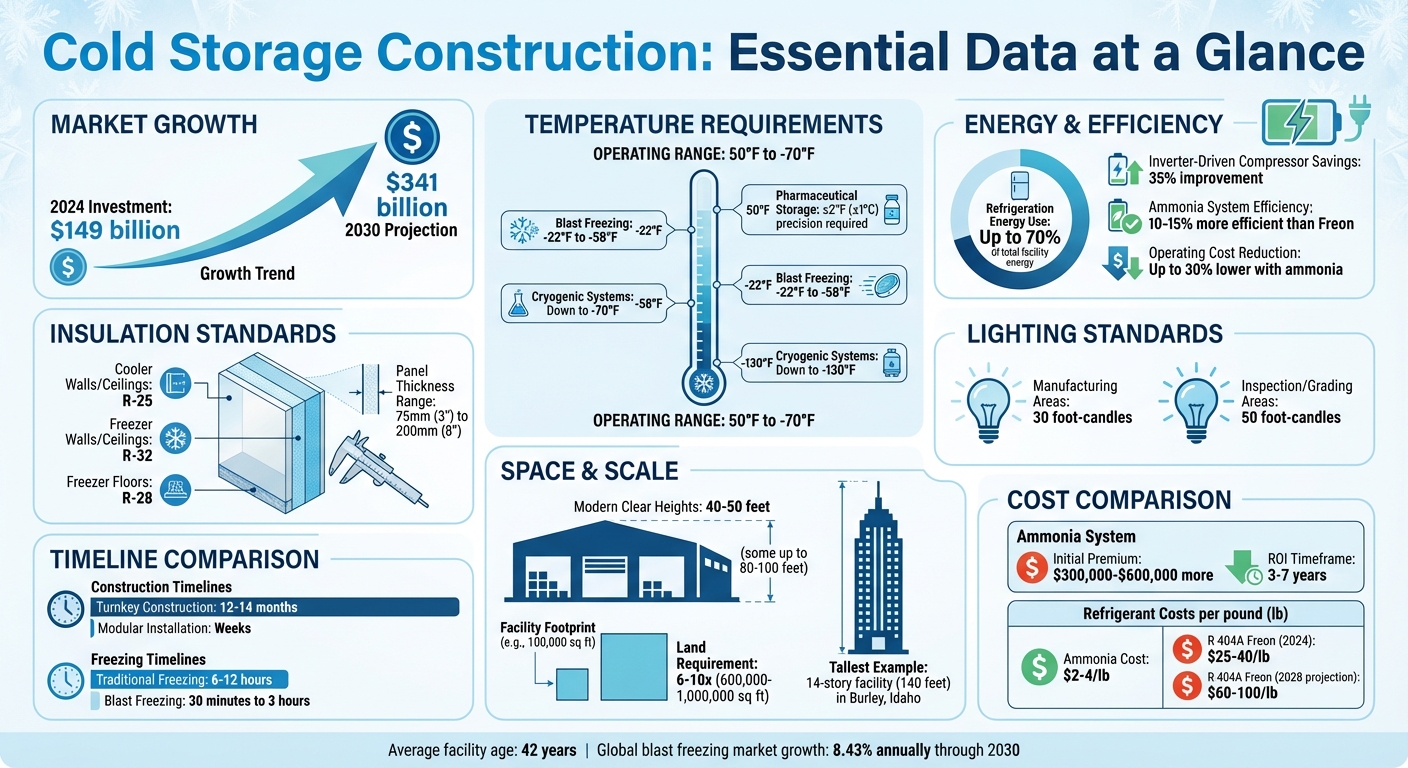
Cold storage construction is one of the most technically demanding building types in the industry — maintaining temperatures from 50°F down to -70°F while meeting FDA and USDA compliance, preventing frost heave, and managing refrigeration loads that consume up to 70% of total facility energy. With global investment reaching $149 billion in 2024 and projected to hit $341 billion by 2030, the margin for design errors has never been smaller.
At a glance: Five technical domains determine the success of every cold storage construction project:
Design and Thermal Zoning: Multi-zone layouts, vapor barriers, and airlock systems prevent moisture infiltration and thermal shock during product transfers.
USDA and FDA Compliance: Food-grade materials, drainage slope, lighting standards, and hygienic zone separation are construction requirements — not afterthoughts.
Insulation and Refrigeration Systems: R-value targets, panel selection, and the ammonia vs. Freon decision drive long-term operating costs.
Site Preparation and Foundation: Frost heave prevention through sub-slab heating and soil testing protects the entire structure from the ground up.
Turnkey vs. Modular Construction: Design-build models compress timelines; modular systems enable rapid scaling and multi-temperature flexibility.
Cold Storage Construction: Key Statistics and Requirements by Category
1
Design Considerations for Cold Storage Facilities
Think of a cold storage facility as a six-sided box: walls, roof, and floor slab must form a continuous thermal and vapor barrier. Break that envelope anywhere — a missed joint, an unsealed penetration, a thermal bridge — and moisture infiltrates. Moisture leads to ice buildup, insulation failure, and structural damage. Every design decision flows from protecting that envelope.
Thermal Zoning and Multi-Temperature Facilities
Separate temperature zones reduce energy waste and protect product integrity. Multi-temperature facilities typically include ambient buffer zones (50°F–70°F) between the exterior and refrigerated areas — these zones reduce thermal shock when products move in and out and counteract the reversed stack effect, where cold dense air creates negative pressure that pulls in warm humid air.
In the Northeast U.S., facilities set at 20°F face condensation risk for over 80% of the year because exterior dew points exceed interior temperatures. Pharmaceutical cold storage adds another layer: precise temperature control within ±2°F (±1°C) is required. Vapor barriers must be placed on the warm side of insulation — not the cold side — to prevent condensation forming inside the wall assembly. Airlocks, vestibules, or air curtains at loading docks maintain temperatures during product transfers.
The centralized vs. decentralized refrigeration question matters here. Centralized systems use a single large unit for the entire facility — simpler to maintain. Decentralized systems run smaller units per zone — more flexible for multi-temperature operations and more resilient if one zone fails.
Storage Layouts for Logistics and Accessibility
Modern cold storage facilities reach clear heights of 40–50 feet; some go significantly higher. NewCold's 14-story facility in Burley, Idaho — approximately 140 feet tall — demonstrates how vertical space and automation can maximize storage while minimizing footprint. Poorly positioned racks block evaporators and create hot spots. Design rules: aisles at minimum 36 inches wide (ADA compliance), floor slope of 1:100 for drainage, and staff pathways that keep office personnel out of freezing storage zones entirely. Separate ethylene-producing items — apples, onions, tomatoes — into isolated rooms to prevent spoilage of sensitive adjacent products.
Energy Efficiency and Sustainability
Refrigeration accounts for up to 70% of total facility energy use. High-performance insulation materials like extruded polystyrene (XPS) or vacuum-insulated panels (VIPs) reduce heat transfer. Inverter-driven compressors improve efficiency by as much as 35%. Natural refrigerants — ammonia (R-717) and CO2 (R-744) — offer better heat transfer and dramatically lower environmental impact versus traditional HFCs. Heat recovery systems capture waste heat from refrigeration and redirect it to warm floor slabs in sub-zero areas, eliminating dedicated sub-floor heating systems. Walmart's 330,000 sq ft Case-Ready Beef Processing Facility used this approach to cut both construction and energy costs. Solar with battery storage offsets peak demand; IoT sensors and AI algorithms fine-tune cooling in real time.
2
USDA and FDA Compliance Standards
The FDA oversees food facility registration and enforces FSMA. The USDA regulates facilities handling meat, poultry, and egg products. Which agency governs your facility determines your specific construction standards — and those standards must be built into the design from day one, not added as corrections during inspection.
Food-Grade Construction Requirements
Floors, walls, and ceilings must be smooth, nonporous, and easy to clean. Light-colored finishes are required for walls and ceilings in processing and storage areas — they make contamination visible. Lighting fixtures above exposed food require shatterproof bulbs or protective shields. USDA lighting standards: 30 foot-candles on working surfaces in manufacturing areas; 50 foot-candles in areas where products are graded or inspected. Food-contact surfaces must be stainless steel or corrosion-resistant material — Type 316 stainless steel is the specified standard. Equipment mounted on floors must be elevated at least 6 inches; table-mounted equipment requires 4 inches of clearance to allow cleaning beneath.
Continuous, sealed walls, ceilings, and self-closing doors must divide processing areas from other sections — no shared air, no shared drainage path between zones of different hygienic classification.
Hygienic Design and Drainage Systems
Floors must be made of impervious materials — tile or concrete — sloped to direct water away from work areas. In cold storage rooms, floors may slope toward an exit rather than internal drains. All drains connected to sewers require an air break or mechanical backflow prevention device to stop back-siphonage. Ventilation is critical in processing and container-washing areas — excessive moisture fosters Listeria and mold. Listeria survives in refrigerated environments, not just warm ones, making moisture control in cold storage zones a regulatory requirement, not just an operational preference. Separate raw and ready-to-eat areas into distinct hygienic zones. Seal all service pipe openings through exterior walls with tight metal collars — these are the entry points pests use.
3
Insulation Systems and Refrigeration Technologies
“The vapor barrier is absolutely paramount. Once moisture gets into a cold storage facility, the problems multiply quickly.”
— Adam Bortz, Director and Account Leader of Industrial, Nelson Worldwide
Selecting Insulation Panels for Cold Storage
U.S. Department of Energy standards set minimum R-value targets: R-25 for cooler walls and ceilings, R-32 for freezer walls and ceilings, and R-28 for freezer floors. Panel thickness ranges from 75 mm (3 inches) for moderate temperatures (32°F–50°F) to 200 mm (8 inches) for environments below -4°F.
Core material drives thermal performance and fire safety. Polyurethane (PU) panels at 0.018–0.022 W/m·K thermal conductivity are the reliable standard for general cold storage. Polyisocyanurate (PIR) panels match PU thermal performance but excel in fire resistance (B-s2,d0 rating) at 10–15% higher cost — for facilities at -4°F, PIR can reduce energy costs by 10–25% over EPS. Cold storage panels achieve R-values of 6.5–8.0 per inch, outperforming standard construction panels by 25–30%.
Apply 3–5 mm beads of silicone or polyurethane sealant to all panel joints — microgaps cause condensation during temperature fluctuations. Vapor barrier permeance must be less than 0.01 perms. Pay particular attention to roof-to-wall transitions and penetrations — these are the most common failure points. For freezer floors, sub-slab heating (glycol or electric) is not optional; it is structural protection against frost heave.
Ammonia vs. Freon Refrigeration Systems
Ammonia (R-717) systems run 10–15% more efficiently than Freon-based systems, with operating costs up to 30% lower in large facilities. The higher upfront cost — typically $300,000–$600,000 more for mid-sized facilities — is offset within 3–7 years through energy savings and refrigerant cost advantages. Ammonia costs $2–$4 per pound. R-404A Freon has risen from $5–$8/lb in 2019 to $25–$40/lb by 2024, with projections of $60–$100/lb by 2028 as regulatory phase-downs accelerate.
Starting January 1, 2026, refrigerants with a Global Warming Potential (GWP) over 150 are restricted in new cold storage warehouses with charges of 200 lbs or more. Ammonia has a GWP of 0. HFCs range from GWP 1,300–3,900. The regulatory direction is clear. For systems under 100 tons, Freon remains more cost-effective due to simpler infrastructure requirements. For systems over 200 tons, ammonia's long-term efficiency makes it the preferred specification.
Factor
Ammonia (R-717)
Freon (HFCs)
Efficiency vs. Freon
10–15% more efficient
Baseline
Refrigerant Cost (2024)
$2–$4/lb
$25–$40/lb (R-404A)
GWP
0
1,300–3,900
Upfront Cost Premium
$300K–$600K more (mid-sized)
Lower upfront
Cost Recovery Period
3–7 years
Ongoing higher operating costs
Best For
Systems over 200 tons
Systems under 100 tons
Blast Freezing Technologies for Sub-Zero Storage
Blast freezers use high-velocity airflow — 10–20 feet per second — to rapidly freeze products, forming small ice crystals that preserve texture and cellular structure. Operating at -22°F to -58°F, blast freezers complete the freeze in 30 minutes to 3 hours versus 6–12 hours for conventional methods. The global blast freezing market is projected to grow from $2.11 billion in 2025 to $3.16 billion by 2030 at an 8.43% annual growth rate.
Top-performing systems for meat freezing now operate at 80–120 kWh per ton versus 140–200 kWh in standard facilities. Adding VSDs to compressors cuts electricity use by 8–15%; floating head pressure control reduces compressor power by 1.5–3% per 1.8°F drop in condensing temperature. The San Diego Blood Bank reported a 317% increase in throughput after replacing mechanical freezers with Cryometrix B-90 liquid nitrogen blast freezers — freezing 400 units of plasma from 68°F to -130°F in under 10 minutes, with ROI achieved in 28.5 months.
4
Site Preparation and Foundation Techniques
“One of the greatest dangers to your cold storage area may be right under your feet: frost heave.”
— Matt Gurreri, Product Marketing Manager, Emerson Automation Solutions
Sub-zero temperatures freeze soil moisture and form ice lenses — formations that exert upward pressure, lifting concrete slabs and tilting storage racks. By the time you see the symptoms, the structural damage is already underway. Prevention happens in the design phase, not the repair phase.
Preventing Ground Freeze with Foundation Design
Keeping soil above 32°F is the goal. Two systems achieve this: electric heating cables — self-regulating, minimal maintenance, replaceable without disturbing the floor — and pumped glycol systems that heat glycol to approximately 65°F, with the option to repurpose refrigeration waste heat. Glycol systems are effective but carry leak detection and environmental contamination risks that electric systems don't.
Sub-slab insulation must be installed in multiple layers with staggered joints to eliminate thermal gaps — one inch of high-quality insulation provides the same thermal protection as approximately two feet of soil. Redundant heating loops are non-negotiable: a single-loop failure without backup means frost heave risk during the repair window. Pressure-test both glycol and electric systems before pouring concrete. Thermal breaks at slab, wall, and roof transitions prevent cold from bypassing insulation through structural elements. Cool the facility gradually over several weeks to minimize thermal shock during commissioning.
“The point of a cold storage facility is to bring the temperature down, but below the floor is soil and earth that can freeze, which can shift the foundation of the building or heave the slabs.”
— Kate Lyle, Principal Architect, Lamar Johnson Collaborative
Soil Testing and Site Preparation
Soil testing identifies frost-heave susceptibility and determines required heating capacity. Tests focus on thermal properties and moisture content — both directly influence foundation design. High-moisture or frost-susceptible soils require more robust heating and drainage solutions. Use non-frost-susceptible backfill and ensure proper site grading to reduce moisture accumulation under the foundation. Modern cold storage facilities reaching 80–100 feet clear heights impose significant loads that require higher slab tolerances — coordinate slab specifications with racking system design from the start, not after concrete is poured.
5
Turnkey Construction and Modular Cold Storage Solutions
Benefits of Turnkey Cold Storage Construction
Turnkey design-build models overlap design, site preparation, procurement, and construction — targeting a 12–14 month timeline from planning to completion. By integrating architects, engineers, and specialized contractors from day one, design-build eliminates the gaps between disciplines that cause redesigns and permitting delays. Dedicated teams for thermal envelopes and refrigeration systems ensure better project sequencing, and bulk purchasing of Insulated Metal Panels produces measurable cost savings.
Engage local authorities early to address utility constraints and fire code requirements before they cause mid-project stoppages. Coordinate mechanical refrigeration loads with electrical infrastructure from the start — refrigeration consumes up to 70% of facility energy, and mid-project adjustments to electrical capacity are expensive.
Modular Cold Storage Systems for Scalability
Modular systems use factory-produced insulated panels assembled on-site. Installation can be completed in weeks, not months — a significant advantage for operations responding to seasonal demand or rapid market changes. Modern modular designs include “swing rooms” that switch between chilled (+35°F) and frozen (-20°F) settings without structural modification. Temperature capability: -40°F to +40°F. Mobility is another advantage — modular units can be relocated as operational needs change.
Since modular units are often classified as equipment or temporary structures, they can bypass lengthy building permit requirements. Design in an additional 10–20% of space for future expansion — adding modules later is far cheaper than structural modifications to a fixed building. Even large turnkey projects can incorporate modular elements, making technology upgrades or capacity expansion achievable without significant structural changes.
6
Cold Storage Retrofits and Expansions
The average cold storage facility in the U.S. is 42 years old. That means outdated insulation, refrigeration systems that predate modern efficiency standards, and structural configurations never designed for today's automation loads. Retrofits are where the technical complexity of cold storage construction is most concentrated.
Retrofitting Older Facilities
“In a cold storage environment, vapor barriers need to be airtight, not just watertight.”
— Stellar
Preserving the thermal envelope is the first priority in any retrofit. Even small warm-air infiltration points cause ice buildup and structural damage. When converting a warm warehouse section to cold storage, install a thermal break in the concrete floor — without it, cold transfers across the slab and condensation forms on the warm side. Older facilities often lack the roof load-bearing capacity for modern compressors and evaporators, which are typically roof-mounted. Structural reinforcements — double columns, girders, stronger roofing — are frequently required before refrigeration equipment can be installed. Plan for refrigeration equipment lead times of 10–12 months; retrofits that don't account for this in the schedule will stall.
Upgrading to Energy-Efficient Systems
High-efficiency compressors with VSDs adjust cooling output to real-time demand — immediate and measurable energy savings. Switch to low-GWP refrigerants (ammonia R-717 or CO2 R-744) for both compliance and efficiency gains. New DOE regulations set compliance deadlines: non-display doors by December 23, 2027; refrigeration systems by December 31, 2028. Replacing fluorescent lights with LEDs and motion sensors cuts heat output and reduces refrigeration load. Insulated Metal Panels with high R-values and built-in vapor barriers are ideal for retrofits where space is limited — they deliver both thermal performance and moisture control in a single assembly.
Conclusion
Cold storage construction succeeds or fails at the intersection of thermal integrity, regulatory precision, and mechanical engineering. The six-sided thermal envelope — floor, walls, roof — must be continuous and vapor-tight. Site preparation must protect the foundation from frost heave before the first structural element goes up. Refrigeration system selection must account for a 20–30 year operating horizon, not just the installation quote. And the construction method — turnkey or modular — must match the project's timeline, scalability requirements, and budget constraints.
These projects require specialized expertise at every phase. US Cold Storage Builders manages every aspect of cold storage construction — from thermal envelope design and foundation engineering through insulated panel installation, refrigeration system integration, and regulatory compliance — ensuring facilities meet USDA and FDA standards and perform efficiently for decades.
frequently asked questions
FAQ — Cold Storage Construction
How do I choose the right temperature zones for my facility?
Start with your product requirements — frozen, refrigerated, or multi-temperature — then design zones to keep those conditions separate with minimal energy transfer between them. Ambient buffer zones between exterior and refrigerated areas reduce thermal shock during transfers and manage the reversed stack effect. For pharmaceutical applications requiring ±2°F precision, decentralized refrigeration systems give you finer control per zone. Work with cold storage engineers from the design phase — zone boundaries, vapor barrier placement, and airlock positioning are decisions that are expensive to reverse once construction begins.
What's the best way to prevent frost heave under freezer floors?
Install sub-slab heating — electric heat-trace cables or glycol loop systems — to keep soil above 32°F and prevent ice lens formation. Layer sub-slab insulation with staggered joints to eliminate thermal gaps; one inch of high-quality insulation equals approximately two feet of soil in thermal protection. Install redundant heating loops — a single loop failure without backup puts the slab at risk during the repair window. Pressure-test all systems before concrete is poured. Conduct soil testing first: high-moisture or frost-susceptible soils require more aggressive heating and drainage solutions than standard fill.
When should I use a modular build instead of a traditional build?
Modular is the right choice when speed, scalability, or operational flexibility are primary drivers. Modular installations complete in weeks versus months for traditional construction, making them ideal for seasonal capacity needs or rapid market entry. Swing rooms that shift between chilled and frozen settings add operational flexibility that traditional fixed-wall construction can't match without major renovation. For large, long-term facilities with stable temperature requirements, turnkey design-build typically delivers better long-term thermal performance and lower operating costs. Many developers use both — turnkey for the primary structure, modular for expansion capacity.

 The FDA oversees food facility registration and enforces FSMA. The USDA regulates facilities handling meat, poultry, and egg products. Which agency governs your facility determines your specific construction standards — and those standards must be built into the design from day one, not added as corrections during inspection.