Insulation is the first line of defense in any freezer warehouse — before the refrigeration system, before the vapor barrier, before the controls. Choose the wrong material or install it incorrectly, and no amount of mechanical cooling compensates. The right insulation system maintains stable temperatures, controls moisture, meets regulatory compliance, and reduces energy costs for the life of the facility.
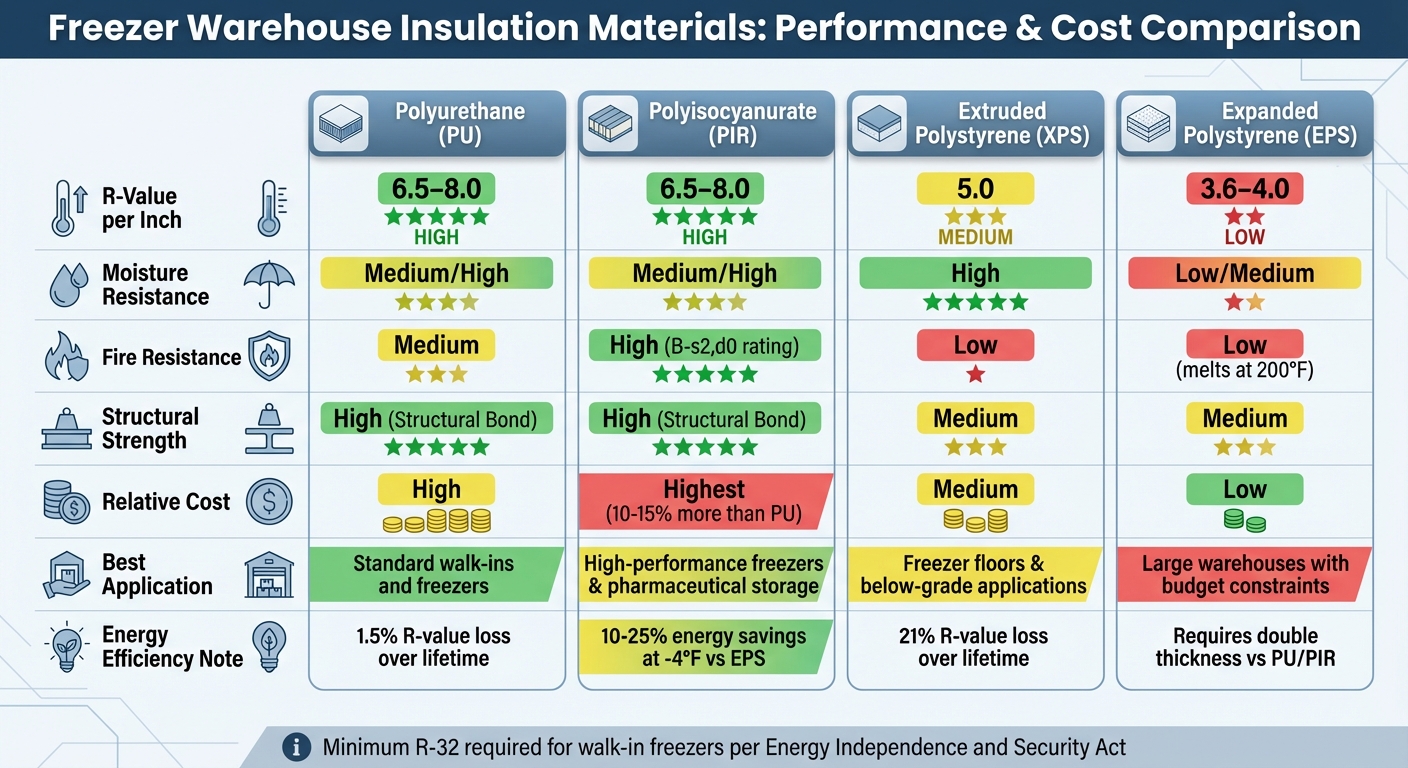
At a glance: Four insulation materials dominate freezer warehouse construction — each suited to a different performance level, application, and budget:
Polyurethane (PU): R-6.5 to R-8.0 per inch, high structural bond strength, moisture-resistant closed-cell structure. Industry standard for walk-ins and freezers.
Polyisocyanurate (PIR): Same R-value as PU with superior fire resistance (B-s2,d0 rating). Required for pharmaceutical and high-compliance food storage. 10–15% cost premium over PU.
Extruded Polystyrene (XPS): R-5.0 per inch, highest compressive strength, lowest water absorption. Best for freezer floors and below-grade applications.
Expanded Polystyrene (EPS): R-3.6 to R-4.2 per inch, lowest cost. Suitable for large-scale moderate-temperature warehouses. Requires robust vapor barriers and thicker panels.
1
Key Factors When Choosing Freezer Warehouse Insulation
Thermal Resistance: R-Value and Thermal Conductivity
“The higher the R-value, the more effective the material is at insulating. This calculation is based on thermal resistance, meaning how slowly heat passes through the material.”
— American Insulated Panel
The Energy Independence and Security Act sets a minimum R-value of 32 for walk-in freezers — but exceeding that minimum produces measurable energy savings. Thermal conductivity (k-value) works inversely: polyurethane and polyisocyanurate achieve R-6.0 to R-6.6 per inch, while expanded polystyrene falls at R-3.6 to R-4.2. In a 50,000 sq ft warehouse, that gap translates to tens of thousands of dollars in annual energy cost differences.
Thermal bridges — where steel frames in metal buildings bypass cavity insulation — are a compounding problem. These conductive pathways allow heat to flow through the structure even when panel R-values are high. Perimeter frames can conduct up to 600% more heat than adjacent insulation, despite covering only about 10% of the panel surface. Installing continuous exterior insulation blocks this heat transfer. Even the best insulation underperforms with gaps, air leaks, or improperly sealed seams — installation quality directly determines whether the panel delivers its rated R-value.
Moisture Resistance and Vapor Barrier Integration
“Moisture is expensive. It causes ice build-up on evaporator coils and ceilings, shortens equipment life, undermines insulation, and creates slip-and-sanitation hazards.”
— American Insulated Panel
In freezer environments, water vapor moves from warm exterior air toward the colder interior. Without a continuous vapor barrier on the warm side, moisture infiltrates, condenses, and becomes trapped inside insulation. Saturated insulation boards can absorb 10–15 times their weight in water, leading to frost buildup on ceilings and evaporator coils. Closed-cell foams — XPS, PIR, and polyurethane — naturally resist moisture with low water vapor transmission rates. EPS absorbs significantly more moisture, making it less suitable for sub-zero freezer applications without robust vapor protection.
In many regions, exterior dew points exceed freezer interior temperatures for the majority of the year — vapor control is a constant demand, not a seasonal concern. The reversed stack effect compounds this: cold, heavy air sinks and creates negative pressure that pulls humid air in through roof-to-wall joints. Over time, this causes interstitial condensation, structural damage, and fastener failures when ice buildup temporarily holds hardware in place, then releases it as it melts.
Durability, Fire Ratings, and Regulatory Compliance
Food-grade storage insulation must meet FDA 21 CFR standards for processed foods or USDA requirements for meat and poultry. Panels require food-safe coatings that resist contamination and withstand frequent high-pressure cleaning. Stainless steel Grade 304 or 316 is standard for inner skins in meat and dairy facilities due to low porosity and corrosion resistance. Pharmaceutical storage must additionally meet GMP and ISO 14644 cleanroom standards.
Fire safety requirements under ASTM E 84 typically demand a 25/50 flame spread and smoke developed rating, plus FM 4880 standards for large-scale fire testing. PIR panels achieve a B-s2,d0 fire rating under EN 13501-1, withstanding continuous temperatures up to 248°F. Mineral wool tolerates up to 1,832°F but requires additional vapor barriers due to higher moisture permeability. Watch for thermal drift — some materials lose R-value over time through chemical changes or gas loss. XPS loses approximately 21% of its R-value over its lifetime in freezer applications; properly sealed urethane panels (PU or PIR) drop only about 1.5%.
2
Common Insulation Materials for Freezer Warehouses
Polyurethane (PU) Panels
PU panels deliver R-values between 6.5 and 8.0 per inch. Their dense closed-cell structure (95% cell integrity) minimizes water absorption and vapor penetration — critical for preventing ice buildup in sub-zero environments. PU panels chemically bond to metal facings, providing compressive strengths of 150–200 kPa that integrate directly into the structural framework.
“In environments where square footage is at a premium, polyurethane's efficiency can provide long-term savings on heating and cooling costs.”
— American Insulated Panel
Cam-lock or tongue-and-groove installation systems create a continuous air barrier with leakage below 0.05 m³/h·m². In a 2023 project by Barrier Specialty Roofing & Coatings, a 145,000 sq ft cold storage warehouse was insulated with spray polyurethane foam in 23 days — one week ahead of schedule — creating a monolithic vapor and thermal barrier. Standard PU withstands continuous temperatures up to 194°F; fire-retardant additives are available for facilities with elevated fire safety requirements.
Polyisocyanurate (PIR) Panels
PIR is a modified version of polyurethane with better fire resistance and higher temperature tolerance. It provides the same R-6.0 to R-8.0 per inch performance as PU, with thermal conductivity as low as 0.018–0.022 W/m·K, but achieves a B-s2,d0 fire rating under EN 13501-1 and withstands continuous temperatures up to 248°F — versus 194°F for standard PU. A closed-cell structure limits water absorption to 0.05–1.5%.
Facilities operating at -4°F can reduce energy consumption by 10–25% when switching from EPS to PIR. The 10–15% cost premium over PU is typically justified by energy savings, fire performance, and durability for pharmaceutical and food-grade applications requiring precise temperature control.
Extruded Polystyrene (XPS)
XPS delivers R-5.0 per inch with water absorption rates as low as 0.30% — making it the material of choice for floor insulation and below-grade applications. Its compressive strength handles ground moisture and heavy forklift traffic while maintaining consistent thermal performance under constant load. XPS's stable R-value over time in horizontal applications makes it reliable for freezer floor systems where thermal transfer and ground moisture infiltration are the primary concerns. XPS may require additional fire protection in areas with higher fire exposure due to variability in its fire rating.
Expanded Polystyrene (EPS)
EPS offers R-3.6 to R-4.2 per inch at the lowest cost of any common insulation option. Its open-cell structure makes it more prone to moisture infiltration — water absorption can reach 5.0% — requiring robust vapor barriers to maintain thermal performance. EPS melts at approximately 200°F, limiting its use in facilities with stringent fire safety requirements. For deep-freeze applications below -4°F, EPS requires panels nearly double the thickness of PU or PIR to meet energy codes, reducing usable interior space. Best suited for large distribution centers with moderate temperature requirements (14°F–50°F) where cost is the primary driver.
3
Comparing Insulation Materials: Performance and Cost
“Polyurethane and Polyisocyanurate panels are a higher cost but are considered the industry standard for insulated panels when maintaining temperature or humidity control is critical.”
— KPS Global
The long-term performance gap matters as much as the upfront cost difference. XPS loses 21% of its R-value over its lifetime in freezer applications. Properly sealed urethane panels drop only 1.5%. That difference compounds over decades of energy consumption. PIR justifies its premium in pharmaceutical and high-compliance food storage. EPS can serve large distribution centers with moderate temperature requirements where budget is the primary constraint — provided vapor barriers are robust and panel thickness accounts for the lower R-value per inch.
4
Integrating Insulation with Freezer Warehouse Construction
Panel Installation and Structural Integration
Two systems dominate panel installation. Cam-lock systems use mechanical hooks to secure panels, forming a strong airtight seal — the right choice for high-use, deep-freeze environments where air leakage tolerance is minimal. Plug-in (tongue-and-groove) systems rely on sliding connections for quicker, more cost-effective installation but don't achieve the same airtightness. Modular insulated metal panels (IMPs) can be installed vertically or horizontally without extensive secondary framing, cutting construction time by up to 40% compared to traditional masonry methods.
For facilities needing both durability and high thermal performance, Insulated Concrete Forms (ICF) combine EPS foam with a concrete core for enhanced temperature regulation.
“The key element of an ICF wall assembly is the thermal mass of the concrete, which modulates the temperature transfer through the wall, maintaining a near constant temperature.”
— Fox Blocks
Panel installation costs typically run $20–$40 per square foot. For facilities operating below -30°C, panels of 150–200 mm thickness are recommended to maintain thermal stability.
Vapor Barrier and Moisture Control Systems
Vapor barriers must be placed on the warm (exterior) side of insulation — vapor moves from warm to cold, and the barrier must intercept that movement before it reaches insulation. The barrier must be completely continuous at every junction: roof-to-wall joints, floor-to-wall intersections, and around all utility penetrations. A compromised vapor barrier allows insulation boards to absorb up to 15 times their weight in water. Use high-performance sealants on all seams and joints. Install EPDM or silicone gaskets rated to -40°F at panel connections. All electrical conduits and refrigerant lines should pass through pre-drilled sleeves filled with expanding foam to maintain barrier integrity. High-quality panel joints reduce air leakage to below 0.05 m³/h·m² at 50 Pa.
Thermal Bridging and Energy Efficiency
Thermal bridging through metal studs or I-beams undermines panel R-values even in well-insulated buildings. Perimeter frames conduct up to 600% more heat than adjacent insulation while covering only 10% of the surface area — a disproportionate energy loss. Solutions: install continuous insulation (CI) to interrupt heat flow through metal components; at ceiling-to-wall connections, cut the interior metal skin of ceiling panels to break the conductive path; add insulated battens over panel joints. Advanced framing systems like FUSIONFRAME embed structural elements within a polyurethane jacket, eliminating traditional thermal bridges and delivering R-values five times higher than conventional framing. For floors, the thermal break must fully isolate the freezer floor from the rest of the building — incomplete isolation allows ice buildup along exterior edges.
Conclusion
Insulation selection is a long-term financial and operational decision, not a line-item cost. A facility insulated with PU or PIR panels, properly sealed vapor barriers, and thermally broken structural connections will outperform an under-specified facility for decades — in energy costs, product protection, maintenance frequency, and regulatory compliance. Aim for R-45 minimum for freezers operating between -20°F and 25°F, airtightness below 0.1 m³/h·m² at 50 Pa, and panel thickness of 6–8 inches in sub-zero environments. Match material to application: PIR for pharmaceutical and high-compliance food storage, PU for standard freezers, XPS for floors and below-grade, EPS for moderate-temperature large-scale distribution with cost constraints.
US Cold Storage Builders specifies, sources, and installs high-performance insulation systems for freezer warehouses across the United States — engineered for your temperature requirements, compliance obligations, and long-term operating budget.
frequently asked questions
FAQ — Freezer Warehouse Insulation
How thick should freezer insulation be?
For facilities operating below -20°C (-4°F), insulation panels should be 150–200 mm (6–8 inches) thick to maintain thermal stability. The required thickness depends on the material's R-value per inch and the target temperature — PU and PIR achieve adequate performance at lower thickness than EPS, which may require nearly double the panel thickness for equivalent thermal resistance. For blast freezers operating at -40°F, minimum 3/8″ applied thickness at the bond line is recommended in addition to panel thickness requirements.
Where should the vapor barrier go in a freezer?
On the warm (exterior) side of the insulation — always. Water vapor moves from warm to cold, and the barrier must intercept that movement before it reaches the insulation assembly. Installing the barrier on the cold (interior) side traps moisture inside the wall, which is worse than having no barrier at all. Ensure complete continuity at roof-to-wall joints, floor-to-wall intersections, and all penetrations for conduit and refrigerant lines. These junctions are where most vapor barrier failures occur.
What is the best insulation for freezer floors?
XPS is the preferred choice for freezer floor insulation due to its high compressive strength, low water absorption (0.30%), and stable R-value under constant load from forklift traffic. For sub-slab applications where frost heave prevention is the primary goal, foamed-in-place polyurethane provides a monolithic, seamless barrier with excellent thermal performance. In both cases, install insulation in multiple layers with staggered joints to eliminate thermal gaps, and pair with an active sub-slab heating system in any facility operating below 32°F.