Best Flooring Systems for Cold Storage Warehouses: Trends for 2026
Compare epoxy, polyurethane, Ucrete and MMA flooring for extreme cold, heavy loads, and food‑grade hygiene; cure times, temperature ranges and lifespan.
Cold storage floors face conditions that destroy standard industrial flooring: temperatures as low as -49°F, thermal shock from steam cleaning at 250°F, and forklifts pushing 8,000 lbs across frozen surfaces. The wrong flooring system means cracks, frost heave, bacterial contamination, and shutdowns. Here's how to choose the right one.
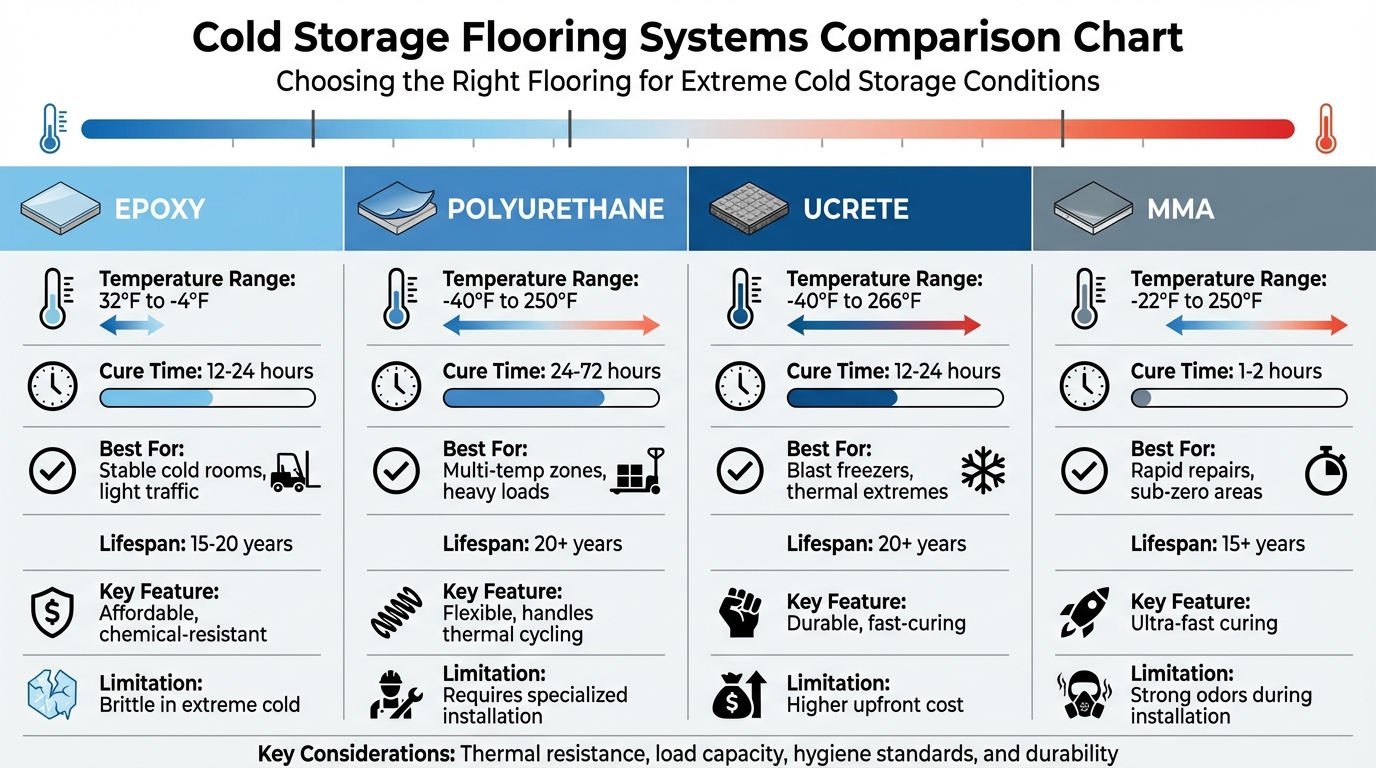
At a glance: Four flooring systems dominate cold storage in 2026. Each serves a different temperature range, load profile, and budget:
Epoxy: Affordable, chemical-resistant, best for stable cold rooms with light traffic. Brittle in extreme cold.
Polyurethane: Flexible, handles thermal cycling from -40°F to 250°F, lasts 20+ years. Best all-around for multi-temp facilities.
Ucrete: Cementitious urethane built for blast freezers and extreme thermal zones. Fast-curing, 20+ year lifespan.
MMA: Cures in 1–2 hours at sub-zero temperatures. Best for rapid repairs and live-site upgrades.
Quick Comparison
Flooring Type
Temperature Range
Cure Time
Best For
Lifespan
Epoxy
32°F to -4°F
12–24 hours
Stable cold rooms, light traffic
15–20 years
Polyurethane
-40°F to 250°F
24–72 hours
Multi-temp zones, heavy loads
20+ years
Ucrete
-40°F to 266°F
12–24 hours
Blast freezers, thermal extremes
20+ years
MMA
-22°F to 250°F
1–2 hours
Rapid repairs, sub-zero areas
15+ years
Cold Storage Flooring Systems Comparison: Temperature Range, Cure Time, and Lifespan
1
Main Challenges for Cold Storage Flooring
Thermal Shock and Temperature Extremes
A floor at -40°F gets hit with 250°F steam during cleaning. That 290°F swing causes materials to expand and contract at different rates than the concrete beneath them — leading to cracks, delamination, and blistering. Traditional epoxy coatings become brittle in freezing temperatures and simply can't survive this kind of thermal cycling.
“Flooring materials that fail to move with the substrate will crack along the surface, creating unsightly and unhygienic gaps where contaminants can accumulate.”
— Dave McNeece, Vice President, Flowcrete Americas
Cementitious urethane systems are specifically engineered for this — handling -49°F to 250°F while sharing a similar thermal expansion rate with concrete. They move together with the slab instead of fighting it.
Frost heave is the other major thermal threat. Moisture beneath the floor slab freezes, the sub-base expands, and the entire floor system lifts and cracks. Preventing it requires vapor barriers, rigid insulation, and often underfloor heating — not just a better floor coating.
Load-Bearing Capacity and Heavy Traffic
Forklifts, pallet jacks, and automated machinery create concentrated point loads that crack and dent surfaces. As facilities push to 80–100 feet clear heights to maximize pallet positions, the loads transferred to the floor only increase. Mezzanine panels in these environments must handle dynamic and static loads from 2,000 to 8,000 lbs.
Even the strongest surface coating fails if the bond between coating and concrete is weak. For high-traffic refrigerated areas, cementitious urethane coatings are applied at 1/4″ to 3/8″ thickness to protect that critical bond layer from impact.
Food-Grade and Regulatory Requirements
USDA, FDA, and HACCP regulations require seamless, non-porous surfaces — no joints where ice or bacteria can accumulate. In sub-zero environments, even hairline cracks from heavy traffic can trap Listeria, turning minor surface damage into a contamination event. Seamless resinous flooring systems eliminate this risk. Boston Sword & Tuna installed 10,000 square feet of cementitious urethane with antimicrobial properties, high coving, and stainless steel drainage to meet HACCP standards — the right approach for food processing environments.
2
Epoxy Flooring Systems
Epoxy is the most common starting point for cold storage flooring — and in the right application, it's a solid choice. It creates a continuous, non-porous surface that blocks moisture from penetrating the concrete substrate, resists oils, acids, and harsh disinfectants, and can last 15–20 years with proper installation.
You can customize epoxy with anti-slip finishes (quartz or sand broadcasts) and use color coding to mark pedestrian walkways and forklift lanes. Its reflective surface can boost ambient lighting by 20–30%, lowering energy costs. Over a 10-year period, facilities save 30–50% on flooring costs compared to traditional options.
Where Epoxy Works — and Where It Doesn't
Epoxy performs well in stable cold environments between 32°F and -4°F — walk-in coolers, dry storage, and logistics areas. In those conditions, it's cost-effective and durable.
But push it into extreme cold or rapid temperature swings and it fails. Epoxy becomes brittle at sub-zero temperatures, cracking under heavy loads or sudden thermal changes. In environments cycling between -40°F and 250°F, the thermal expansion mismatch between epoxy and concrete causes failure — reliably.
“Flooring materials that fail to move with the substrate will crack along the surface, creating unsightly and unhygienic gaps where contaminants can accumulate.”
— Dave McNeece, Vice President, Flowcrete Americas
Feature
Light-Duty Epoxy
Heavy-Duty Epoxy
Typical Thickness
10–20 mils
1/4″ to 3/8″
Load Capacity
Foot traffic, light carts
Heavy forklifts, pallet jacks, high-density racking
Polyurethane is the most commonly specified flooring system in cold storage — and for good reason. It handles what epoxy can't: continuous thermal cycling across a range of -40°F to 248°F without cracking or delaminating. Unlike rigid epoxy, polyurethane concrete expands and contracts at a rate similar to the underlying slab. That flexibility is what prevents failures in multi-temperature facilities transitioning between freezer zones and ambient loading docks.
“PU is the most common type of flooring used in cold storage facilities because it is seamless, extremely hard-wearing, and temperature/thermal shock resistant.”
— TREMCO Construction Products Group
Its seamless, non-porous surface resists fats, oils, organic acids, and harsh sanitizers — meeting HACCP standards and withstanding high-pressure washdowns and steam cleaning. High-quality water-based urethane mortar flooring lasts over 20 years. For heavy-duty cold storage with frequent steam cleaning, apply at 6 mm to 12 mm thickness (1/4″ to 1/2″) for adequate thermal shock resistance.
Polyurethane also contributes to energy efficiency — its insulating layer reduces refrigeration energy use by 3%–8%. Water-based urethane mortars install with zero VOC emissions, allowing facilities to stay operational during application.
Factor
Polyurethane
Epoxy
Thermal Flexibility
High; adapts to temperature changes
Low; prone to cracking under shock
Temperature Range
-40°F to 250°F+
Best for stable ambient temperatures
Thermal Shock Resistance
Excellent; handles rapid swings
Poor; may delaminate or blister
Durability in Cold
Maintains flexibility; withstands heavy impacts
Becomes brittle; cracks under heavy loads
Best Application
Multi-temp rooms, blast freezers, food processing
Stable warehouses, dry storage, logistics offices
4
Ucrete Flooring Systems
Ucrete is the benchmark for extreme cold storage environments. This cementitious urethane system — a blend of urethane resin, Portland cement, and reactive aggregates — handles -40°F to 266°F, with specialized formulations tolerating occasional spills up to 302°F. It expands and contracts at nearly the same rate as its concrete base, which is why it survives rapid temperature shifts exceeding 220°F without cracking or delaminating.
In blast freezer applications at -40°F, install at a minimum 3/8″ thickness to protect the bond line from thermal stress. Its dense, non-porous surface meets food-grade standards, resists harsh organic acids from meat and dairy processing, and can be cleaned to the same standard as stainless steel.
“Urethane cement will shrink… the preparation typically requires a minimum of CSP-3 profile to help provide a 3-dimensional lock.”
— Jeff Neal, Division Manager, The Witmer Group
That CSP-3 profile — achieved through shot blasting or grinding — compensates for material shrinkage during curing. The concrete substrate needs a minimum compressive strength of 4,350 psi and tensile strength of 218 psi. Unlike epoxy, Ucrete tolerates some residual moisture on the slab, provided the surface is visibly dry and at least 5°F above the dew point — a major advantage in cold storage retrofits where minimizing downtime is critical.
Certain Ucrete grades reach full operational capacity five hours after installation, even at 50°F. Standard installations allow foot traffic within six hours and forklift traffic in 12–24 hours. For live-site weekend or overnight repairs, that timeline is invaluable. Ucrete can also withstand occasional cryogenic spills — up to 1.3 gallons of liquid nitrogen — without damage.
“You're not just buying a floor; you're buying extended service intervals and predictable operational budgets.”
— High Performance Systems
A growing trend for 2026: strategic zoning — Ucrete in high-stress areas like freezer doors, loading docks, and heavy traffic lanes; standard epoxy in less demanding zones. This approach delivers peak performance where it matters without over-specifying the entire floor budget.
Factor
Ucrete
Polyurethane
Epoxy
Temperature Range
-40°F to 266°F
-40°F to 250°F+
Best for stable ambient
Thermal Shock Resistance
Excellent
Good
Poor; prone to cracking
Cure Speed
12–24 hours full traffic
24–72 hours per coat
Up to 7 days full cure
Moisture Tolerance
High
Moderate
Low; requires dry slab
Service Life
20+ years
20+ years
5–10 years in harsh zones
Best Application
Blast freezers, extreme thermal zones
Multi-temperature rooms
Stable warehouses, dry storage
5
Methyl Methacrylate (MMA) Flooring Systems
Most flooring systems have one fatal flaw for live cold storage operations: they can't cure in sub-zero conditions. MMA solves that. It cures fully in 1–2 hours at temperatures as low as -22°F (-30°C) — no need to warm the space, relocate products, or shut down operations.
“Using an MMA system avoids the time and effort that would otherwise be needed to raise the ambient temperature in the refrigerated area high enough in order to refurbish it.”
— Dave McNeece, Vice President, Flowcrete Americas
MMA also tolerates substrate moisture up to 92% relative humidity — far beyond the 75% limit for most epoxy and polyurethane systems. Its seamless, non-porous surface meets HACCP, FDA, and USDA standards, and with compressive strength of 60–90 MPa, it lasts 15+ years with proper maintenance.
One unique advantage: MMA is self-bonding. New layers chemically bond to existing coatings, eliminating mechanical abrasion and creating a monolithic system. This simplifies future repairs and reduces delamination risk. Its UV stability also prevents yellowing — an advantage for loading docks with sun exposure.
The tradeoffs: MMA has high VOC content and produces a strong odor during installation, requiring temporary ventilation and removal of exposed food products. It's also flammable in liquid state and demands skilled, specialized crews. Cost runs $8–$15+ per square foot — higher upfront, but the reduced downtime often makes it the lowest total-cost option for live-site work.
Factor
MMA
Polyurethane
Epoxy
Cure Time
1–2 hours
24–72 hours per coat
~7 days full cure
Min. Install Temp
-22°F (-30°C)
50°F (10°C)
50°F (10°C)
Max Substrate RH
92%
75%
75%
Odor During Install
Very strong
Low to moderate
Low to moderate
Refurbishment
Chemical bonding; no abrasion needed
Requires mechanical prep
Requires mechanical prep
Cost per Sq Ft
$8–$15+
Moderate
Lowest upfront
6
Flooring Trends for Cold Storage in 2026
“Sustainability is no longer optional; it's a baseline requirement. In 2026, we expect even greater emphasis on flooring systems with low VOCs, recycled content, and transparent manufacturing processes.”
— Sally Reis, Director of Architectural Design & Commercial Market Strategy, Stonhard
Clients are now requiring Environmental Product Declarations (EPDs) and Health Product Declarations (HPDs) to assess the lifecycle impact of flooring systems before specifying them. That push is driving real innovation in materials.
Low-Impact Flooring Materials
Bio-based resins now match traditional systems on strength with lower ecological impact. Solvent-free polyaspartic polyurea formulations control VOC emissions and protect workers during installation — especially important in cold storage retrofits where ventilation is limited. High-solids formulations create thick, durable coatings in fewer applications, cutting both VOC output and installation time. Recycled aggregates (glass, marble chips, synthetic flakes) are being incorporated to achieve industrial-grade strength with reduced petrochemical dependency. The industry is also moving away from PVC-based products toward polypropylene and PET alternatives.
Sensor-Embedded Flooring Systems
In freezer facilities below 14°F, sub-slab heating systems — electrical trace heating or glycol lines — are embedded beneath insulation layers to prevent frost heave. Sensors now monitor temperature fluctuations in real time, ensuring the floor and concrete expand and contract in sync. Modern flooring systems are also being designed to support AGVs and AMRs, which require precise surface finishes for smooth navigation. Integrated monitoring enables predictive maintenance — addressing potential failures before they become operational shutdowns.
Conclusion
No single flooring system works across every cold storage application. The decision comes down to your specific temperature range, traffic load, hygiene requirements, and tolerance for downtime during installation or repair.
Use epoxy in stable cold rooms with light traffic. Specify polyurethane for multi-temperature facilities with heavy loads and frequent thermal cycling. Deploy Ucrete in blast freezers and extreme thermal zones where nothing else holds up. Choose MMA when you need fast, live-site repairs in sub-zero conditions without shutting down operations.
The wrong choice means cracks, delamination, contamination risk, and expensive repairs in conditions that are as difficult to work in as they are to design for. Get the floor spec right at the design stage — retrofitting it is three to five times more expensive than doing it correctly the first time.US Cold Storage Builders integrates advanced flooring systems — including sensor-embedded sub-slab heating, high-performance resinous coatings, and seamless thermal envelopes — into every cold storage project across the United States.
frequently asked questions
FAQ — Cold Storage Flooring Systems
How do I choose the right floor for each temperature zone?
Match the flooring system to the thermal and load demands of each zone. Chiller rooms (+32°F to +50°F): insulated concrete with epoxy coatings handles the load and hygiene requirements at a reasonable cost. Freezer zones (-13°F to -4°F): polyurethane concrete for thermal flexibility and long-term durability. Blast freezers (-22°F or lower): Ucrete or MMA — systems that move with the concrete and survive extreme temperature swings. Across all zones, seamless and non-slip surfaces are non-negotiable for safety and regulatory compliance.
What prevents frost heave under freezer floors?
Frost heave happens when moisture beneath the slab freezes and expands — cracking or lifting the entire floor system. The solution is a combination of rigid insulation beneath the slab, vapor barriers to block moisture migration, and active sub-slab heating (glycol loops or electric heat-trace). Build in redundancy: if one heating loop fails without a backup, you're looking at a full slab repair in sub-zero conditions. Test glycol systems for leaks before pouring the concrete — not after.
Can flooring upgrades be done without shutting down operations?
Yes — with the right material. MMA cures in 1–2 hours at sub-zero temperatures, making live-site repairs possible without raising the facility temperature or relocating inventory. For joint repairs and crack filling, fast-setting polyaspartic polyurea formulations designed for low-temperature environments minimize downtime further. The key is specifying the right system before the repair is needed — emergency flooring decisions in active freezers are expensive and constrained.

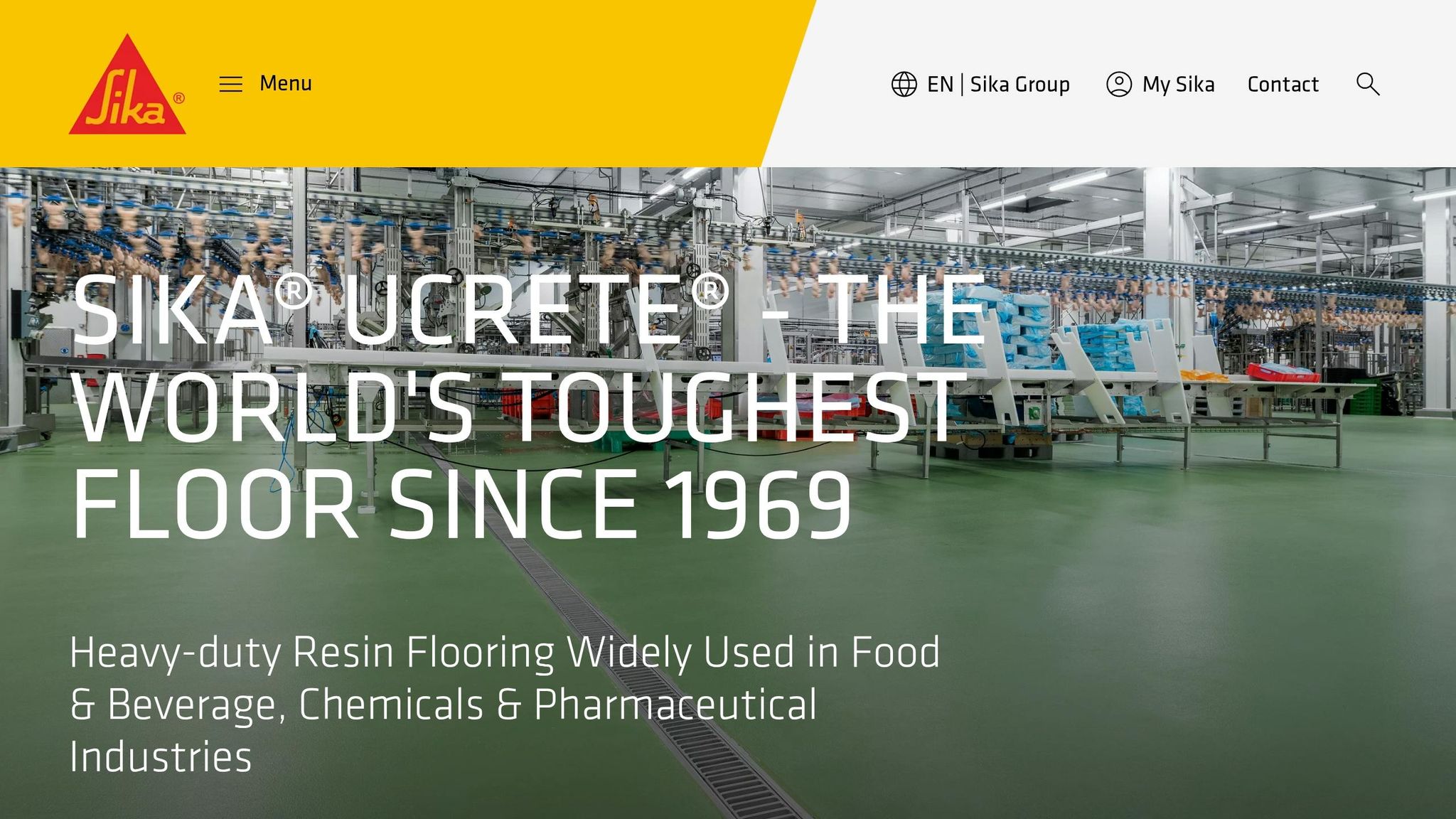 Ucrete is the benchmark for extreme cold storage environments. This cementitious urethane system — a blend of urethane resin, Portland cement, and reactive aggregates — handles -40°F to 266°F, with specialized formulations tolerating occasional spills up to 302°F. It expands and contracts at nearly the same rate as its concrete base, which is why it survives rapid temperature shifts exceeding 220°F without cracking or delaminating.
In blast freezer applications at -40°F, install at a minimum 3/8″ thickness to protect the bond line from thermal stress. Its dense, non-porous surface meets food-grade standards, resists harsh organic acids from meat and dairy processing, and can be cleaned to the same standard as stainless steel.
Ucrete is the benchmark for extreme cold storage environments. This cementitious urethane system — a blend of urethane resin, Portland cement, and reactive aggregates — handles -40°F to 266°F, with specialized formulations tolerating occasional spills up to 302°F. It expands and contracts at nearly the same rate as its concrete base, which is why it survives rapid temperature shifts exceeding 220°F without cracking or delaminating.
In blast freezer applications at -40°F, install at a minimum 3/8″ thickness to protect the bond line from thermal stress. Its dense, non-porous surface meets food-grade standards, resists harsh organic acids from meat and dairy processing, and can be cleaned to the same standard as stainless steel.