Ammonia vs. Freon for Cold Storage: Refrigerant Selection Knowledge Hub
Refrigerant selection determines your facility's energy costs, regulatory exposure, staffing requirements, and long-term capital strategy — for the life of the building. Ammonia and Freon each dominate a different segment of the cold storage market. Choosing the wrong one for your scale and application adds cost every year for decades. Here is how to make the right call.
At a glance: The ammonia vs. Freon decision breaks cleanly along facility size, with meaningful differences in cost, safety, and regulatory trajectory:
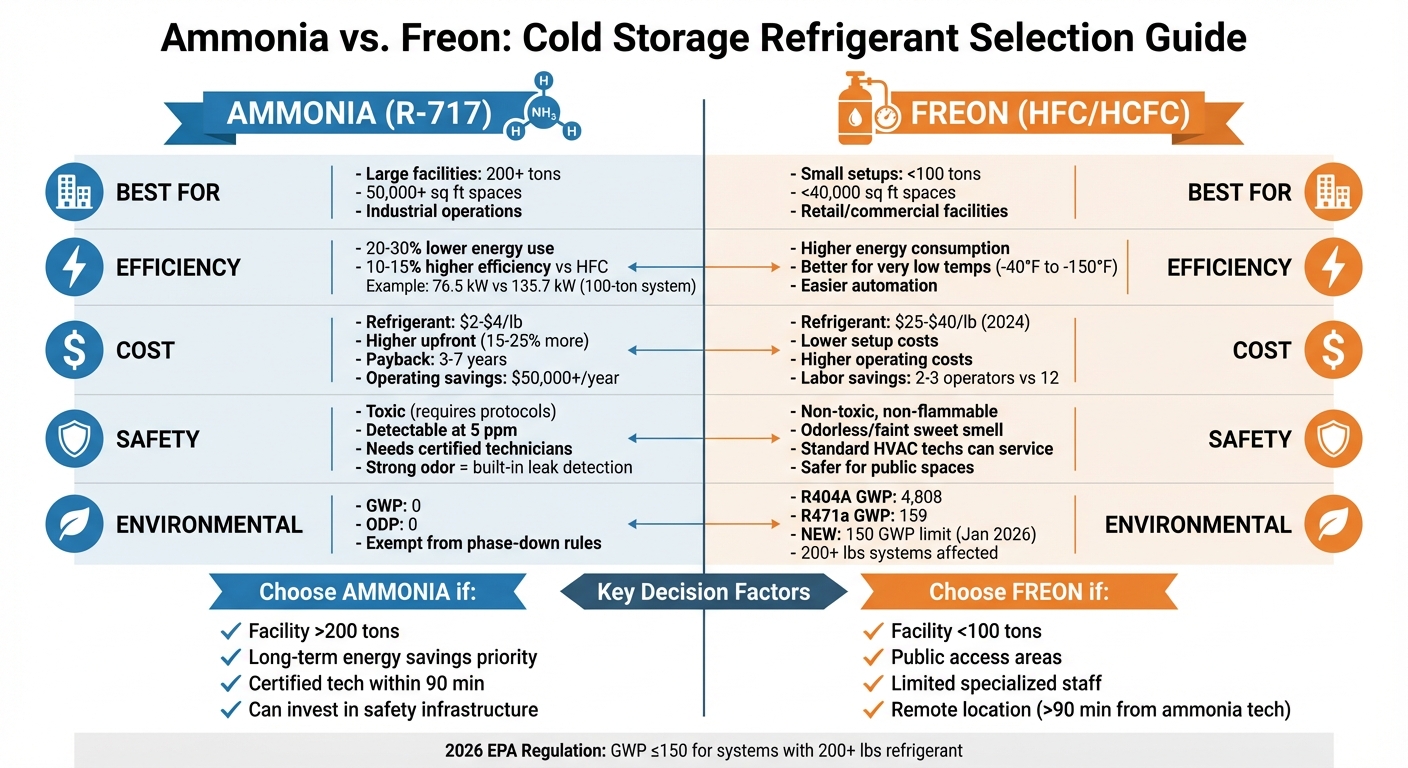
Ammonia (R-717): Best for large-scale facilities (200+ tons, 50,000+ sq ft). 20–30% lower energy use, zero GWP, exempt from EPA phase-down rules. Requires certified technicians and strict safety protocols.
Freon (HFC/HCFC): Best for smaller setups under 100 tons. Lower installation cost, serviceable by standard HVAC contractors. Faces GWP cap of 150 for systems with 200+ lbs of refrigerant starting January 2026.
Cost crossover: Ammonia costs $2–$4/lb vs. $25–$40/lb for Freon (2024). Ammonia's higher upfront investment typically pays back in 3–7 years on large systems.
Technician access: If you are more than 90 minutes from a certified ammonia technician, Freon is the more practical choice regardless of facility size.
Regulatory direction: The AIM Act mandates an 85% reduction in HFC production by 2036. Ammonia's zero GWP makes it exempt from all phase-down restrictions.
Ammonia vs Freon Refrigerant Comparison for Cold Storage Facilities
Criteria
Ammonia (R-717)
Freon (HFC/HCFC)
Best For
Large facilities (200+ tons, 50,000+ sq ft)
Small setups (<100 tons, <40,000 sq ft)
Efficiency
20–30% lower energy use
Higher energy consumption
Refrigerant Cost
$2–$4/lb
$25–$40/lb (2024)
Safety Profile
Toxic; requires certified technicians
Non-toxic; standard HVAC serviceable
GWP
0
Varies — R404A = 4,808; R471a = 159
Regulatory Status
Zero GWP; exempt from phase-down rules
GWP cap of 150 (200+ lb systems) from Jan 2026
1
Ammonia Refrigerant: Properties, Performance, and Uses
Properties of Ammonia
Ammonia (R-717) achieves its thermal efficiency through a high latent heat of vaporization — allowing refrigeration systems to operate with 10–20% smaller piping and roughly half the refrigerant weight compared to halocarbon systems. It is a naturally occurring, biodegradable compound with zero GWP and zero Ozone Depletion Potential. Its strong pungent odor is detectable at just 5 ppm — well below the 25 ppm exposure limit — which acts as a built-in leak detection system. Cost: $2–$4 per pound.
Performance in Cold Storage Systems
“Ammonia is the main refrigerant for most industrial applications due to its high efficiency and low price per pound.”
— Kuhlman Inc.
In a direct performance comparison, a 100-ton cooler operating at 38°F with ammonia required 76.5 kW for compression — versus 135.7 kW for an R-449A Freon system. That is approximately 77% greater efficiency, translating to over $50,000 in annual electricity savings for a 100-ton system. In large facilities, ammonia cuts operating expenses by 20–30%. A July 2025 case study by Kurt Liebendorfer (VP, Evapco) and Ryan Reardon (President, R2 Mechanical Consultants) analyzed an 850-ton load at a 250,000 sq ft facility in San Antonio, Texas. A low-charge ammonia system consumed 10 million kWh annually versus 12 million kWh for a transcritical CO₂ system. Liebendorfer noted that in year seven, the extra $1 million capital cost paid for itself through lower electric bills — with $4.7 million in operating cost savings projected over 30 years. Although the upfront cost of an ammonia system runs 15–25% higher than alternatives, operational savings typically offset the premium within 3–7 years.
Where Ammonia Works Best
Ammonia is the clear choice for refrigeration loads exceeding 200 tons or facilities larger than 50,000 sq ft. It excels at low-temperature blast freezer applications (below -20°F) and spiral freezers, maintaining efficiency and affordability to -60°F. Industries where ammonia dominates: meat processing, dairies, breweries, and pharmaceutical storage. It also performs exceptionally well in flooded evaporator systems, which optimize full use of the evaporator surface to maximize the refrigeration effect.
2
Freon Refrigerant: Properties, Performance, and Uses
Properties of Freon
Freon is non-toxic, non-flammable, and non-corrosive — with either no odor or a faint sweet smell. These characteristics make it suitable for facilities where public access is a factor or where safety infrastructure for ammonia is not feasible. Freon systems use smaller, less expensive hermetic or semi-hermetic compressors with simpler piping, reducing both construction cost and installation complexity. The regulatory challenge: traditional Freon refrigerants like R404A carry a GWP of 4,808. The EPA will enforce a GWP cap of 150 for facilities with 200 lbs or more of refrigerant starting January 1, 2026, driving adoption of lower-GWP alternatives like R471a (GWP of 159).
Performance in Cold Storage Systems
“Freon is simple to maintain since well-trained heating and air conditioning contractors can handle it themselves.”
— JEC Parts
Freon's performance advantage is in very low-temperature (VLT) applications — maintaining temperatures between -40°F and -150°F — making it a strong choice for pharmaceutical storage, medical freezers, and environmental chambers. For smaller facilities under 100 tons, Freon systems require just 2–3 operators versus the 12 typically needed for a comparable ammonia system, producing annual labor savings of approximately $28,000. Freon's oil miscibility also prevents the buildup issues that can compromise thermal efficiency in ammonia systems.
Where Freon Works Best
Freon excels in fulfillment centers under 40,000 sq ft and facilities with refrigeration loads below 100 tons. It is the standard in retail and commercial environments — grocery stores, supermarkets, convenience stores — where its non-toxic nature eliminates the safety infrastructure ammonia requires. The 90-minute rule applies here: if your facility is more than 90 minutes from a certified ammonia technician, Freon is the logical choice regardless of load size. Unlike ammonia systems holding 10,000 lbs or more — which trigger OSHA Process Safety Management regulations — Freon installations generally avoid these compliance requirements.
3
Cost, Efficiency, Safety, and Environmental Comparison
Cost and Energy Efficiency
“While the initial cost of an ammonia system may seem high in comparison to CFC and HFC systems, the difference in operational savings can sometimes pay for the price difference in just a few short years.”
— Kuhlman Inc.
For loads under 100 tons, Freon systems are typically more affordable due to simpler installation. For loads exceeding 200 tons, ammonia becomes the more economical choice despite higher upfront costs from stainless steel piping and specialized safety systems. Ammonia refrigerant costs $2–$4/lb versus approximately $25–$40/lb for Freon equivalents in 2024. R22 costs roughly 2.5 times more per kilogram than ammonia; R134a is nearly 7 times more expensive. At scale, ammonia uses 20–30% less energy — a gap that compounds annually and justifies the capital premium for large industrial operations.
Safety Considerations
“If you are an hour and a half away from a trained and certified technician, you may not want to go with ammonia.”
— Steve Brading, Architect, Food Plant Engineering
Ammonia is highly potent at low concentrations and becomes flammable under high heat — requiring strict safety protocols, regular hazard analyses, and access to certified technicians. Its strong odor is a natural warning system. Freon is non-toxic and non-flammable, making it safer for public-access environments. The trade-off: Freon leaks are harder to detect without sensors, and standard HVAC contractors — available virtually everywhere — can service Freon systems without specialized certification.
Environmental Impact
Ammonia has zero ODP and zero GWP. It faces no future regulatory restrictions on environmental grounds and will not require reformulation or system retrofits as EPA rules tighten. Freon refrigerants face the opposite trajectory. R404A carries a GWP of 4,808 — nearly 5,000 times more harmful than CO₂. The EPA's 150 GWP cap starting January 2026 forces facilities with 200+ lbs of Freon to retrofit or replace systems with low-GWP alternatives. Every year a Freon-based facility delays planning for this transition increases its regulatory and capital risk.
4
EPA Regulations and Industry Trends
US EPA Regulations and Phase-Outs
The American Innovation and Manufacturing (AIM) Act mandates an 85% reduction in HFC production and consumption by 2036. For new facilities: systems with 200 lbs or more of refrigerant must use a GWP below 150; systems under 200 lbs are capped at GWP 300. The EPA is currently in a non-enforcement phase until final regulations are introduced in Q2 2026. Industry groups have pushed for a temporary GWP ceiling of 700, but the ultimate limit for larger systems remains 150. Freon systems face additional compliance burdens under the AIM Act: the leak tracking threshold has been lowered to just 15 lbs of refrigerant, and systems containing 1,500 lbs or more must install automatic leak detection (ALD) systems within 30 days of new installation. Ammonia facilities storing 10,000 lbs or more must comply with EPA Risk Management Plan (RMP) requirements — non-compliance has resulted in civil fines ranging from $100,000 to over $300,000 per facility.
Future Refrigerant Adoption Trends
“Ammonia and CO₂ systems are not 'alternative' technologies — they are the current industry standard.”
— Gary Schrift, President, International Institute of All-Natural Refrigeration (IIAR)
Low-charge ammonia systems are gaining significant traction because they help facilities stay below the 10,000-lb OSHA PSM threshold while maintaining ammonia's efficiency advantages. The July 2025 San Antonio case study confirmed this direction: $4.7 million in operating cost savings over 30 years versus transcritical CO₂. A2L refrigerants — including R-454C and R-455A — are emerging as a middle path, with GWP values below 300 and operational similarities to traditional Freon. However, A2L systems require specialized leak detection and ventilation upgrades due to their mild flammability.
Conclusion
The refrigerant decision is a 20-to-30-year financial commitment embedded in your facility's infrastructure. For industrial cold storage over 200 tons, ammonia's energy efficiency, zero GWP, and exemption from EPA phase-down rules make it the clear long-term choice — provided you have the safety infrastructure and technician access to support it. For facilities under 100 tons, Freon's lower installation cost, easier maintenance, and non-toxic profile justify its continued use — but the GWP compliance deadline of January 2026 requires immediate action if your current refrigerant charge and refrigerant type are not already compliant. Ask three questions before deciding: Does your facility have the infrastructure for ammonia safety protocols? Is a certified technician within 90 minutes? Do long-term energy savings justify the higher upfront cost? US Cold Storage Builders engineers refrigeration systems for both ammonia and Freon applications — sized, specified, and built for your facility's operational requirements and 30-year cost profile.
frequently asked questions
FAQ — Ammonia vs. Freon for Cold Storage
How do I estimate my facility's refrigeration load to choose between ammonia and Freon?
Refrigeration load in tons is calculated through a full heat load analysis covering insulation quality, product entry temperature, product volume and turnover rate, ambient temperature differentials, door open time, and equipment heat gains. As a starting point: facilities below 100 tons typically favor Freon for cost and simplicity; facilities above 200 tons almost universally favor ammonia for efficiency and long-term economics. The 100–200 ton range is where other factors — technician access, product type, facility location, safety infrastructure, and budget — drive the decision. For an accurate load calculation specific to your project dimensions, consult a mechanical engineer before committing to a refrigeration system type.
What upgrades does my Freon system need to meet the 2026 GWP rules?
If your facility has 200 lbs or more of refrigerant, your system must use a refrigerant with GWP at or below 150 under EPA rules taking effect January 2026. R404A (GWP 4,808), R134a (GWP 1,430), and most legacy HFCs exceed this limit. Compliant options include R471a (GWP 159), A2L refrigerants like R-454C and R-455A (GWP below 300, but with added leak detection and ventilation requirements), or conversion to natural refrigerants including ammonia or CO₂. The EPA is currently in a non-enforcement phase until Q2 2026 when final rules are published — but facilities should begin planning now, as system retrofits for new refrigerants may require pressure vessel recertification, compressor compatibility checks, and updated leak detection infrastructure.
What safety systems are required for an ammonia cold storage facility?
Facilities with ammonia charges of 10,000 lbs or more must comply with EPA Risk Management Plan (RMP) requirements and OSHA Process Safety Management (PSM) regulations — both of which require formal hazard analyses, written emergency response plans, and documented operator training. For all ammonia facilities: install ammonia leak detection sensors calibrated to alarm at concentrations well below the 25 ppm exposure limit, post clear hazard signage at all ammonia storage and equipment areas, establish written SOPs for normal operations and emergency response, and ensure all personnel who may contact ammonia are trained in proper handling and evacuation procedures. Low-charge ammonia systems — designed to keep ammonia charge below 10,000 lbs — allow facilities to capture ammonia's efficiency benefits while avoiding PSM and RMP compliance thresholds.